


 Amanda Pell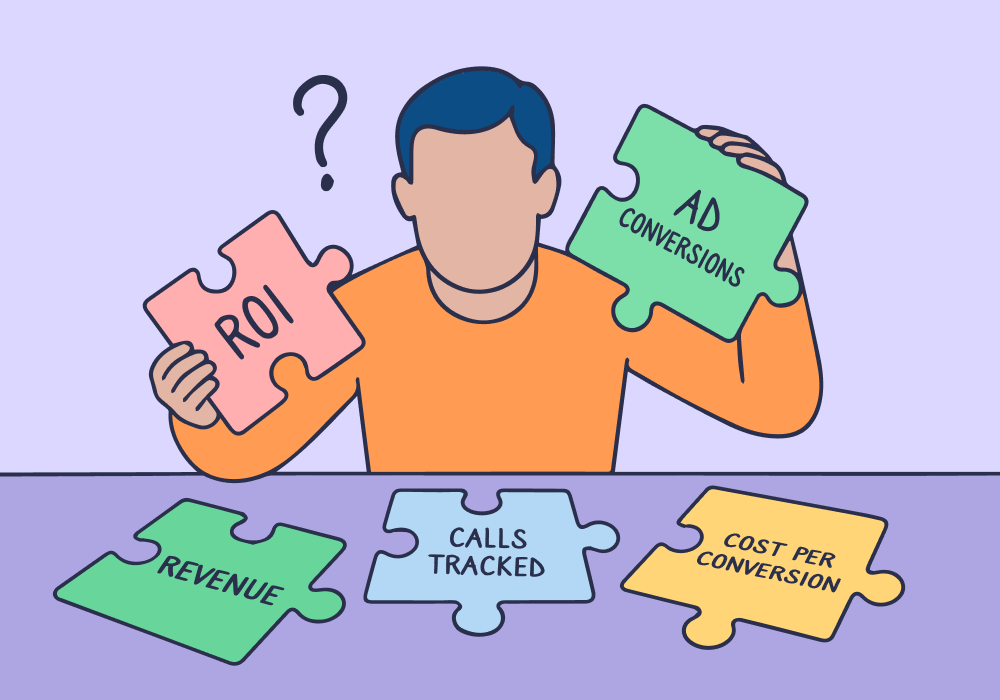
Marketing has a data problem—but not the one most agencies think.
The challenge isn't getting the data. It's not data quality.
The problem is that every piece of marketing data lives somewhere different, and clients are the ones paying the price.
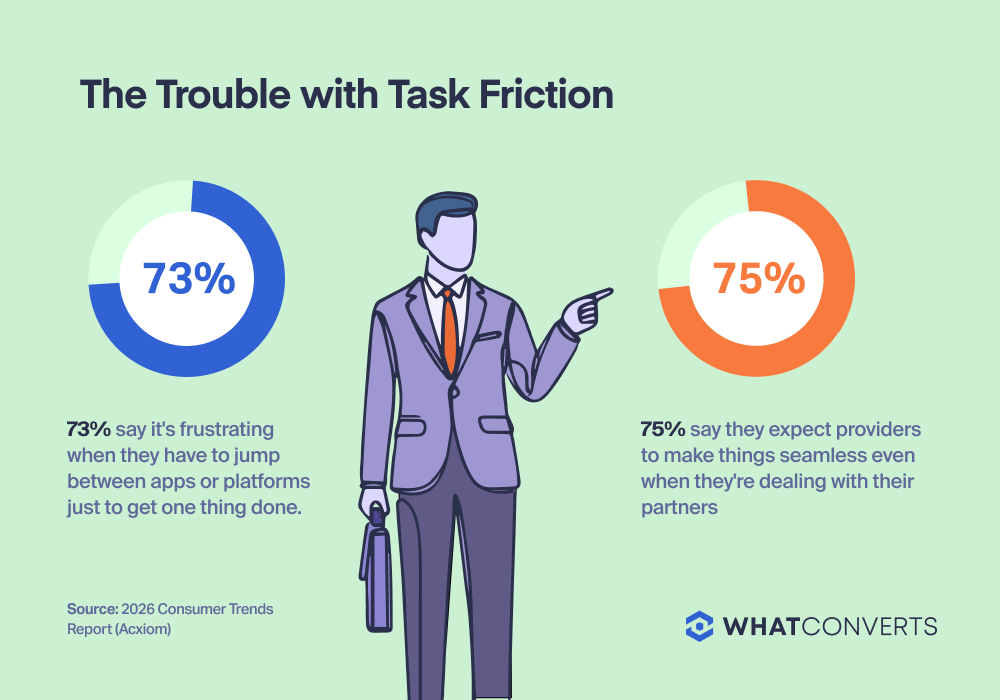
Acxiom's 2026 Consumer Trends report shows the problem: 73% of people get annoyed when they have to bounce between apps just to finish one task. But that’s what clients deal with when agencies give them separate logins for ads, call tracking, CRM, and analytics.
Clients don’t care which tool owns which data; they expect their agency to bring it all together. Since 75% of consumers expect things to work smoothly, clients notice when agencies make them connect the dots themselves.
The Real Problem: Fragmented Reporting Breaks Client Trust (and Patience)
Most agencies use a bunch of separate tools. They use one for ads, one for social, one for call tracking, one for sales info, one for website traffic, and sometimes one for email follow-ups.
Each platform works, each provides valuable data, but none of them talk to each other.
So when a client asks, "How's our marketing performing?"—a question that should take 30 seconds to answer—the reality looks like this:
- Log into Google Ads to pull campaign performance
- Switch to the call tracking platform to see phone lead volume
- Open the CRM to check which leads converted
- Jump back to Google Analytics to understand web traffic patterns
- Export each dataset into separate spreadsheets
- Manually compile everything into a single view
By the time you've answered the question, 45 minutes have passed. And the client still doesn't have real-time access—they're dependent on you to repeat this process every time they want an update. With reporting this hard, clients start to tune out because getting useful insights from your agency feels like too much work.
When your tools don’t work together, it does more than add work—it annoys clients, tests their patience, and can even push them to leave.
How Fragmentation Erodes Agency Value
Fragmented reporting creates business-level consequences that clients notice immediately:
1. Confusing, inconsistent reporting
Nothing undermines trust faster than three platforms showing three different conversion counts.
2. Slow, reactive decision-making
When data lives in six places, agencies spot problems late. A campaign can waste budget for days before someone pieces the story together.
3. Missed optimization opportunities
If agencies don’t combine phone, form, and chat leads into one view, they can’t tell which campaigns bring real prospects and which ones just bring junk.
4. Competitors look more sophisticated
The moment another agency shows a unified dashboard, clients wonder why you didn’t.
These issues compound. A disengaged client stops checking reports… then stops seeing wins… then stops trusting the work.
The Fix: One Place to See the Truth
Better spreadsheets won’t fix your fragmentation problem. The answer is to eliminate spreadsheet reporting altogether and replace it with a single unified tracking and reporting dashboard.
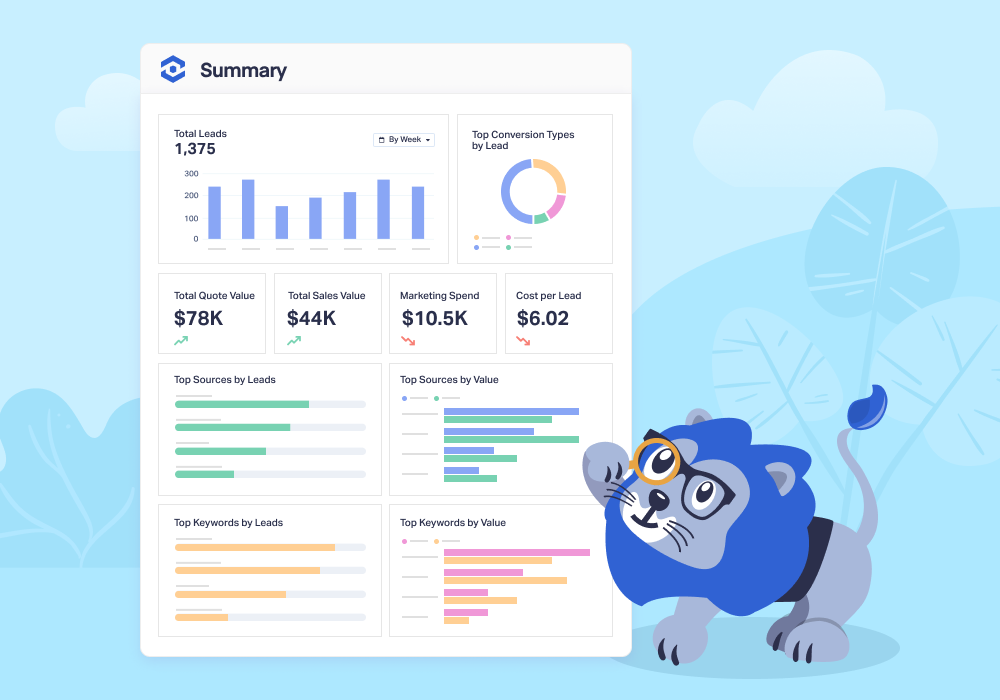
WhatConverts does this by pulling all conversion data—calls, forms, chats, transactions—into a single platform with complete attribution for each lead. Instead of forcing clients to jump between systems, everything they need lives in one place.
One dashboard. Every lead. Full attribution.
Here's what that looks like in practice:
- All conversion types in one view: calls, forms, chats, transactions. No more switching platforms.
- Full attribution for every lead: campaign, keyword, ad, landing page — automatically tied together.
- Lead qualification and value tracking: see which marketing actually drives revenue, not just conversions.
- Instant answers to client questions: filter and sort in seconds instead of compiling reports manually.
WhatConverts doesn't just aggregate data. It unifies the entire lead story—from first click to final outcome—so clients can understand performance without depending on you to compile it for them.
Automated Client Reporting That Stays Current
It’s not enough for you to have unified data. The bigger payoff is giving clients that same seamless view—without piling on manual tasks.
WhatConverts automates client reporting through shareable dashboards and scheduled reports that update in real time:
- Live client dashboards. Share a custom view that shows exactly what each client needs to see: their campaigns, their leads, their ROI. The data stays current automatically—no more outdated PDFs or stale spreadsheets.
- Scheduled summary reports. Set up automated reports that email weekly or monthly performance summaries. Clients get consistent updates without you lifting a finger.
- On-demand transparency. When clients want to dig deeper, they can log in and explore their own data—filtered by date, campaign, lead source, or qualification status. They're never blocked by your availability.
This is what 75% of clients expect: seamless reporting that doesn't require jumping between platforms or waiting for someone to manually compile updates.
With WhatConverts, that's the default experience.
Real Success: WhatConverts + Digilatics — 22 % Growth, $1 M MRR, 90 % Lower Cost-per-Conversion
Before WhatConverts, Digilatics struggled with the same fragmentation problem most agencies face: conversion data trapped in separate systems, no unified attribution, and hours spent stitching reports together for clients across dozens of locations.
Their home-services client had strong lead volume, but no single source of truth to show which campaigns, keywords, or locations were actually driving revenue.
After consolidating all calls, forms, chats, and conversions inside WhatConverts, Digilatics finally had one platform with complete attribution for every lead. They could see performance by campaign, location, landing page, and keyword in seconds, without reconciling conflicting dashboards.
With unified reporting in place, Digilatics was able to:
- Cut cost-per-conversion by 90%
- Grow the client’s business by 22%
- Help the client surpass $1M in monthly revenue for the first time
Fragmentation kept their client guessing. Unifying everything in WhatConverts gave them clarity—and that clarity fueled real, measurable growth.
Read More: Advanced Reporting and Clear Attribution Powers 22% Growth [Case Study]
From Scattered to Seamless
Fragmented reporting forces clients to fill in the gaps themselves. It makes wins invisible, slows decision-making, and erodes trust.
Unified reporting removes that friction entirely.
When clients can see all their leads, all their attribution, and all their outcomes in a single, always-current dashboard, they stop guessing whether marketing is working. They can see it—and so can you.
If your reporting lives across six platforms, your clients feel it.
Give them one source of truth.
Start your free 14-day trial of WhatConverts today or book a demo with a product expert to see how we help prove and grow your ROI.
Get a FREE presentation of WhatConverts
One of our marketing experts will give you a full presentation of how WhatConverts can help you grow your business.
Schedule a DemoGrow your business with WhatConverts