


 Amanda Pell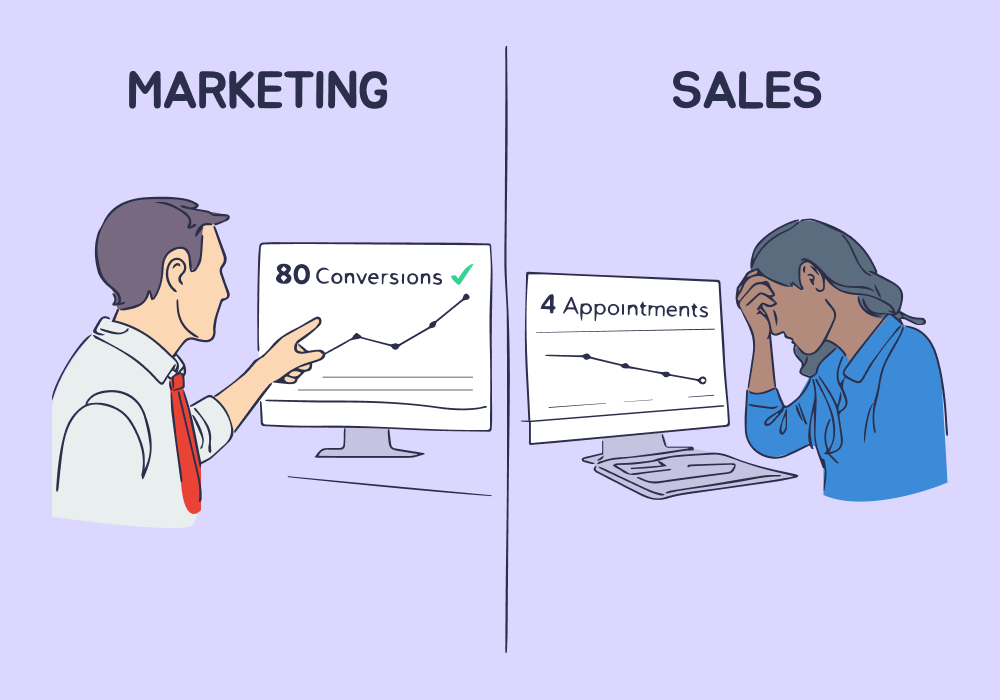
Your Google Ads campaigns look great.
Conversions are up. Cost per conversion is down. Dashboards are green across the board.
Then sales sends a message: “Lead quality is terrible.”
You check the numbers again. Conversions climbed 40%. Spend is efficient. By every Google Ads metric, things are working.
So how can quality be down?
Here’s the problem: marketing and sales use the same word—conversion—to describe completely different outcomes. And that mismatch quietly pulls budgets in the wrong direction.
This article explains why that happens with Google Ads, why it’s dangerous for optimization, and what needs to change if you want your data to align with revenue.
Note: Not a WhatConverts user yet? Start your free 14-day trial of WhatConverts today or book a demo with a product expert to see how we help prove and grow your ROI.
What "Conversion" Means Inside Google Ads
In Google Ads, a conversion is a completed action: something measurable, triggered by user behavior, recorded immediately.
For phone calls, that usually means:
- A call initiated from an ad
- A call that lasts longer than a set duration (typically 60 seconds)
Google Ads treats a call as a completed action, not a business outcome.
The platform doesn't know if the caller booked an appointment, asked for pricing, or hung up the moment someone answered. It just knows a 60-second call happened.
This definition makes perfect sense for Google Ads. The system needs fast, consistent signals to optimize bids in real time. Observable actions—clicks, form submissions, calls—fit that requirement. Revenue outcomes don't.
Google Ads isn't trying to measure revenue. It's trying to predict user behavior.
For the complete breakdown of:
- How Google Ads call tracking actually works
- What it can and can't measure,
- What agencies need to think about when phone calls drive real revenue
Check out the full guide:
Related Reading: The Best Way to Track Calls from Google Ads
What Sales Means When They Say "That Call Didn't Convert"
Sales defines conversion differently. For them, a conversion is progress toward revenue.
That usually means:
- A qualified opportunity
- A booked appointment
- A quoted job
- A closed deal
These milestones happen after the call, outside Google Ads, often days or weeks later.
Sales defines conversion as movement toward revenue, not activity.
Where the Definitions Collide
This is where problems begin. A typical scenario:
- Google Ads optimizes toward calls, not lead quality
- Campaign conversion rates improve
- Sales reports lead quality declining
- Trust erodes
No one did anything wrong.
Google Ads did exactly what it was designed to do. Sales is judging leads based on revenue outcomes. Marketing is optimizing based on platform data.
But because everyone is using the same word to mean different things, they’re operating in conflicting realities.
Why This Mismatch Is Invisible in Most Reports
Google Ads reports only its own definition of conversion.
Dashboards reinforce that definition. Reports get built around it. Optimization decisions depend on it.
Sales outcomes live somewhere else: in CRMs, spreadsheets, inboxes, or nowhere at all.
So if you’re only looking at Google Ads data, you’re only seeing Google Ads truth.
When call tracking stops at “call happened,” the gap between marketing activity and sales outcomes stays hidden. And because it’s hidden, it never gets corrected.
How This Impacts Optimization Decisions
Bidding strategies optimize for whatever's marked as a conversion.
If calls = conversions, spend flows toward call-heavy queries.
If calls ≠ revenue, optimization drifts away from what actually works.
For example:
| Calls | Cost per Lead | |
| Campaign A | 80 | $40 |
| Campaign B | 30 | $110 |
Google's Smart Bidding sees Campaign A performing better and shifts budget accordingly.
But when you track those calls to outcomes:
| Calls | Cost per Lead | Revenue | |
| Campaign A | 80 | $40 | $2,000 |
| Campaign B | 30 | $110 | $22,000 |
The "expensive" Campaign B is actually generating 11x more revenue.
Without visibility into what happens after the call, optimization rewards volume, not value, and moves in the wrong direction.
Related Reading: How to Maximize ROI with Google Smart Bidding
The Limitation Isn't Sales or Marketing—It's Shared Language
This is a vocabulary problem, not a performance issue.
Google Ads counts what it can observe: the call event itself. Sales measures what drives revenue: appointments, quotes, closed deals.
Both definitions are valid. They're just measuring different stages of the same process.
The breakdown happens when teams operate on different definitions without realizing it.
Related Reading: The Sales Accountability Problem: Why Marketers Get Blamed
Bridging the Gap Between Definitions
Google Ads isn't wrong to count calls as conversions, but agencies need to understand what that definition includes and what it leaves out.
When phone calls are a major conversion source, knowing how Google Ads call tracking actually works—and where its visibility stops—becomes essential to aligning marketing and sales expectations.
The right call tracking system closes this gap by connecting the call event Google Ads sees to the business outcomes sales cares about. It tracks the 60-second call and what the caller wanted, whether they qualified, and if they converted to revenue.
That's how agencies stop debating whose numbers are right and start optimizing for what actually drives business results.
Ready to see what your calls are really worth?
Start your free 14-day trial of WhatConverts today or book a demo with a product expert to see how we help prove and grow your ROI.
Get a FREE presentation of WhatConverts
One of our marketing experts will give you a full presentation of how WhatConverts can help you grow your business.
Schedule a DemoGrow your business with WhatConverts