


 Amanda Pell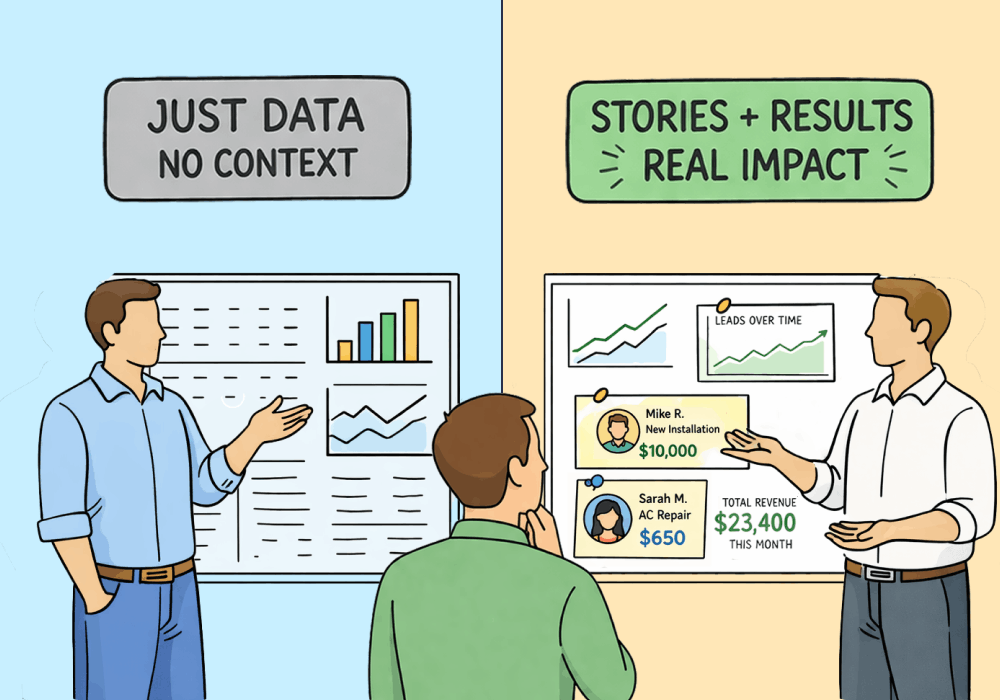
When it comes to reporting, numbers prove the work—but it’s stories that make clients believe it.
Most agency reports lead with aggregate data: total leads, cost per lead, conversion rate. That's the right instinct. Aggregate data is defensible, scalable, and hard to dispute. But data alone has a ceiling. It tells clients that something happened. It doesn't make them feel it.
The agencies retaining clients longest aren't just reporting better numbers—they're pairing those numbers with individual lead examples that make the results tangible. But in order to pull a specific story out of a monthly report, you need something most reporting tools don't provide: visibility into individual leads, not just totals.
This article explains why that combination is so effective and what it takes to build it into every monthly report.
Note: Not a WhatConverts user yet? Start your free 14-day trial of WhatConverts today or book a demo with a product expert to see how we help prove and grow your ROI.
Why Aggregate Data Isn't Enough on Its Own
Aggregate reporting answers surface-level questions. It doesn't answer the questions that keep clients up at night.
A client sees "62 leads at $48 CPL this month" and thinks: Are those real? Are they any good? Is that person calling because they actually want to buy something, or is it spam?
The numbers look fine, but doubt fills in the gaps they can't see.
This is especially true in slow months. When volume dips—even if quality holds steady—clients start second-guessing the whole program. Without a specific example to anchor on, the report just looks like a bad month.
Aggregate data summarizes, but it doesn't reassure.
What One Real Lead Can Do
When you pull up a specific lead—a name, a recording, a form submission, a chat transcript—something shifts. Our users have told us time and again that data alone isn’t what makes campaign results resonate with their clients.
“[If] you can put a name, phone number, [and] a transcript in front of these clients, then it makes a world of difference.”
—Sam Oh, Director, Atomic Marketing
When reports are tied to real leads, the conversation stops being about clicks and starts being about the people who actually booked services as a direct result of the agency’s work.
Another user, Diana Akroyd, turned this story-sharing into a deliberate retention strategy for her agency, iDigital Marketing. In monthly reports, she includes four or five individually selected calls that showcase her team’s real results. She also keeps up a steady stream of “positive nuggets” sent to her clients throughout the week—notes based on individual lead cases, like, “Hey, Jim took this call and I think he did a really great job.”
The message she sends to the client is I’m personally invested in your team’s success, and I can prove my team’s work is contributing to it.
John Corrigan, VP of Marketing Operations at Make the Turn agency, described the shift this way: before individual lead data, they reported "40 lead forms" and "15 phone calls." The client called them "mystery leads." Now, they can tell a client: "It was John Smith who booked that fitting on that day through our ads"—and that specificity quantifies lead quality in a way aggregate totals never could.
The bottom line is that sharing individual lead outcomes is more than just a decorative “feel-good” tactic. It’s a concrete retention mechanism that drives measurable results.
The Combination That Works
The reporting format that drives the most client confidence pairs aggregate performance data with individual lead examples. Specifically:
Lead with the numbers. Total leads, CPL, qualified rate, quote value—whatever metrics the client cares about. This establishes credibility and scope. It answers "how are we doing overall?"
Follow with a specific example. One or two individual leads that illustrate the quality behind the volume. A recording of a high-intent call. A form submission tied back to a keyword and a quoted job. A chat transcript that shows a real buyer with a real project.
The aggregate data says the month worked. The anecdote proves it wasn't just noise.
For clients who are skeptical—especially ones who doubt that leads are coming from your campaigns rather than their existing relationships—individual attribution turns the conversation. Agencies report being able to say: "This person, Alex Thompson, came in from Google. You reached out, and it was a quotable lead." That's not an opinion. It's a record.
How WhatConverts Makes This Routine
Building this two-layer reporting format manually isn't sustainable. Pulling individual leads from a call tracking platform, cross-referencing form submissions, and writing up examples takes time most agencies don't have.
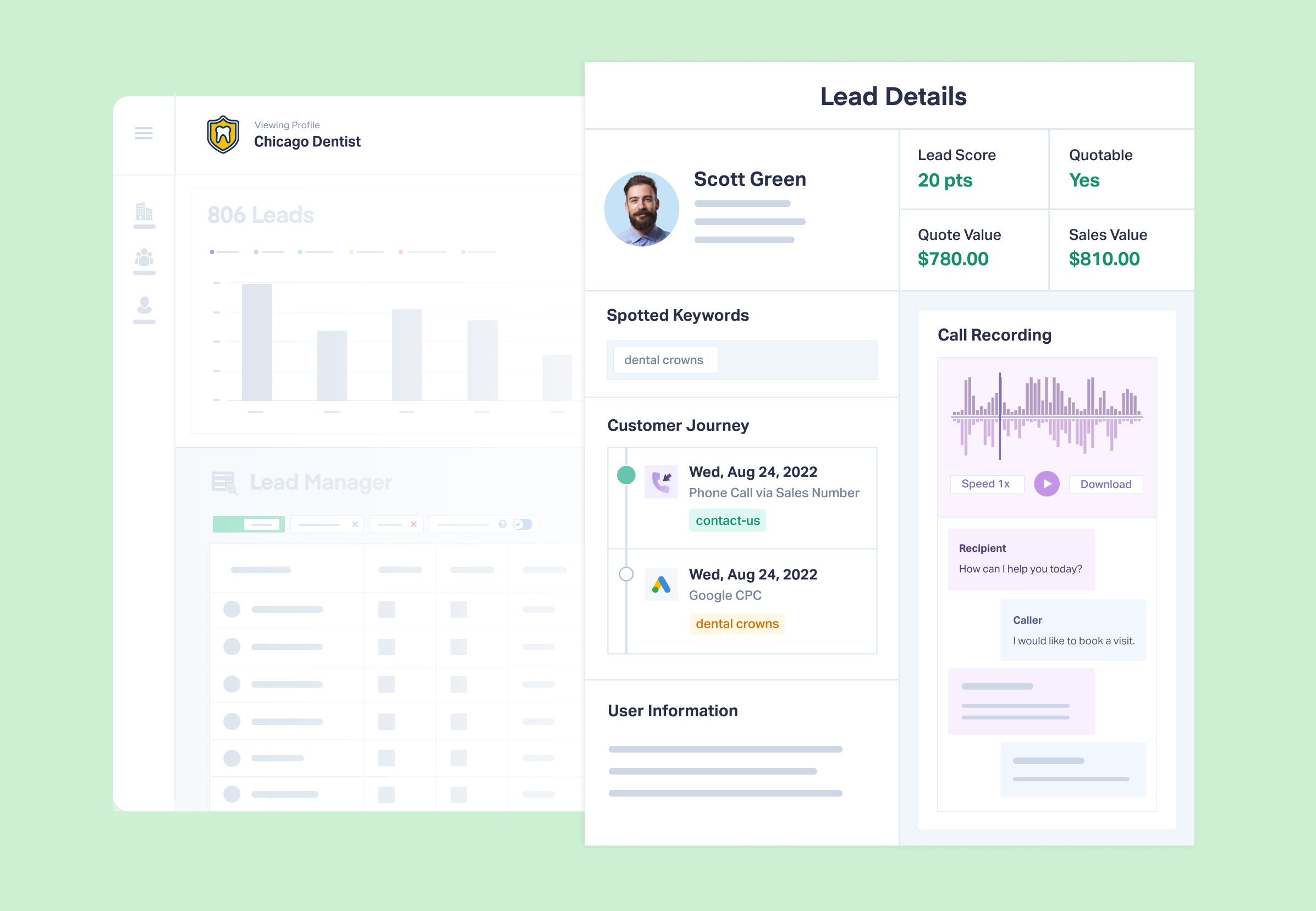
WhatConverts makes it automatic. It captures every lead type—calls, forms, chats, and transactions—in the Lead Manager, and each lead carries full marketing attribution: the source, campaign, keyword, and landing page that drove it. Every call has a recording and transcript. Every form shows every field submitted.
That means pulling a "positive nugget" for a monthly report isn't a research project. It's two clicks.
The Lead Details panel shows:
- Who the lead is (name, phone, email)
- What they wanted (call recording, form fields, chat transcript)
- Where they came from (campaign, keyword, full customer journey)
- What they were worth (quote value, sales value, qualification status)
When a high-ticket deal closes, agencies can look it up mid-client call and tie it back to the campaign on the spot. That's not a reporting improvement. That's a trust-building superpower.
The Reporting Upgrade That Retains Clients
Here's the structure that works:
- Open with aggregate performance. Total leads, qualified rate, CPL, quote value trends. This is the proof.
- Select 2–3 individual lead examples. Choose ones that illustrate quality—a high-value call, a lead with a strong transcript, a job that closed. These are the validation.
- Show source attribution for each example. Don't just say "a good lead came in." Show exactly which campaign drove it. That closes the loop between ad spend and real business.
- Flag any patterns you noticed. Specific examples often reveal insight aggregate data obscures—a keyword that's pulling in the wrong service type, or a landing page that's converting unusually well.
Numbers give clients confidence the program is working. Names and transcripts give them certainty.
When clients can see the data and look at the actual person who called, doubt doesn't have anywhere to live.
Ready to turn every monthly report into proof that sticks?
Start your free 14-day trial of WhatConverts today or book a demo with a product expert to see how we help prove and grow your ROI.
Get a FREE presentation of WhatConverts
One of our marketing experts will give you a full presentation of how WhatConverts can help you grow your business.
Schedule a DemoGrow your business with WhatConverts