


 Amanda Pell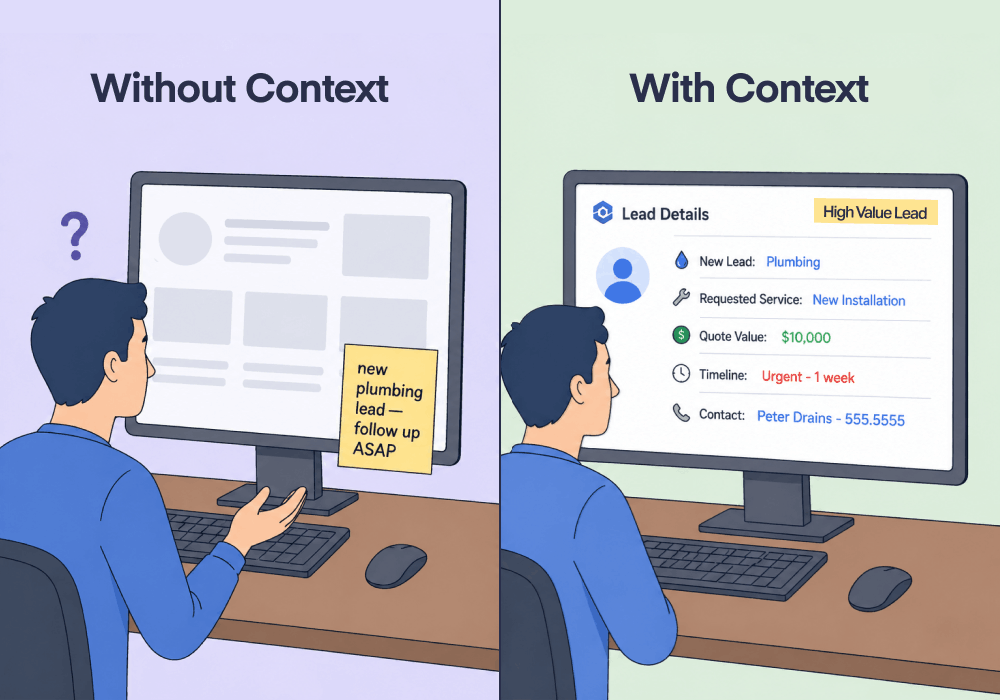
A sticky note is simultaneously one of the most useful, and most useless, tools ever invented. It all depends on where you stick it.
Let’s say you write “call Peter—urgent” and stick it to your monitor. You know Peter is a high-value lead ready to move forward. But to anyone else, Peter could be a prospect, a vendor, or your kid. Without any context, the note is meaningless.
Revenue data has the same problem. The moment a deal closes, the final sale number gets separated from the marketing that drove it. What lands in the report is a number, but it’s missing the story behind it.
This article explains why that loss of context costs agencies budget, clients, and credit for results they actually earned—and how to fix it.
Note: Not a WhatConverts user yet? Start your free 14-day trial of WhatConverts today or book a demo with a product expert to see how we help prove and grow your ROI.
When Revenue "Sticks" to the Wrong Thing
Your agency is running Google Ads for a plumbing client. April was strong: calls and form fills are up, cost per lead is down.
You send the report, and the client writes back: April was slow for closed jobs. They want to cut the Google Ads budget.
You can see the leads, but you can’t see what happened to them:
- Which ones got quoted
- Which closed
- Which campaigns drove the jobs that actually paid out
That data lives on the client's side—in a CRM, on a spreadsheet, in someone's head—disconnected from the marketing source that generated it.
So you can't make the case to defend your ad budget. The report shows activity, the client sees results, but nothing connects the two.
Why This Happens (and Why You Can’t Fix It Later)
By the time you’re drafting the report, the “sticky notes” that contained the values of the jobs that came from your leads have already been separated from your data. Once they’re separated, it’s all but impossible to stitch them back together again.
That’s why this is a tracking problem, not a reporting one. The issue isn’t that the data doesn’t exist; it’s that it lives in different places, and your tracking system doesn’t keep them connected.
When a lead comes in, it carries its context with it: campaign, keyword, channel. Then it gets picked up by sales, and the chain breaks. Marketing tracks lead attribution; sales tracks the deal and its value. Without a shared record connecting the two, the relationship fades.
The Consequences of Contextless Tracking
When revenue isn’t tied to its marketing source, it does more than just confuse reporting.
Budgets Shift to the Wrong Channels
When attribution breaks, credit goes to whatever is closest to the sale—not what actually drove the lead.
A $90K job that started from a Google Ads campaign gets recorded as “organic” because that’s what was active when it closed. On paper, organic looks like the winner. Paid search looks inefficient.
Agencies Can’t Prove What Actually Drove Revenue
Campaigns generate leads. Some of those leads turn into real jobs weeks later. But if that outcome never makes it back to the original source, there’s no way to connect the dots.
From the client’s perspective, the story is simple: leads came in, but revenue didn’t follow—at least not in a way they can see.
Without that connection, agencies are left pointing to activity instead of outcomes. And “trust us” isn’t a convincing argument when budgets are on the line.
Winning Campaigns Get Shut Off
When decisions are based on when revenue closes instead of what created it, timing starts to distort performance.
A campaign drives strong leads in February. Those leads close in April. April’s report shows revenue, but doesn’t tie it back to February’s campaign.
So February looks weak. April looks mixed. And the campaign that actually worked gets reduced or shut off.
Not because it underperformed, but because the proof didn’t survive long enough to show it.
The Fix: Keep Context Attached to the Lead
The problem starts when revenue gets separated from the lead that created it. So instead of trying to reconnect everything later, the solution is to stop that separation from happening in the first place.
When a lead comes in, it already contains the only reliable attribution you’ll get—source, campaign, keyword. From there, most systems break the connection. Marketing tracks the lead, sales tracks the deal, and revenue gets recorded at close, grouped by date.
To avoid that, the lead has to remain the single record from start to finish:
- The original lead stays intact as it moves through the funnel
- Qualification, quotes, and revenue all attach to that same record
- Nothing gets copied into another system or matched later
That’s what changes reporting.
You’re not trying to reconstruct what happened or guess which campaign drove the outcome.
The answer is already there—because the connection never broke.
How Attribution Should Actually Work
To prevent that separation from happening, attribution needs to be attached to the lead, not to the conversion action itself.
The attribution record begins with the initial conversion action, and then every chat, call, and click that occurs from that point forward gets attached to that same lead journey—not documented as a completely separate lead event.
- When a lead comes in, capture everything: source, campaign, keyword, channel, and conversion type.
- When that lead is qualified and receives a quote, attach them to the original lead profile.
- When it closes, mark that same lead profile sold.
Now revenue doesn't just exist in a vacuum. It's anchored to the originating lead and the marketing that drove it—regardless of when the deal closes.
WhatConverts does exactly this. Every call, form, and chat gets tracked back to its source. Quote value and sales value attach directly to the lead record. So when a $14,200 job closes in April on a lead that came in from a Google Ads keyword in February, that revenue traces back to that keyword—not to whatever happened to be running in April.
What Changes When You Can Prove Revenue Driven
When you can tie every dollar of revenue generated back to the marketing source, it fundamentally changes the game:
- Campaigns get credit for revenue they actually drove, not revenue that happened to close during the same reporting period
- Budget decisions reflect real performance, not coincidental timing
- Client conversations shift from defense to strategy—you're showing them exactly what their spend produced, tied to specific campaigns, down to the lead level
Making Your Revenue Data Stick
A sticky note only works if it stays attached to the thing it refers to. The same goes for your revenue.
If your data can’t show:
- Where a lead came from
- What it was worth
- What it turned into
…it can’t guide decisions.
Stop guessing which campaigns work.
See exactly which leads turn into revenue—and prove it.
Start your free 14-day trial of WhatConverts today or book a demo with a product expert to see how we help prove and grow your ROI.
Get a FREE presentation of WhatConverts
One of our marketing experts will give you a full presentation of how WhatConverts can help you grow your business.
Schedule a DemoGrow your business with WhatConverts