


 Amanda Pell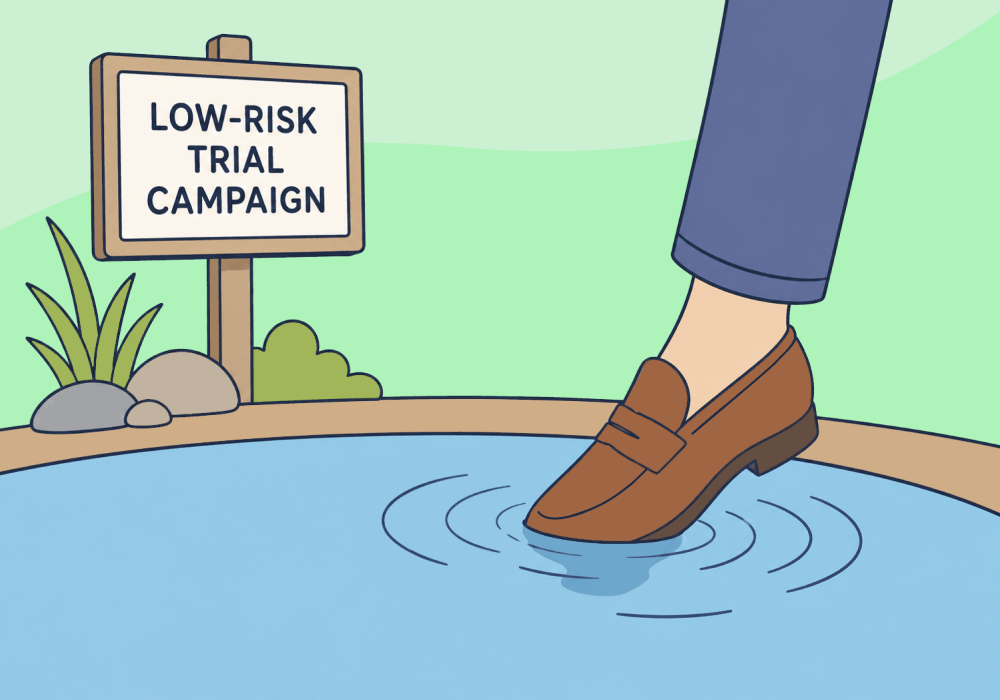
A client's "no" to a new channel is rarely about the channel. It’s about the risk of trying something new.
Spending money on something unproven feels like gambling with money they can’t afford to lose.
You know a new paid social channel could work, but the client “doesn’t trust it” or “would rather focus on what we’re already doing.” The safe channels stay funded, the untested one never gets a shot, and your growth with the client stalls.
No amount of arguing will convince a client to take a risk they don’t want to take. Instead, you need to lower the stakes.
This article shows how to introduce new channels with a low-risk, high-ROI test that makes the results impossible for clients to dismiss.
Note: Not a WhatConverts user yet? Start your free 14-day trial of WhatConverts today or book a demo with a product expert to see how we help prove and grow your ROI.
When "No" Really Means "Prove It First"
When a client refuses to fund a new channel, most of the time they’re not making a strategic call. They're managing risk.
They've seen budget disappear into opportunities that sounded good. So a full commitment to an unproven channel feels like all downside: real money out, uncertain money back, and their name on the decision if it flops.
That fear is rational, and you can't argue someone out of a rational fear with nothing more than a convincing pitch deck. Most agencies push the recommendation anyway, get a soft "let's revisit next quarter," and watch the channel stay locked.
Until the risk feels small and the result feels certain, the answer will always be no.
Replace Increased Pressure with Lowered Risk
The vendor move is to win the argument. Better case, bigger promises, more pressure. The partner move is to remove the reason for the fear entirely.
Instead of asking a client to believe in a channel, you ask them to fund a small, fixed test of it. Not an open-ended budget. A capped experiment with a number attached and a clear question:
Does this channel produce revenue for this business, yes or no?
A trial campaign changes what the client is agreeing to. They're not approving a strategy; they're approving a controlled test with a known maximum cost.
And a known maximum cost is something even a cautious client can say yes to.
How to Structure the Trial
A trial only works if the terms are tight. Loose budgets and fuzzy goals recreate the exact uncertainty you're trying to remove.
Set four things before you launch:
- A fixed budget. Pick a number small enough that losing it wouldn't hurt. A single-month cap like $2,500 keeps the stakes low and the decision easy.
- A single channel. Test one thing so the results are clean. Splitting the budget across channels muddies the proof.
- A revenue goal, not a lead goal. The client doesn't care about clicks or form fills. Define success as dollars earned.
- An exit built in. If it works, we scale it. If it doesn't, we walk away. The client keeps the off-ramp, which is what makes them comfortable getting on.
The structure does the persuading. You're not asking a client to trust a channel. You're asking them to run a cheap, reversible experiment with a clear finish line.
Why WhatConverts: The Proof Has to Be Airtight
A trial is only as convincing as the numbers you show at the end. And this is where most trials fall apart.
If you can't isolate the revenue that came specifically from the trial budget, the client can wave the results away. "Those sales probably would've come through search anyway." Now you've spent the money and won nothing.
WhatConverts closes that door. It ties each lead back to the exact channel, campaign, and ad that produced it, then attaches the sales value of the ones that convert.
Isolate the trial channel. Filter your leads down to the trial campaign alone, so the results reflect that budget and nothing else.
Report in revenue, not activity. Attach sales values to converted leads and show dollars earned against dollars spent, not a pile of form submissions.
Answer the "it would've happened anyway" objection. Because every lead is tied to its source, you can prove the revenue came from the new channel specifically, not borrowed credit from an existing one.
That's the difference between "social seems to be working" and "your $2,500 produced $43,000 in tracked sales." One is an opinion. The other ends the debate.
Proof: FatCat Strategies Turned $2,500 Into a 60% Budget Increase
North Carolina agency FatCat Strategies ran into this exact wall. A bathroom remodeling client had seen strong results from FatCat's SEO and paid search, but wouldn't commit real budget to social advertising.
So FatCat proposed a trial: a single month, a fixed $2,500, one channel. If it worked, the client would invest more. If not, they'd move on.
FatCat used WhatConverts to track every lead from the campaign back to its source and attach a sales value to each one that converted. From that $2,500, the campaign generated:
- 30 qualified leads
- Over $43,000 in sales
- Amore than 17x return
The client couldn't argue with revenue tied directly to the channel. They increased their social budget by 60%, and FatCat used the tracked results to bring more skeptical clients on board.
The Trial Unlock
Here's how to turn a client's "no" into a channel they fund on purpose:
- Propose a capped, single-channel trial with a budget small enough to feel safe.
- Define success in revenue, and build in a clean exit so the client keeps the off-ramp.
- Track every trial lead back to its source in WhatConverts, isolated from your other channels.
- Attach sales values so the result is dollars earned, not activity generated.
- Present the tracked revenue as proof the channel works for this specific business.
- Scale the budget on the strength of numbers the client can't dismiss.
You don't convince a skeptical client with a better argument. You convince them with a small bet that pays off in front of them.
Ready to turn a hesitant "no" into proof your client can't ignore?
Start your free 14-day trial of WhatConverts today or book a demo with a product expert to see how we help prove and grow your ROI.
Get a FREE presentation of WhatConverts
One of our marketing experts will give you a full presentation of how WhatConverts can help you grow your business.
Schedule a DemoGrow your business with WhatConverts