


 Amanda Pell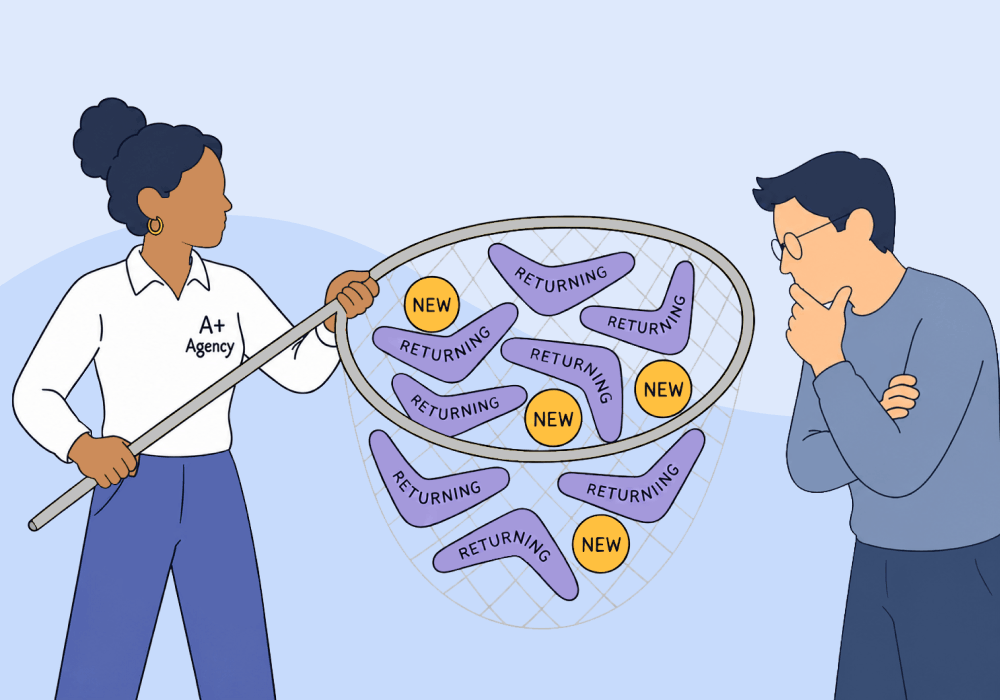
A 7x ROAS month should be cause for a victory lap. So why is your client still calling to complain?
High return on ad spend feels like proof the campaigns are working. But if a chunk of that return comes from existing customers, you're not measuring acquisition. You're measuring loyalty that already existed (and you can't take credit for).
Those customers were going to buy anyway. Many would have found the client through organic search, direct traffic, or a bookmark. Instead, paid caught them on the way and took the credit.
This article shows how to separate the customers your ads actually won from the ones you paid to re-acquire, then bid accordingly.
Note: Not a WhatConverts user yet? Start your free 14-day trial of WhatConverts today or book a demo with a product expert to see how we help prove and grow your ROI.
Why a Great ROAS Can Still Cost You the Client
A blended ROAS number treats every conversion the same. A first-time buyer and a returning customer both land in the same total.
That total looks great in the report. Then the client checks their own books and sees something you can't see in the ad account: they're paying to reach people who already know them.
Here's what that gap looks like:
| Metric | Blended View | Segmented View |
| Conversions from paid | 100 | 100 |
| New customers | ? | 55 |
| Repeat customers | ? | 45 |
| Reported ROAS | 7x | 7x |
| New-customer ROAS | ? | 3.8x |
The blended 7x hides the number that matters to the business. Growth comes from new customers. When 45% of your paid conversions are people who would have returned on their own, the campaign is subsidizing revenue the client already owned.
This becomes a campaign cannibalization problem, and a strong headline ROAS is exactly what keeps it hidden.
The Old Way: Optimize for Total Return
The standard playbook rewards whatever produces the highest ROAS. Feed the algorithm conversions, watch the return climb, scale the winners.
The trouble is that returning customers convert cheaply and fast. They already trust the brand, so they click, buy, and inflate your numbers. Bidding toward total return steers budget toward the audience that needed the least convincing.
Real growth works the other way. It comes from strangers: people who didn't know the client existed last month. Those conversions cost more and close slower, which makes them look worse to a system optimizing for raw return.
Optimize for the blended number and you train your campaigns to chase the wrong buyer.
How to Optimize for New Customer Acquisition
Fixing this takes two moves: label every lead by customer status, then bid toward the segment that grows the business.
Here's the workflow:
- Tag each lead as new or repeat. Every conversion gets a status so you know whether the campaign won a customer or re-billed one.
- Segment ROAS by status. Pull return for new customers on its own, separate from repeat. Now you can see which campaigns actually acquire.
- Compare channels by who they bring in. Some channels drive first-time buyers. Others mostly recycle existing ones. The split is rarely what the blended report suggests.
- Shift budget toward new-customer performance. Fund the campaigns that win strangers. Pull spend from the ones cashing in on loyalty that organic or direct would have captured for free.
Step four is where the client's complaint disappears. When you bid on new-customer ROAS, every paid dollar goes to work on growth instead of on customers already in the fold.
Why WhatConverts Makes This Automatic
Tagging customer status by hand doesn't scale. Cross-referencing every lead against past orders breaks the moment volume climbs.
WhatConverts identifies whether each lead is a new or repeat customer for you, and ties that status to the source, campaign, and keyword that drove it.
See new vs. repeat status on every lead. WhatConverts labels each conversion in the Lead Manager, so you know at a glance whether a campaign won a customer or re-reached one.
Filter reports to true New Customer ROAS. Run a Status by Source/Medium report to see which channels bring in first-time buyers and which lean on repeats. Report the acquisition number your client actually cares about.
Reallocate with confidence. When the data shows organic or direct is quietly handling your repeat business, you can move paid budget toward net-new acquisition and prove why.
Proof: Coastal Reign Hit 7x (Net New) ROAS by Focusing on New Acquisition
Coastal Reign, a custom apparel company with a fast-growing eCommerce business, had strong sales but vague attribution. Their stack couldn't tell them which channels delivered real ROI, and one of their core questions was simple: which leads are new versus repeat?
With WhatConverts, they ran a Status by Source/Medium report and saw the split clearly. Organic campaigns generated more repeat customers, and a higher percentage of them, than paid did.
That insight let them stop asking paid to do a job organic was already doing. They could invest in organic for repeats and point paid spend at new acquisition, with lead-level attribution backing every call.
The clarity paid off. Coastal Reign reached a 7x ROAS, up from roughly 2x when they were tracking everything manually, and gained the confidence to double their ad budget month over month.
The Unlock
Here's what changes when you can tell new customers from repeat ones:
- Label every conversion by customer status, so no returning buyer hides inside your acquisition numbers.
- Segment ROAS by new vs. repeat to expose what paid is really winning.
- Map which channels acquire and which recycle, since the blended report won't tell you.
- Move budget toward new-customer performance and stop paying for revenue you already had.
- Show the client the acquisition number, not a vanity metric that falls apart under scrutiny.
A high ROAS isn't the goal. A high ROAS on new customers is.
Ready to see which campaigns actually grow the business?
Start your free 14-day trial of WhatConverts today or book a demo with a product expert to see how we help prove and grow your ROI.
Get a FREE presentation of WhatConverts
One of our marketing experts will give you a full presentation of how WhatConverts can help you grow your business.
Schedule a DemoGrow your business with WhatConverts