










































 Amanda Pell
Most agencies optimize for lead volume, CPL, and conversion rate. But once a lead comes in, performance turns into a black box.
Calls get answered, deals get closed, and revenue shows up. All of it gets attributed to “sales” as a whole.
That’s a problem, because not all sales reps perform equally. Some turn your leads into revenue, while others quietly leak opportunity.
If you can’t see that difference, you can’t improve it. And you can’t defend your work when a client says, “The leads aren’t good.”
WhatConverts's Sales Call Handling Report tracks individual rep performance across call handling quality, conversion rates, response times, and conversation patterns—giving you visibility into what happens after the lead comes in.
Note: Not a WhatConverts user yet? Start your free 14-day trial today or book a demo with a product expert to see how we help prove and grow your ROI.
Why Agencies Need Individual Rep Visibility
Delivering leads is table stakes. Helping clients understand what happens after the phone rings separates strategic partners from lead vendors.
When you can show clients which reps convert at 45% versus 15%—and explain why—you're providing business intelligence that directly impacts their bottom line. This positions you as invested in the full lead-to-customer journey, not just the marketing piece.
Individual rep data also reveals three insights that strengthen client relationships:
Which Reps Convert Opportunities (And Which Ones Don’t)
The most important signal is simple: Which reps turn calls into real opportunities.
A key metric here is quotable rate—the percentage of calls that result in a legitimate sales opportunity (for example, a booked appointment, a qualified estimate, or a next-step conversation).
When one rep has a 45% quotable rate and another sits at 18%, you’re not looking at a lead quality problem. You’re looking at a sales execution gap.
This is often the fastest way to defuse “bad leads” objections.
Read More: Your Client's Top Salesperson Just Disqualified Your Best Lead Source
How Top Performers Handle Calls Differently
Once you know who your top reps are, the next question becomes: What are they doing differently?
Rep-level data surfaces patterns like:
- Shorter time to first response
- More consistent call structures
- Clearer qualification language
- Stronger close-oriented phrasing
Metrics like call duration, call handling score, and outcome consistency become meaningful when viewed together.
For example, longer calls can indicate better discovery, but only when paired with strong outcomes. Duration alone doesn’t equal quality; context matters.
The goal isn’t to micromanage reps. It’s to give clients something concrete they can coach from.
Where Revenue Is Leaking
When performance varies by rep, every underperforming call is wasted spend.
Rep-level visibility shows:
- Which reps struggle with certain services
- Which leads require stronger follow-up
- Where marketing is delivering opportunity that sales isn’t capturing
That insight creates leverage.
Instead of pushing for more budget, you can help clients recover revenue they’re already paying for—simply by improving what happens after the lead arrives.
Read More: The Sales Accountability Problem: Why Marketers Get Blamed (and How to Fix It)
How Sales Call Handling Reveals Top Performers
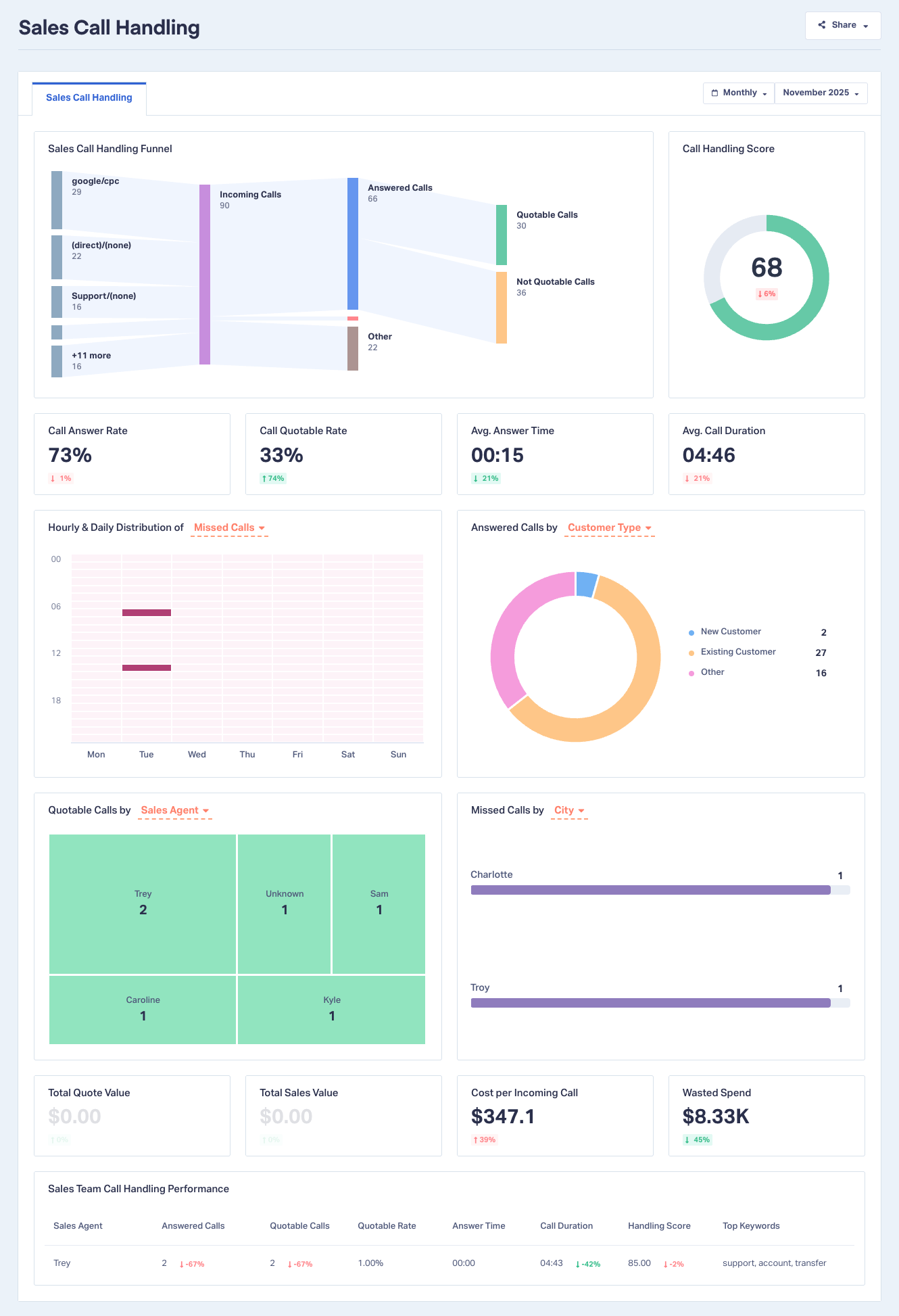
The Sales Call Handling Report includes nine sections:
- Sales Call Handling Funnel: Calls received → answered → booked
- Call Handling Score: Overall conversation quality
- Key Sales Call Metrics: Answer rates, quotable rates, average times
- Hourly & Daily Distribution: When calls come in and get missed
- Handled Calls: Who answers and what customer types they receive
- Booked Calls: Which reps convert conversations to appointments
- Missed Calls: Where opportunities slip through by source
- Value and Spend Metrics: Quote value, sales value, cost per call
- Sales Team Call Handling Performance: Individual rep comparison
This data reveals not just who performs best, but what specific behaviors drive their success.
Inside the Sales Team Performance Section
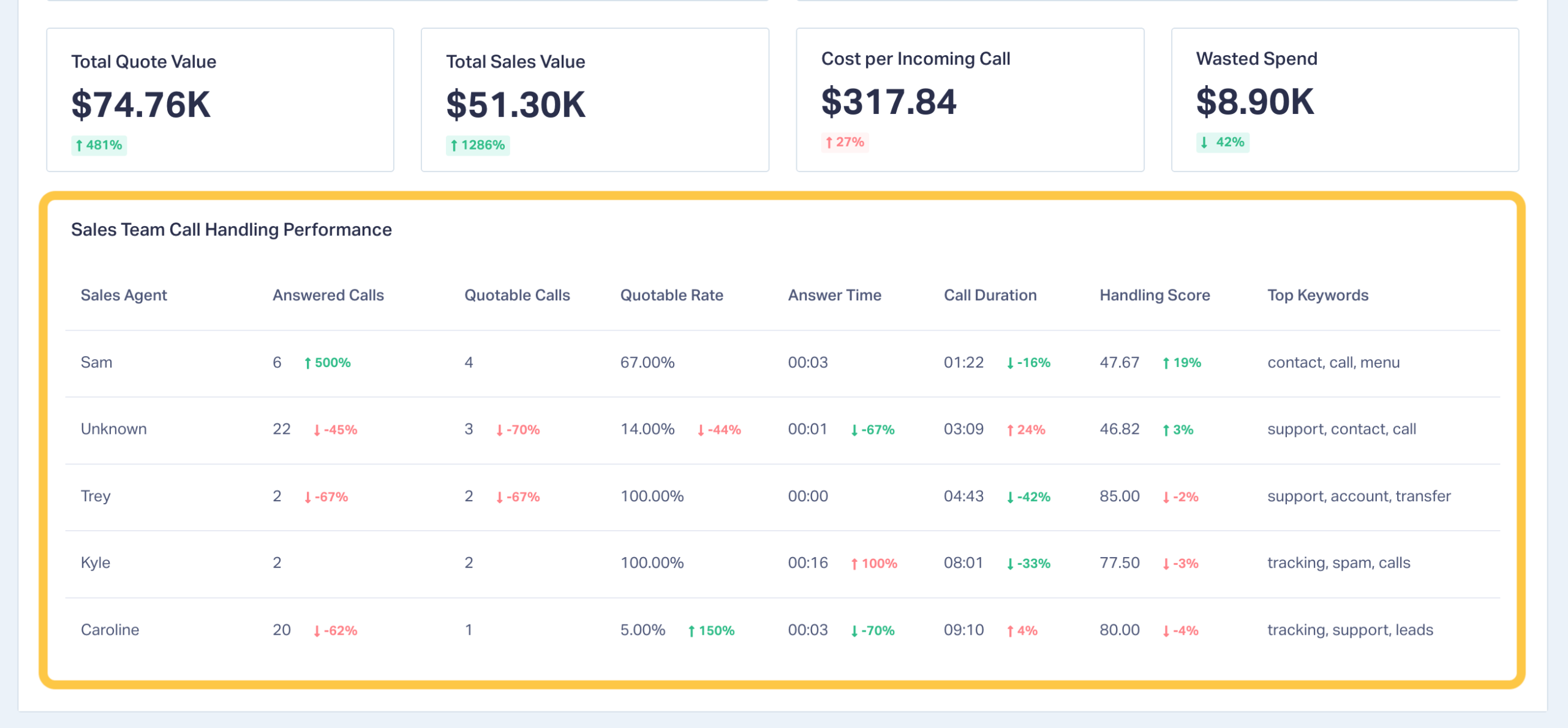
The Sales Team Call Handling Performance section shows you exactly how each rep compares across every metric that drives revenue.
The table displays:
- Total calls handled by each rep
- Average answer time
- Average call duration
- Call Handling Score (conversation quality)
- Quotable rate (conversion percentage)
- Most common keywords from their calls
You can sort by any column to instantly see who's leading and who's lagging in specific areas.
Using the Data to Identify Your Best Reps
Here's how to systematically identify your top performers:
Step 1: Sort by Quotable Rate
Start with the metric that matters most: quotable rate. This shows you which reps consistently turn conversations into bookings.
Click the "Quotable" column header to sort from highest to lowest. The reps at the top are your converters—the ones who know how to move prospects to action.
Step 2: Check Call Handling Score
High quotable rates paired with high Call Handling Scores reveal your true stars. These reps don't just book appointments—they do it with professionalism, clarity, and strong communication skills.
The Call Handling Score evaluates five factors:
- Professionalism and tone: Do they sound confident and trustworthy?
- Understanding caller needs: Do they listen and ask good questions?
- Accuracy and clarity: Do they provide clear, correct information?
- Ability to resolve concerns: Do they address objections effectively?
- Next steps explanation: Do they clearly confirm what happens next?
A rep with a 45% quotable rate and a score of 85+ is someone worth studying.
Step 3: Look at Answer Time and Call Duration
Fast answer times show responsiveness. Longer call durations often indicate thorough conversations where reps build trust and address concerns.
If a top performer has an average call duration of 8 minutes while low performers average 3 minutes, that's a clue: the top rep isn't rushing. They're taking time to qualify properly and set clear expectations.
Step 4: Analyze Common Keywords
The keywords section reveals what types of calls each rep handles and what callers say during conversations.
If your best performer's calls frequently include keywords like "appointment," "schedule," and "available," but a struggling rep's calls show "callback," "voicemail," and "busy," you're seeing the difference between proactive booking and passive response.
Scenario: How an Agency Can Improve a Client’s Revenue (Without Any Marketing Changes)
A marketing agency managing campaigns for a roofing company notices booking rates declining despite consistent lead volume. Instead of immediately recommending more ad spend, they pull the Sales Team Performance data.
The report reveals:
| Quotable Rate | Call Handling Score | Average Call Duration | |
| Sales Rep A | 42% | 88 | 9 min |
| Sales Rep B | 31% | 72 | 7 min |
| Sales Reps C, D, and E | 15-20% | 55-65 | <4 min |
The agency listens to Rep A's recordings and identifies three consistent behaviors:
- Starting with "I can absolutely help you with that" to build confidence
- Asking specific questions about timing and budget to qualify properly
- Ending every call with "Here's exactly what happens next" and confirming appointment details
These aren’t complicated techniques—they’re simple, repeatable behaviors that can be trained.
The agency presents these findings to the client with a recommendation: build training around Rep A's approach before increasing ad spend. The client implements the training, and within six weeks, the whole team's average quotable rate increases from 26% to 34%.
The agency didn't just deliver more leads. They helped the client capture more value from the leads they already had—and strengthened the partnership in the process.
What to Do With These Insights
Once you've identified top performers, here's how to turn that knowledge into client value:
Build Training Around Proven Techniques
Pull recordings from top performers and help clients create a training library. When the entire team can hear exactly how their best reps handle objections, qualify prospects, and confirm appointments, training becomes specific and actionable instead of generic.
Set Data-Backed Performance Benchmarks
Help clients establish clear targets based on actual top performer data:
- Minimum Call Handling Score of 75
- Target quotable rate of 35%
- Average answer time under 15 seconds
- Minimum call duration of 6 minutes for qualified leads
These benchmarks are credible because they're based on proven success within the client's own team.
Demonstrate Value Beyond Lead Generation
When you show clients which reps convert at 42% versus 18%, you're delivering insights that directly impact revenue. This positions you as a strategic partner invested in their complete sales process, not just a vendor delivering leads.
Quantify Revenue Opportunities
Before recommending increased ad spend, show clients the revenue available through improved call handling. If bringing lower performers up to team average would generate an extra $50K in monthly bookings, that's a compelling case for focusing on sales execution first.
Getting Started With Rep Performance Tracking
Ready to identify your best performers?
- Navigate to Reports → Sales Call Handling Report
- Scroll to the Sales Team Call Handling Performance section
- Sort by Quotable Rate to find your top converters
- Review Call Handling Scores to identify quality performers
- Listen to recordings from your best reps to understand their techniques
The data is immediate. The insights are actionable. The revenue impact is measurable.
The Bottom Line: Turn Individual Excellence Into Client Revenue
The best sales techniques are already being used by top performers. The Sales Call Handling Report makes those techniques visible and replicable—giving you insights that help clients maximize revenue from the leads you're already generating.
This transforms how clients see your value. You're not just delivering leads; you're helping them understand and improve their entire conversion process.
Ready to deliver strategic insights that strengthen client partnerships and drive more revenue?
Start your free 14-day trial of WhatConverts today or book a demo with a product expert to see how we help prove and grow your ROI.
Get a FREE presentation of WhatConverts
One of our marketing experts will give you a full presentation of how WhatConverts can help you grow your business.
Schedule a Demo
Grow your business with WhatConverts