


 Amanda Pell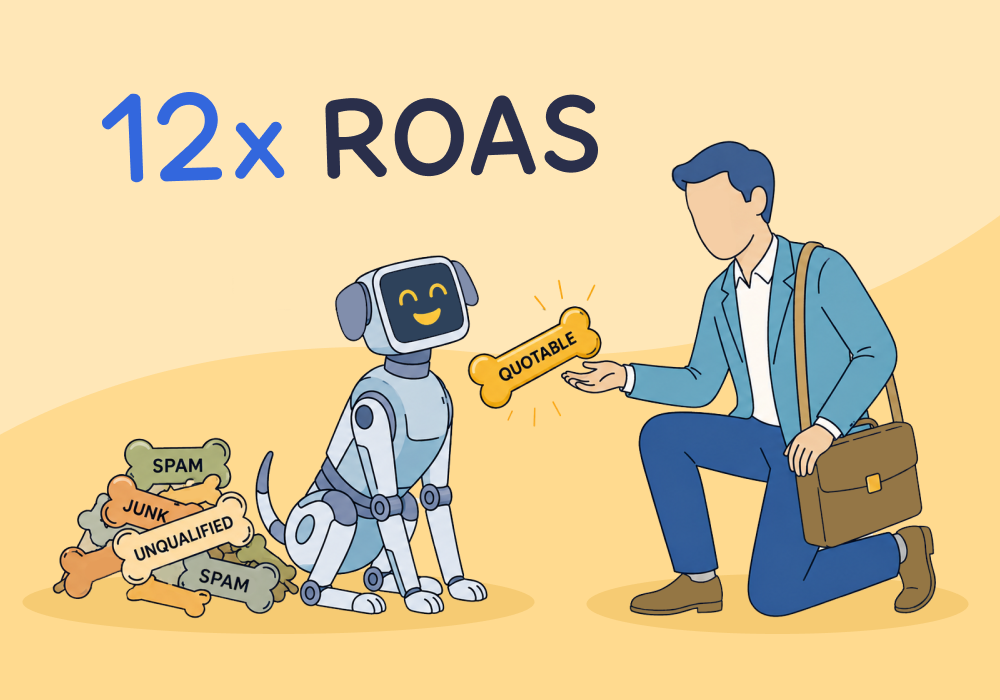
Smart Bidding does exactly what you teach it. The trouble is that most marketers are teaching it the wrong lesson.
Feed Google a conversion every time a form gets filled out, and the algorithm learns one thing: get more form fills. It doesn't know that half of those form fills are spam. It doesn't know the other half are unqualified leads who will never book.
Google only knows you called those conversions "good," so it goes and finds more just like them. If you want Smart Bidding to find something else, you have to train it.
This article shows how to retrain the algorithm by feeding it only the leads that actually matter.
Note: Not a WhatConverts user yet? Start your free 14-day trial of WhatConverts today or book a demo with a product expert to see how we help prove and grow your ROI.
The Problem: Your Algorithm Is Optimizing for Junk
Smart Bidding is only as smart as the data you give it. When every form fill counts as a conversion, the algorithm treats them all as equally valuable.
So it chases the cheapest, easiest conversions it can find:
- Spam submissions from bots and lead-resellers
- Misdials and wrong numbers that last eight seconds
- Price-shoppers who were never going to buy
- Existing customers asking a billing question
The campaign looks healthy. Conversion volume is up, cost per conversion is down, and the client sees a dashboard full of green. But the actual booked revenue stays flat, because the leads filling the pipeline can't close.
The worst part is that the problem compounds. Every junk conversion you send back teaches Google to go find more junk. The algorithm gets more confident and more wrong at the same time.
The Insight: The Algorithm Needs a Feedback Loop
Google's bidding strategies learn from the conversions you report. That's the whole mechanism. Report a conversion, and the system studies that lead's signals and hunts for more people like them.
Which means the question isn't "how do I get the algorithm to behave?" It's "what am I teaching the algorithm to chase?"
Right now, most accounts teach Google that a conversion is anyone who fills out a form. The fix is to teach it something far more specific: a conversion is a lead worth quoting. When you only send back quotable leads, the algorithm stops optimizing for volume and starts optimizing for quality.
That single change rewrites what the system is chasing.
How to Overcome It: Send Back Only Qualified Leads
The repeatable fix isn't more budget or new creative. It's a cleaner feedback loop. Here's the workflow agencies use:
- Capture every lead with full context. Every call, form, and chat comes in tied to its source, campaign, and keyword, so you know exactly what drove it.
- Qualify each lead. Mark which leads are real and quotable and which are spam, misdials, or wrong-fit. This is the judgment Google can't make on its own.
- Send only quotable leads back as conversions. Instead of reporting all conversions, report only the ones that passed your qualification check.
- Let the algorithm recalibrate. Smart Bidding studies the leads you actually want and shifts bids toward the keywords, audiences, and placements that produce them.
The result is a bidding strategy that gets sharper every day, because you've stopped polluting its training data.
Why WhatConverts: Filter the Junk Before It Reaches Google
WhatConverts sits between your leads and your ad platform, so you decide what counts as a conversion before Google ever sees it.
Qualify leads in the Lead Manager. Every call, form, and chat lands with full attribution. Mark it quotable or not, manually or with rules, in seconds.
Sync only "Quotable" leads through the Google Ads Integration. Adjust one setting so that only leads you've marked quotable get sent back as conversions. The spam and the tire-kickers never make it into Google's training data.
Find your highest-quality sources. Sort leads by quotable status to see which channels, campaigns, and keywords actually produce winners, then push budget there.
The algorithm finally learns what a good lead looks like for the business, instead of guessing from a pile of mixed signals.
Proof: Profit Roofing Systems Hit 12.4X ROAS by Training the Algorithm
Profit Roofing Systems wanted to scale results with Smart Bidding but was wary of handing the algorithm control without a way to steer it toward better leads.
Using WhatConverts, the agency pulled quote value from their client's CRM into the Lead Manager, marked which leads were quotable, and used the native Google Ads Integration to send only quotable leads back as conversions. The algorithm stopped learning from junk and started learning from leads that could actually close.
In the three months after the change, the client saw:
- 12.4X ROAS, up from 6.9X
- 57% jump in revenue
- 21% more qualified leads and 60% fewer spam leads
- 19% higher average quote value
The budget didn't balloon. The data got smarter.
The Unlock
When you control what counts as a conversion, you control what the algorithm chases. Here's the complete workflow:
- Capture every call, form, and chat with full attribution in WhatConverts
- Qualify each lead as quotable or not
- Set the Google Ads Integration to sync only quotable leads
- Let Smart Bidding recalibrate around the leads that close
- Reallocate budget toward the sources producing the most quotable leads
Stop teaching Google to chase the cheapest conversion. Teach it to chase the profitable one, and watch ROAS follow.
Ready to train your algorithm on leads that actually convert?
Start your free 14-day trial of WhatConverts today or book a demo with a product expert to see how we help prove and grow your ROI.
Get a FREE presentation of WhatConverts
One of our marketing experts will give you a full presentation of how WhatConverts can help you grow your business.
Schedule a DemoGrow your business with WhatConverts