


 Amanda Pell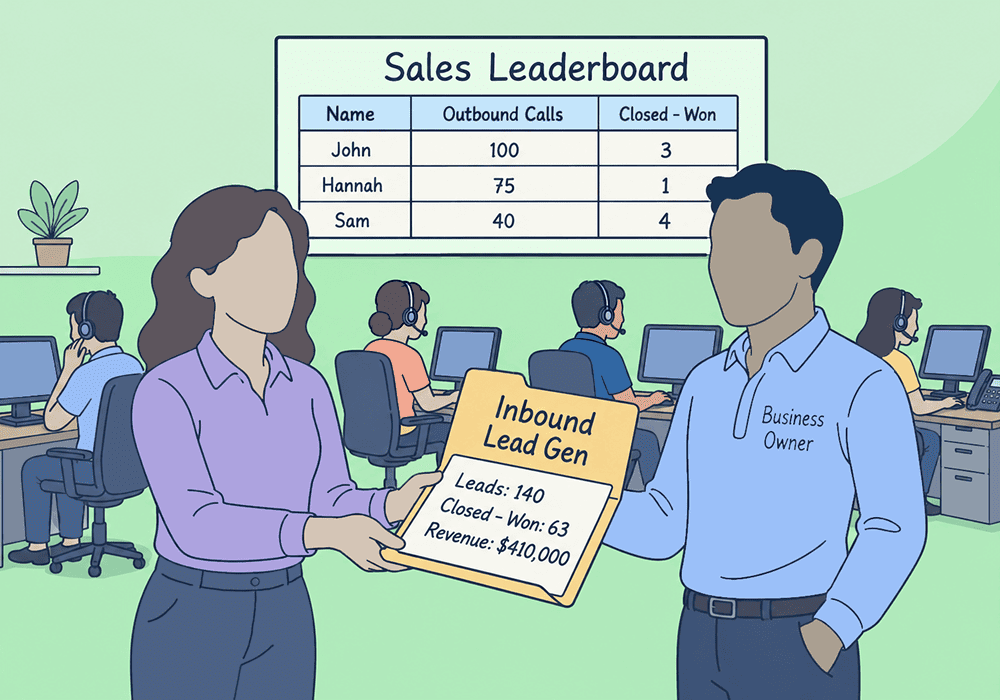
Outbound sales teams are expensive, yet few businesses stop to question whether having an outbound sales team actually makes financial sense for their company. It feels like an essential need: after all, without a sales team, how will they bring in business?
Meanwhile, the phone is already ringing with people who called with pre-existing buyer intent.
It's common knowledge that inbound leads are much warmer than outbound ones. Still, not many companies are willing to put all their eggs in the inbound sales basket and do away with outbound sales entirely. It’s not a question of whether inbound leads are valuable; it’s whether they’re valuable enough to support the entire business without any outbound activity at all.
This article shows how to prove inbound lead quality with hard numbers, so a client can shift budget away from cold calling and toward the marketing that already works.
Related Reading: How to: Identify Your Client’s Best Sales Reps
Outbound Sales Is Expensive and Unaccountable
An outbound team is a heavy fixed cost. Salaries, tools, and overhead are paid for every month whether the reps book anyone or not.
Most of that dialing produces nothing. When a rep works 100 cold prospects to book two, the client still pays for the 98 rejections.
Without a clean line between marketing-driven bookings and cold-call bookings, nobody can say which one is driving revenue. So the client pays for both and doesn’t ask questions.
Inbound Leads Already Have Intent
A cold prospect has to be convinced they have a problem. An inbound lead called because they already know they have a problem, and know you can help them solve it.
That difference shows up in the metrics. Inbound leads close at higher rates, cost less to reach, and need less convincing, because the interest came first.
On paper, moving budget from outbound to inbound is the more efficient play. The only thing standing in the way is proof. A client isn’t going to dismantle a sales team on a hunch. They need to see inbound producing better prospects at a lower cost, lead by lead.
How to Prove Inbound Can Replace Outbound
The argument is won with lead-level data, not a slide about buyer intent.
- Track every inbound lead to its source. Tie each call and form to the campaign, keyword, and channel that produced it.
- Qualify each lead. Separate real buying conversations from noise using call duration, recordings, and outcome.
- Attach value to each lead. Assign quote and sales values so leads are measured in revenue, not counts.
- Compare cost per acquisition. Set the inbound CPA next to the fully loaded cost of the outbound team.
When inbound books at a lower cost per acquisition than a rep dialing cold, the case makes itself.
Why WhatConverts
WhatConverts tracks the quality and value of every inbound lead, which is exactly the proof a budget shift requires.
Track every inbound lead to its source. Calls, forms, and chats come in tagged with the campaign, keyword, and channel behind them, with no manual logging.
Value leads in revenue, not volume. Attach quote and sales values so each channel is judged by the dollars it produces, not the calls it logs.
Compare inbound against outbound on cost. With a real cost per acquisition for inbound, you can put it beside the outbound team's cost and let the numbers settle the question.
Proof: Avita Digital Cut a Client's CPA by More Than 50%
"With WhatConverts, we can track leads and see not only the cost per acquisition drop more than 50%, but also improve our targeting and reduce our sales department because the inbound marketing is working."
Avita Digital's client, a luxury yacht event business, relied heavily on an outbound sales team to fill charters, weddings, and corporate events. The reps chased prospects without knowing which channels worked, and a custom CRM offered little insight into lead quality or campaign performance.
Avita brought in WhatConverts to track every inbound lead, segment leads by event type (weddings around $10,000, corporate events around $25,000), and see the value each channel produced. With high-intent inbound leads proven against cost, the client:
- Cut cost per acquisition by more than 50%
- Eliminated the need for an outbound sales team
- Held conversion rates steady while cutting spend
- Sharpened inbound targeting through ongoing optimization
The Unlock
An outbound team is a bet that cold volume beats warm intent. Lead-level data lets a client check the bet instead of funding it on faith.
- Track every inbound lead back to its source
- Qualify each one by duration, recording, and outcome
- Attach quote and sales values to measure leads in revenue
- Compare inbound cost per acquisition against the outbound team's fully loaded cost
- Move budget toward whichever proves cheaper per booking
Cold calling asks a client to trust that effort equals revenue. Inbound data shows them which leads actually book.
Ready to show a client that inbound can outperform their outbound team?
Start your free 14-day trial of WhatConverts today or book a demo with a product expert to see how we help prove and grow your ROI.
Get a FREE presentation of WhatConverts
One of our marketing experts will give you a full presentation of how WhatConverts can help you grow your business.
Schedule a DemoGrow your business with WhatConverts