











































 Amanda Pell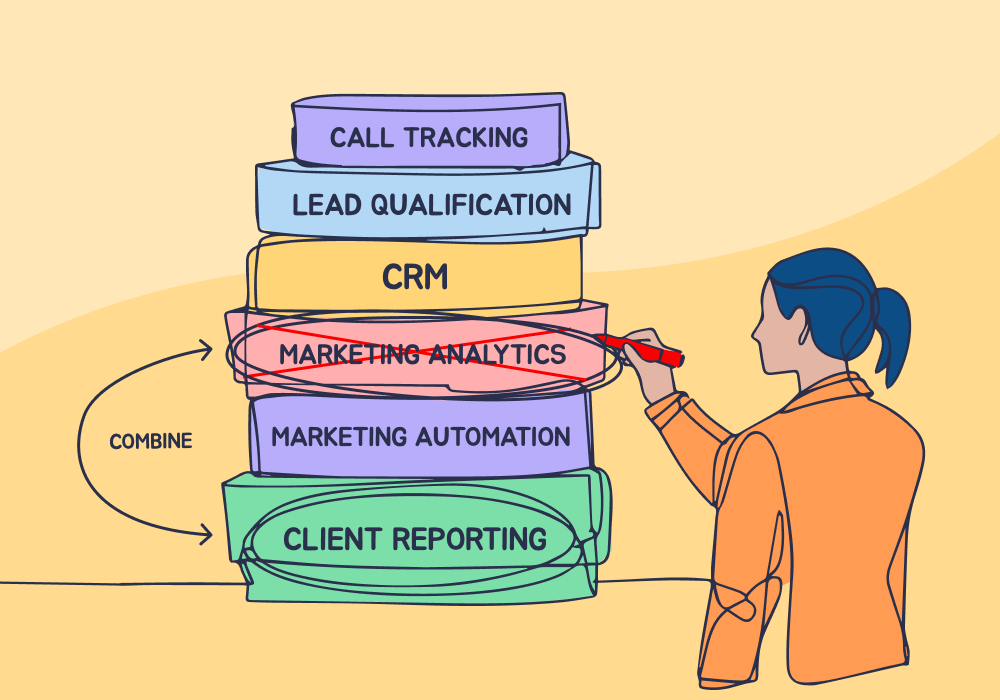
Marketing teams are drowning in software they barely use.
The average B2B marketing tech stack now includes 12-20 tools, and 62% of marketing professionals say they’re using more tools than they did two years ago.
And yet, over 60% of CMOs can't prove their martech investments drive business results, according to Alvarez & Marsal's 2025 report.
This isn't just inefficiency. It's a credibility crisis.
Because when your lead data is fragmented across systems, your campaigns don’t just get harder to manage; they actively get worse at optimizing. Budgets stall, performance plateaus, and clients start asking uncomfortable questions.
But consolidation isn't about cutting tools at random. It's about consolidating the right data, so your systems can finally work the way they’re supposed to.
Note: Not a WhatConverts user yet? Start your free 14-day trial today or book a demo with a product expert to see how we help prove and grow your ROI.
The Real Problem: No One Knows What to Cut
When budgets tighten, the instinct is to slash tools. But which ones?
Cut the wrong platform and you break attribution. Eliminate a tool someone actually uses and productivity craters. Consolidate too aggressively and you lose critical functionality.
Most teams freeze because the risk feels higher than the bloat.
But the status quo has its own cost. Marketing teams spend 23% of their time just managing tools, according to the Alvarez & Marsal report. That's more than a full day per week lost to platform-switching, data exports, and manual reporting.
The pressure to "do more with less" collides with a tech stack nobody fully understands. Who owns what? Which tools actually drive results? Where does critical data live?
Without answers to these questions, consolidation becomes guesswork.
Strategic Consolidation: Data Proximity Over Tool Reduction
The consolidation framework that works isn't "delete everything." It's prioritizing which marketing functions gain exponential value when they share a database.
Some tools work fine standalone. Project management, design software, email platforms—these don't need to talk to your ad attribution.
But call tracking, form capture, chat, attribution, and lead qualification? These create compounding value when unified.
Here's why:
A lead calls from a Google Ad. If your call tracking platform also captures form fills, chats, and eCommerce transactions—and qualifies each lead automatically—you can sync qualified conversion values back to Google Ads in real time.
Now the algorithm learns: "This keyword drove a $2,000 qualified lead. That one drove spam."
Smart Bidding adjusts. Targeting sharpens. ROI climbs.
That's the difference between disconnected tools and a unified system.
What a Unified Lead Platform Unlocks
Instead of juggling five platforms to connect leads to revenue, top agencies consolidate around a single lead tracking system that handles:
- Multi-channel capture: Calls, forms, chats, and transactions tracked automatically
- Attribution by default: Every lead tied to source, campaign, keyword, and customer journey
- Automated qualification: AI scores and values leads based on conversation content and behavior
- Real-time sync to ad platforms: Qualified lead data flows back to Google Ads and Meta instantly
This creates a continuous optimization loop. Every qualified lead becomes a signal that teaches the algorithm what "valuable" looks like. Bidding gets smarter. Targeting improves. Wasted spend drops.
Most importantly: you can prove which marketing drives revenue, not just conversions.
The Consolidation Framework
Not every tool needs replacing. Follow this decision framework:
- Map your data dependencies
Which platforms need to talk to each other for optimization to work? Call tracking, attribution, and ad platforms must share data. Your CMS and email tool? Probably not.
- Identify signal gaps
Where does valuable lead intelligence get trapped? If call recordings live in one system, form data in another, and Google Ads sees neither—that's a revenue-killing gap.
- Consolidate conversion tracking first
Unify how you capture and qualify leads. When calls, forms, and chats flow into one system with complete attribution, everything downstream gets easier.
- Connect qualified data to ad platforms
Use native integrations to sync lead values back to Google Ads and Meta. This is what turns automation from "chasing conversions" into "chasing profit."
- Cut the redundant tools
Only after consolidating core lead tracking should you eliminate platforms that duplicate functionality without adding value.
Proof: What Happens When You Consolidate Smart
301Consulting faced the fragmented stack problem head-on. Their executive search client was generating leads, but the agency couldn't tell which marketing channels brought in high-value ICP leads versus low-value job seekers.
The data lived in separate tools—call tracking here, form tracking there, attribution somewhere else. Then they consolidated that data in WhatConverts, unifying all lead tracking in one platform.
The results:
- 220% more ICP leads in a single year
- Replaced multiple tools with a single dashboard
- Clear ROI visibility by lead type and channel
Before consolidation, 301Consulting was flying blind on which campaigns drove profitable business. After, they could see exactly which channels generated valuable leads—and optimize budgets accordingly.
They didn't increase spending. They just stopped wasting it on channels that brought in the wrong leads.
Read More: Better > More: Agency Segments Leads by Type, Grows Volume 220%
The Bottom Line
Marketing teams aren't drowning in tools because they made bad decisions. They're drowning because solving one problem at a time—call tracking here, form capture there, attribution somewhere else—creates new problems.
But cutting tools blindly breaks things. The key is identifying which functions need to share data for optimization to work, then consolidating those first.
Start with conversion tracking. Unify how you capture calls, forms, and chats. Connect that data to your ad platforms. Then evaluate what else actually needs to stay.
The teams that survive budget cuts aren't the ones with the fewest tools. They're the ones who know exactly which tools drive results—and can prove it.
Ready to unify your lead data and let automation work smarter?
Start your free 14-day trial of WhatConverts today or book a demo with a product expert to see how we help prove and grow your ROI.
Get a FREE presentation of WhatConverts
One of our marketing experts will give you a full presentation of how WhatConverts can help you grow your business.
Schedule a Demo
Grow your business with WhatConverts