












































 Alex Thompson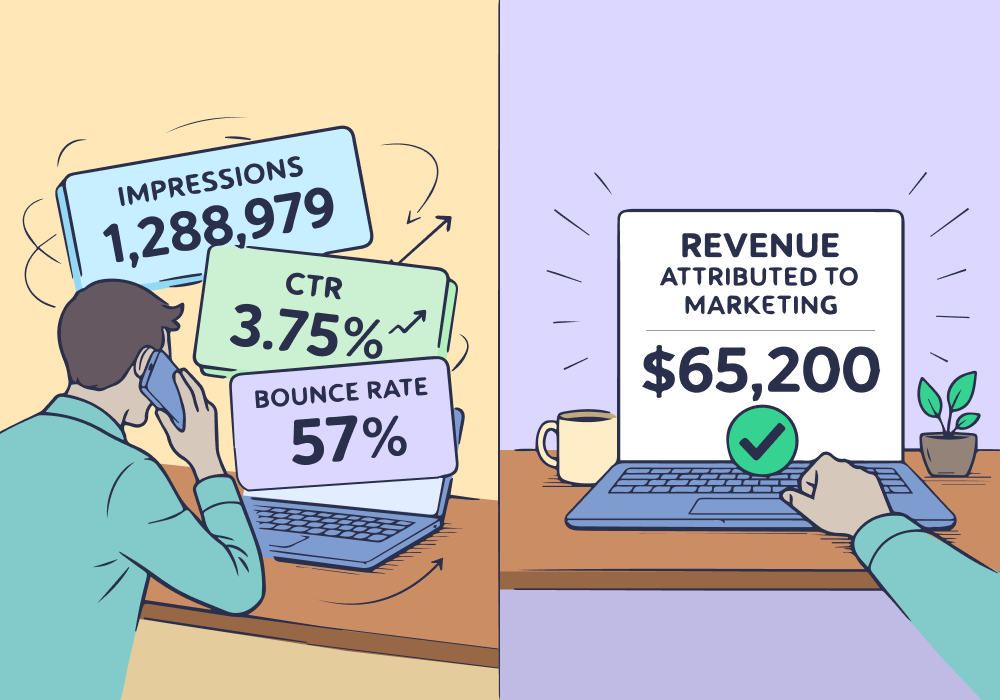
In 2003, an agency owner built a website and ran SEO for a client at $5,000 a month—$60,000 for the year (not bad).
However, the leads he generated produced $6 million in sales. The internal salesperson who answered those calls made a $150,000 commission just for standing between the marketing and the close.
What's wrong with this picture? The agency that created all the value captured almost none of it.
If you're running Google Ads for an HVAC company, a personal injury firm, or a roofing contractor, some version of this math is playing out in your business right now.
This article breaks down exactly why—and what the alternative looks like.
Note: Not a WhatConverts user yet? Start your free 14-day trial today or book a demo with a product expert to see how we help prove and grow your ROI.
The Structural Problem with Billing for Tasks
When you charge for "managing 50 keywords" or "3 blog posts a month," you're pricing your agency on effort rather than outcomes. That creates three problems that compound over time.
1. Your Earning Potential Is Artificially Capped
A task-based retainer has a ceiling built into it. Whether you generate $100,000 or $1 million in revenue for the client, your invoice looks the same.
For agencies, that means the better your campaigns perform, the more underpaid you become. And the moment the client feels the initial setup work is "done"—keywords are optimized, the landing page is built—they start questioning why they're still paying a monthly fee.
2. You Become a Line Item Instead of a Partner
Task-based agencies live on the expense side of the ledger. When a client needs to cut costs, your retainer is one of the first things reviewed—because it's framed as a cost, not a revenue driver.
An agency billing on value lives on the revenue side.
When you can show a client that your campaigns generated $1.3 million in sales, your $30,000 retainer isn't an expense to cut—it's the cheapest revenue they have.
| ⚠️ Expense Side of the Ledger | ✅ Revenue Side of the Ledger |
| $30,000 Monthly Agency Retainer | $30,000 Monthly Agency Retainer |
| with no proven ROI | that generated $1.3M in sales |
| ❌ Framed as a cost ❌ First thing reviewed in budget cuts ❌ No visible connection to revenue | ✅ Framed as a revenue driver ✅ Cheapest revenue the client has ✅ Clear ROI justifies every dollar |
| Client thinks: "Why are we still paying for this?" | Client thinks: "How do we scale this?" |
3. Scaling Means More Overhead, Not More Profit
Task-based pricing doesn't just cap what you earn per client—it caps your entire agency. Because your revenue is tied to time and deliverables, the only way to take on more clients is to add more staff. More staff means more overhead. But the retainers don't grow with results, so margins shrink as you scale. You end up working harder, managing more people, and keeping less of every dollar.
Value-based pricing breaks that cycle. When your fee is tied to outcomes instead of hours, you can earn more per client without adding headcount. A better campaign doesn't require more people—it requires more skill. And the margin you gain by charging on value is what lets you hire higher-caliber people when you do grow—instead of stretching junior staff across too many accounts to make the math work.
The Math That Makes Value-Based Pricing Work
The 10x Rule: When Your Fee Becomes Invisible
You can't arbitrarily raise prices. For a recurring retainer to feel effortless to renew, the client needs to receive at least 10 times more value than their total investment—your fee plus their ad spend.
This is The 10x Rule.
At that ratio, your retainer disappears into the return. Nobody argues about a $30,000 fee when the campaigns behind it are generating $1.3 million.
Lifetime Value Is Your Pricing Superpower
Most agencies undervalue their own work because they're looking at the first transaction. An $800 HVAC repair lead looks modest. But if that customer returns in two years for a $20,000 system replacement, the true value of that initial lead is dramatically higher.
Agencies that specialize in a single vertical—roofing, legal, medical—have a massive advantage because they know the average customer lifetime value, the close rate on different lead types, and the typical upsell path.
A generalist guesses at these numbers. A specialist names them in the pitch meeting.
The Full Picture: Task-Based vs. Value-Based
Below is how the shift plays out across every dimension of how you run your agency.
The last row is the one that matters most. A task-based agency's revenue is capped by hours and scope. A value-based agency's revenue is tied to client growth—and growth has no ceiling.
What You Sell How You're Paid What You Report How Clients See You Your Earning Ceiling | Task-Based Agency Tasks: blog posts, keyword management, ad clicks Hourly rates or flat monthly fees Impressions, CTR, bounce rate A vendor who manages campaigns Capped by hours or task scope | Value-Based Agency Outcomes: qualified pipeline and closed revenue Retainers tied to 10x ROI, per-lead pricing, or revenue share Quote value, sales value, ROAS A revenue partner who grows their business Uncapped — tied to client revenue growth |
The One Thing Standing Between You and Value-Based Pricing
The math is clear. The model is obvious. So why don't more agencies make the switch?
Because you can't charge for value you can't prove you generated.
Most agencies rely on their client's CRM to demonstrate ROI. But CRMs are built for sales teams. Over a long sales cycle, the system credits the deal to the rep who touched it last—erasing the campaign, the keyword, and every marketing touchpoint that created the opportunity. The salesperson gets the commission. You get the budget question.
To make value-based pricing work, you need a tracking layer that captures the full customer journey—from the ad click that brought the lead in, to the phone call that started the conversation, to the quoted value that proves the revenue. That tracking layer is what gives you the receipts—the hard data that lets you walk into a client meeting and say, "Your Google Ads campaigns generated $487,000 in quoted pipeline this quarter."
That's the conversation where a $30,000 retainer stops being an expense and starts being obvious.
So what does the first value-based pricing conversation actually sound like? You don't need to overhaul your pricing overnight. Start with a single prospect and use this framing:
"Let's agree on exactly how we're going to measure success — in dollars. When we're hitting those agreed-upon metrics and proving the ROI, we'll meet again to reevaluate the relationship and decide on budgets and pricing going forward."
What Comes Next
This article covered the why—why task-based pricing caps your agency and why value-based pricing is the alternative. But making the switch requires building the proof that justifies it.
Next in this series: How to build the tracking layer that makes value-based pricing possible—a step-by-step system for setting up full-journey attribution, qualifying the right clients, and using 30 days of data to turn your next retainer conversation into a math problem.
Ready to start building the proof? Start a free 14-day trial of WhatConverts and see exactly how much revenue your campaigns are generating.
Start your free 14-day trial of WhatConverts today or book a demo with a product expert to see how we help prove and grow your ROI.
Get a FREE presentation of WhatConverts
One of our marketing experts will give you a full presentation of how WhatConverts can help you grow your business.
Schedule a Demo
Grow your business with WhatConverts