












































 Amanda Pell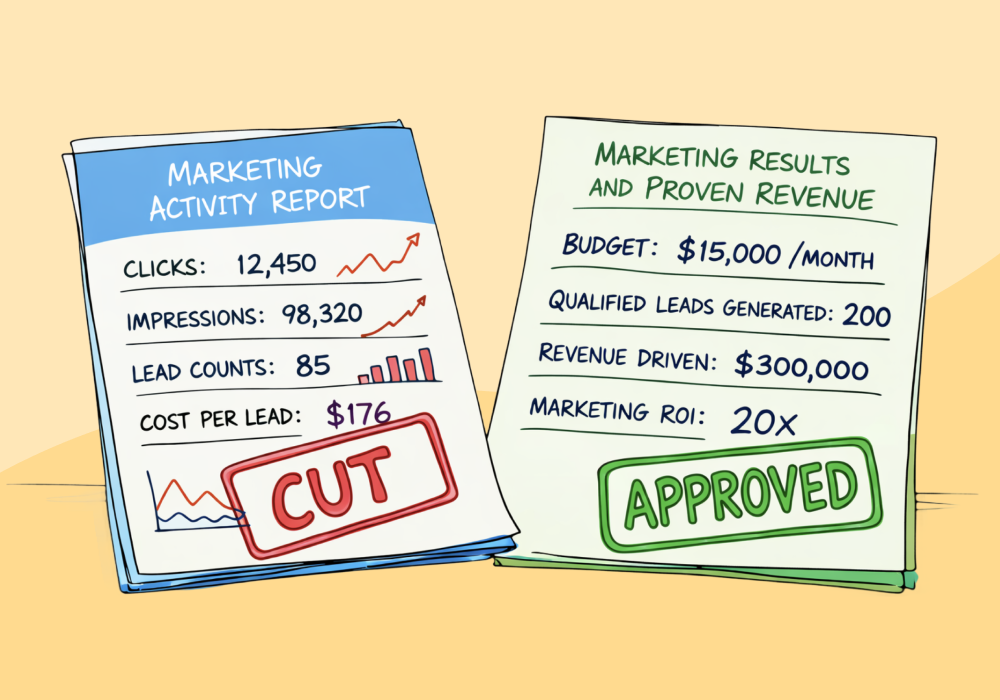
CFOs don't speak in clicks. They don't care about impressions. And they certainly don't find "conversions driven" compelling when they're deciding what to cut.
But that's exactly what most agencies hand their clients to take into that room.
When a report shows impressions, clicks, and cost per lead—but no revenue—it creates a gap. And in finance, gaps don’t get the benefit of the doubt. They get flagged.
Marketing budgets don’t get cut because campaigns fail; they get cut because revenue isn’t connected to the spend.
If agencies can’t close that gap with data, someone in finance will close it with a red pen.
This article shows you how to prevent that.
Note: Not a WhatConverts user yet? Start your free 14-day trial today or book a demo with a product expert to see how we help prove and grow your ROI.
Why Marketing Reports Don't Survive the Finance Meeting
Most agency reports are built for marketers. They show campaign performance, lead volume, cost per lead, keyword rankings. Useful data for optimization. Useless data for a CFO.
Here's what a typical agency report shows a client before a budget review:
- 1,240 impressions
- 87 clicks
- 22 form fills
- 14 phone calls
And here's what the CFO sees: a list of marketing activities with no connection to revenue.
The client goes into that meeting with numbers that don't answer the only question finance is asking. So the CFO does what CFOs do—they look at a $8,000 monthly line item with no clear revenue tie and flag it as a candidate for reduction.
The agency didn't lose because the campaigns failed. It lost because the proof didn't exist.
What a CFO Actually Needs to See
Finance thinks in returns. The only report that survives a budget conversation connects spend to revenue in a single view.
Compare these two statements:
- Version A: "We generated 36 leads last month at a cost of $222 per lead."
- Version B: "Last month's $8,000 in ad spend generated 36 leads. Of those, 14 were qualified. Those 14 leads produced $47,000 in closed revenue—a 5.9x return."
Version A is a marketing metric. Version B is a financial argument. Only one of those survives a CFO's scrutiny.
Most agencies are stuck at Version A—not because they're not doing good work, but because they're missing the infrastructure to connect campaigns to closed deals. The lead comes in, gets handed to the client's sales team, and the revenue outcome disappears into a CRM the agency can't access. No attribution. No proof. No Version B.
The Manual Approach to Building Revenue Attribution
Agencies can close this gap without new software. It just takes process, ongoing maintenance, and a client that’s willing to actively participate.
Every lead has to be tracked after it’s handed off. For each one, sales needs to report:
- Did it close?
- What was the deal size?
- When did revenue hit?
Then someone needs to take that data, match it back to the original campaign, and rebuild the report in financial terms.
In theory, this can work. In practice, it looks like this:
- Sales forgets to update outcomes.
- Revenue numbers stay trapped inside a CRM the agency can’t access.
- Someone exports a spreadsheet at the end of the month and hopes nothing was missed—or if it was, that no one looks too closely.
- By month three, the reconciliation process is all but abandoned.
Manual attribution doesn’t fail because it’s impossible. It fails because it depends on perfect coordination between marketing, sales, and finance—three teams with different priorities. When the process breaks, the proof disappears.
The Automated Solution: Revenue Attribution Reporting
The real solution is to treat revenue tracking as part of the system rather than a monthly project.
With WhatConverts, agencies don’t have to chase sales for updates or reconcile spreadsheets after the fact. Every lead is captured with its marketing source attached. As deals progress, revenue values can be applied directly to the original lead.
This automatically changes the reporting conversation.
- The old version: “We generated 36 leads at $22 per lead.”
- The new version: “Last month’s $8,000 marketing budget produced $47,000 in closed revenue. Campaign A generated 6x return and Campaign B generated 1.2x return. Here’s where to reallocate for continued growth.”
No translation or defense required. No interpreting results for the finance team. No guesswork or praying for luck when contract renewal time comes around.
Revenue is connected to the original marketing source automatically, which means agencies can show exactly what worked and what didn’t before anyone in finance asks.
The conversation moves from defending activity to directing investment.
Proof: When the Data Is Clear, the Decision Is Easy
WolfPack Advising used WhatConverts to track which campaigns were driving closed revenue—not just leads. When the data showed that Google Local Service Ads produced significantly higher ROI than Facebook or standard Google Ads, the client didn't just maintain that budget. They doubled it.
The CFO didn't need to be sold. The data made the case. And WolfPack turned that attribution into a repeatable case study that doubled their entire ad management client base.
Read More: 2x Ad Budget, 2x Clients: ROI Reporting Fuels Growth [Case Study]
Build the Proof Before the Meeting
CFOs don’t try to cut your budget simply because they have it out for the marketing team. They’re trying to eliminate risk.
When your budget line shows cost without a clear return, you’re a liability. When that same line shows spend tied to revenue, you become a valuable investment.
Agencies that rely on activity metrics walk into reviews hoping performance was “good enough.” Agencies that connect campaigns to closed revenue walk in with allocation recommendations.
One defends spend; the other directs it.
The next CFO budget review is coming. The only argument that works is the one built on revenue data.
Start your free 14-day trial of WhatConverts today or book a demo with a product expert to see how we help prove and grow your ROI.
Get a FREE presentation of WhatConverts
One of our marketing experts will give you a full presentation of how WhatConverts can help you grow your business.
Schedule a Demo
Grow your business with WhatConverts