


 Alex Thompson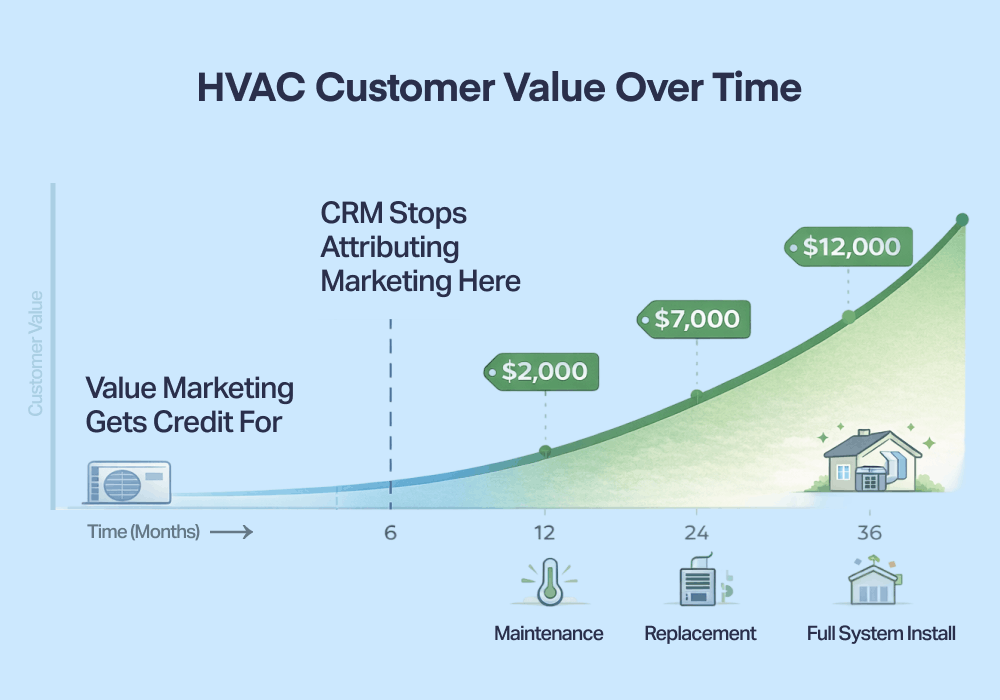
In the HVAC industry, marketing campaigns usually get about six months of credit. After that, the revenue gets reassigned.
When a customer comes back in Year 2 for a system replacement, the marketing team doesn't get the win. Instead, you hear this:
- "The sales team is closing better."
- "Our new pricing strategy improved margins."
- "Operations finally fixed our retention problem."
This is the "6-Month Lie."
It convinces owners that marketing is an expense that barely breaks even, while operations and sales are the true revenue drivers.
But the demand didn't come from nowhere. Marketing created it. The other departments are just harvesting the crop that marketing planted 18 months ago.
Here is how the 6-Month Lie caps your growth—and the math that proves your marketing is worth 4x more than you think.
Note: Not a WhatConverts user yet? Start your free 14-day trial of WhatConverts today or book a demo with a product expert to see how we help prove and grow your ROI.
The Problem: The 6-Month Attribution Cutoff
Most HVAC businesses unknowingly operate with a silent rule: If revenue doesn’t show up within six months, marketing didn’t cause it.
This isn't malicious; it's mechanical. It happens because of how standard reporting works:
- FSM/CRM Reclassification: Tools like ServiceTitan often reclassify a lead as an "Existing Customer" after a short window (often 90 days).
- Reporting Resets: Finance evaluates marketing spend on quarterly or annual cycles.
- First-Job Focus: Reporting focuses on the revenue of the first invoice (often a cheap repair) rather than the Lifetime Value (LTV).
The result? Marketing is viewed as a short-term cost center in a business model that relies entirely on long-term revenue.
How This Plays Out in Real Companies
When you measure your marketing on a short timeline, clients misinterpret the success.
| What Business Owners See | The Internal Interpretation | The Marketing Reality |
| Rising Branded Search | "Our brand is just getting stronger on its own." | These are prospects who saw your ads 12–24 months ago and are now ready to buy. |
| Increased Average Ticket | "The sales team is finally upselling better." | Marketing filled the pipeline with high-intent leads who value quality over the lowest price. |
| Higher Maintenance Renewals | "Operations has fixed our churn problem." | These are the same leads your PPC campaigns acquired 18 months ago finally maturing. |
| Growth in Replacements | "Our customer base is just aging into new units." | Marketing earned the initial $100 repair trust years ago, securing the $15k replacement today. |
Why This Matters
When the reporting window closes too early (the "6-Month Lie"), the connection between your initial marketing spend and this long-term revenue is severed. By using a table like this in your content, you help clients realize that cutting marketing today doesn't just hurt this month—it starves their growth two years down the road.
The Real HVAC Revenue Timeline (0–36 Months)
To see the truth—and the true value of your marketing—you have to look at the full lifecycle of an HVAC lead.
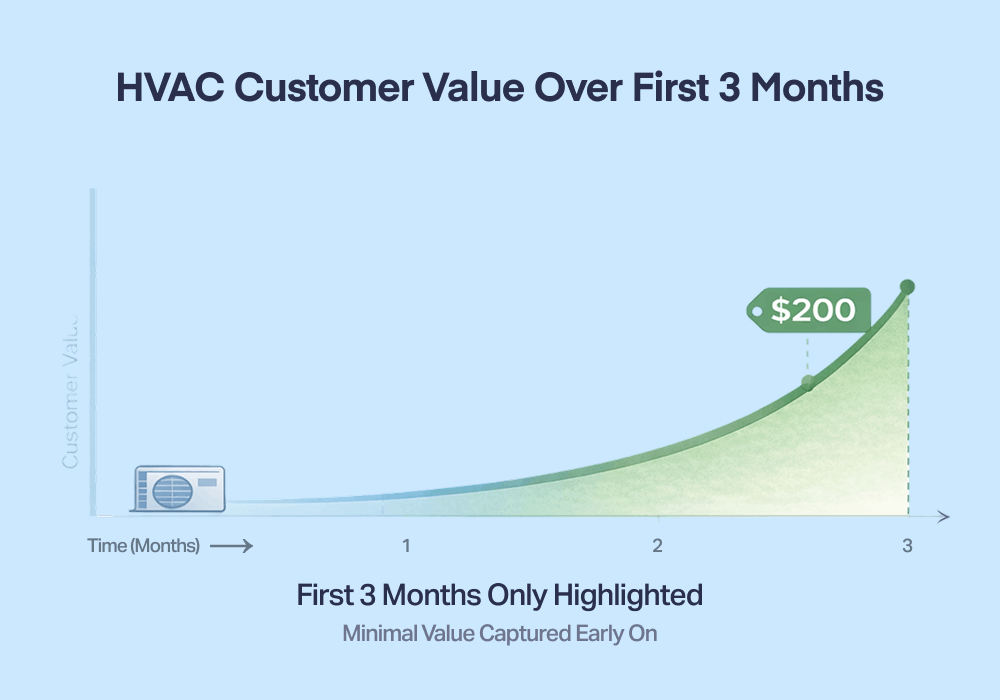
Months 0–3: The "Efficiency Trap"
You launch new Local Services Ads (LSA) and PPC campaigns.
- The Cost: Leads are expensive ($50–$250).
- The Job: Many are emergency repairs, tune-ups, or filter changes ($89–$300).
- The Reporting: ROI looks tight. You might even be breaking even.
- The Danger: Pressure builds to "optimize" or cut spend because the immediate return looks thin.
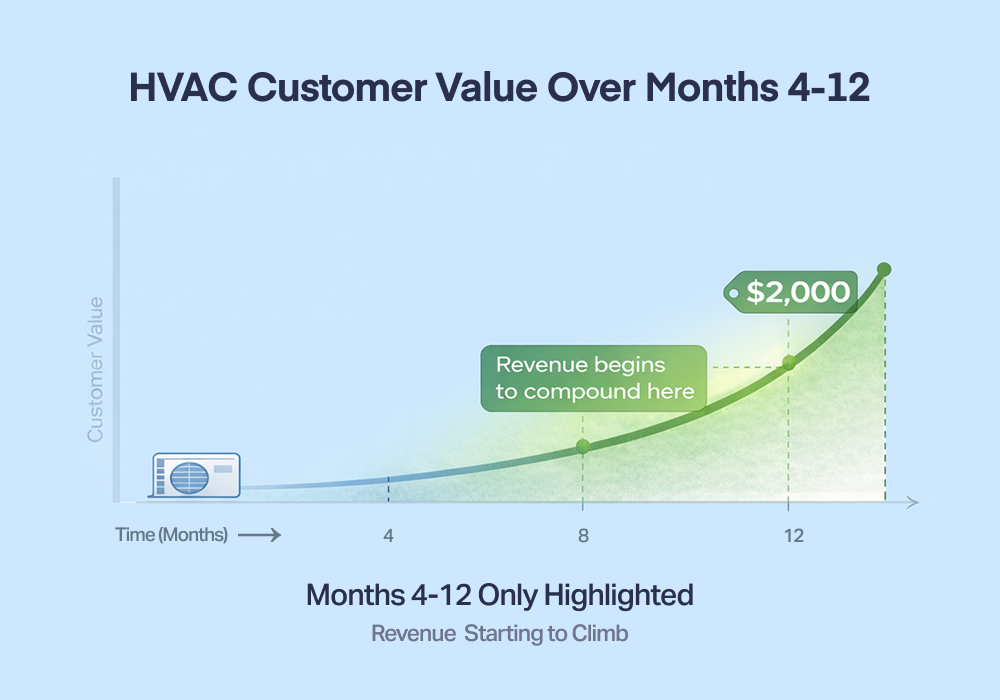
Months 4–12: The "Trust Phase"
The immediate emergency is fixed. Brand recognition increases.
- The Shift: First-time customers rebook for seasonal checks.
- The Revenue: Close rates improve because they already know you. Maintenance memberships begin.
- The Attribution Failure: Revenue per customer rises, but the original campaign that bought the customer no longer gets credit.
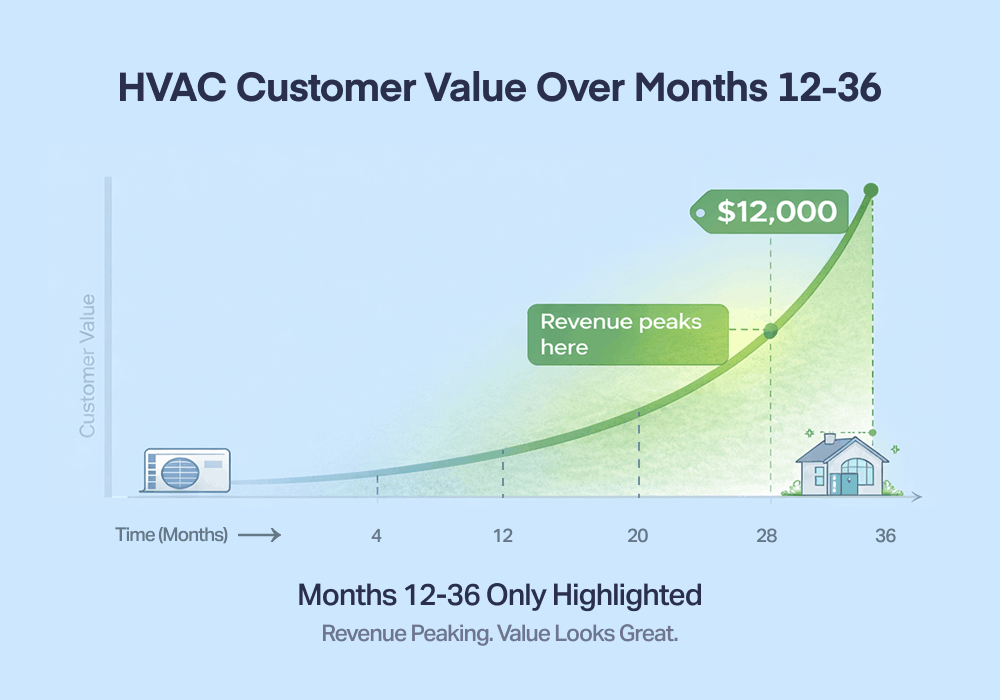
Months 12–36: The "Profit Phase"
This is where the real money is made.
- The Compound: Maintenance agreements compound.
- The "Whale": Replacement cycles mature. That $300 repair lead from Year 1 becomes a $15,000 system replacement in Year 2.
- The Multiplier: Referrals accelerate.
- The Reality: Marketing is evaluated only on Year 1 performance, completely missing the windfall in Years 2 and 3.
The Simple Math That Exposes the Lie
If you judge your marketing based on the "Year 1" view, you will inevitably underinvest.
The "Accounting" View (Year 1 Only):
- Marketing Spend: $300,000
- Attributed Revenue: $360,000
- ROI: 1.2x
- Conclusion: "Marketing barely works. Let's cut the budget."
The "Revenue" View (Years 1–3):
- Year 1 Revenue: $360,000 (Acquisition)
- Year 2 Revenue: $900,000 (Replacements/Maintenance from same cohort)
- Year 3 Revenue: $1.2 Million (Referrals/Replacements from same cohort)
- True ROI: 8.2x
- Conclusion: Marketing didn’t "barely work." It created a multimillion-dollar asset.
Marketing created the demand. Accounting just reassigned the credit.
The Fix: Stop Trusting Your CRM for Marketing Data
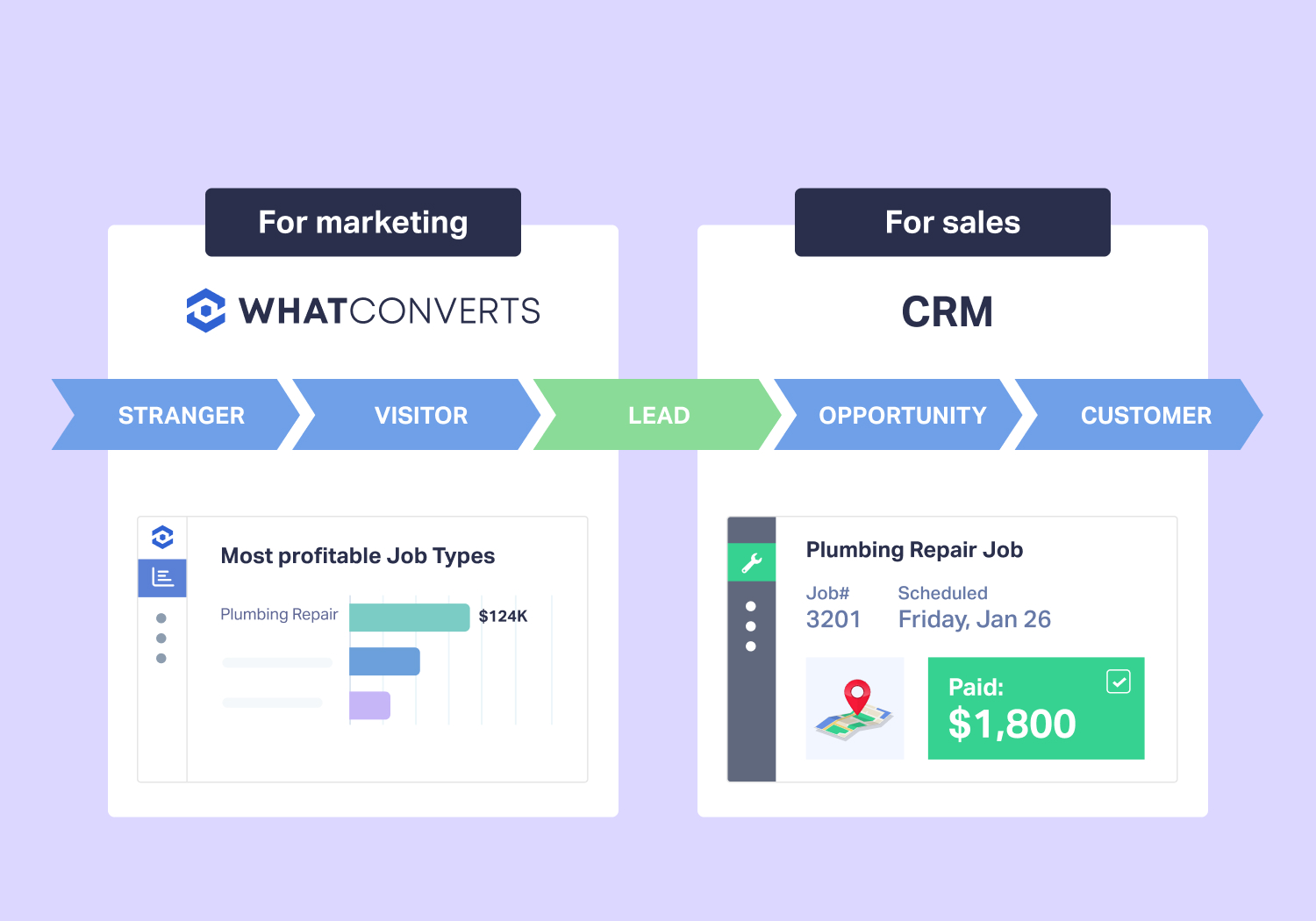
The reason the 6-Month Lie exists is that most HVAC companies rely on their FSM or CRM (like ServiceTitan or Housecall Pro) to track marketing performance.
This is a mistake. CRMs are built to manage current customer relationships, not historical lead origins. They are designed to overwrite data as the customer status changes (from "Lead" to "Customer" to "Renewal").
To fix your attribution, you need to separate your Lead Tracking from your Customer Management.
1. Don't Rely on a CRM for Marketing Data
CRMs are great for operations, but terrible for attribution. When a customer converts, the CRM often overwrites the "Source" field or archives the original lead data.
- The Fix: Treat your CRM as the tool for Sales and Operations, not marketing measurement. You need a dedicated system that "locks" the original source data forever, regardless of how many times the customer status changes in the CRM.
2. Find a Lead Tracker with "Forever Attribution"
You need a system that tracks the Full Customer Journey, not just the last click.
- The Fix: Use a dedicated lead tracking platform like WhatConverts. WhatConverts assigns a permanent record to every lead. If a user clicks a Google Ad today, calls you, and then buys a system three years from now, WhatConverts remembers the original ad click and every other touchpoint.
- Why it matters: It bridges the gap between the $89 repair (today) and the $15,000 replacement (in 18 months). The credit for the replacement flows back to the original ad, proving the true long-term ROI.

3. Measure "Business Value Earned," Not Vanity Metrics
Stop optimizing for "Lead Volume" or "Low CPL." These are vanity metrics that encourage you to buy cheap, low-quality leads that never turn into replacements.
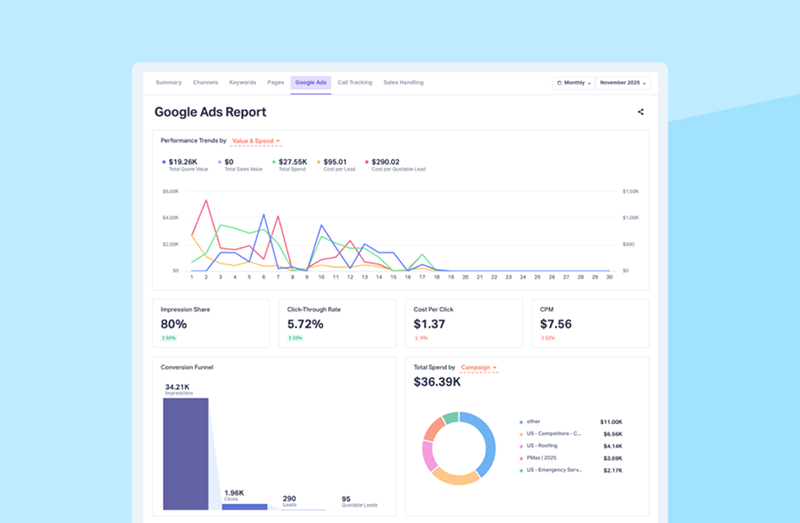
- The Fix: Focus on Business Value. WhatConverts allows you to assign specific Sales Value or Quote Value to every lead.
- The Result: You can see that "Campaign A" generated 50 cheap leads (total value $5,000), while "Campaign B" generated only 10 expensive leads (total value $150,000). Without value tracking, you’d cut Campaign B. With value tracking, you double it.
The Revenue Lag Audit Checklist
Are you falling for the 6-Month Lie? Run this quick check:
- Check Your Attribution Window: Is your Google Ads lookback window set to 30 days? If your sales cycle for replacements is 18 months, you are blind to 95% of the data.
- Audit "Existing Customer" Revenue: Pull a list of "Existing Customer" sales from last month. Trace 10 of them back to their first contact date. Did they originate from a paid campaign 12+ months ago?
- Track The "Whale" Lag: Calculate the average time gap between a customer's first "repair" invoice and their first "replacement" invoice. If that gap is >6 months, your reporting is broken.
Conclusion: Stop Optimizing for Minnows
Marketing ROI doesn’t disappear after six months. It starts compounding.
If your reporting system can’t connect the First Job, the Maintenance Revenue, the Replacement Revenue, and the Referral Revenue back to the original lead source, you aren’t measuring marketing ROI.
You’re measuring a fraction of it. And in HVAC, that fraction is the difference between a business that stalls and a business that scales.
Ready to track revenue across the full lifecycle?
Start your free 14-day trial of WhatConverts today or book a demo with a product expert to see how we help prove and grow your ROI.
Get a FREE presentation of WhatConverts
One of our marketing experts will give you a full presentation of how WhatConverts can help you grow your business.
Schedule a DemoGrow your business with WhatConverts