

 Amanda Pell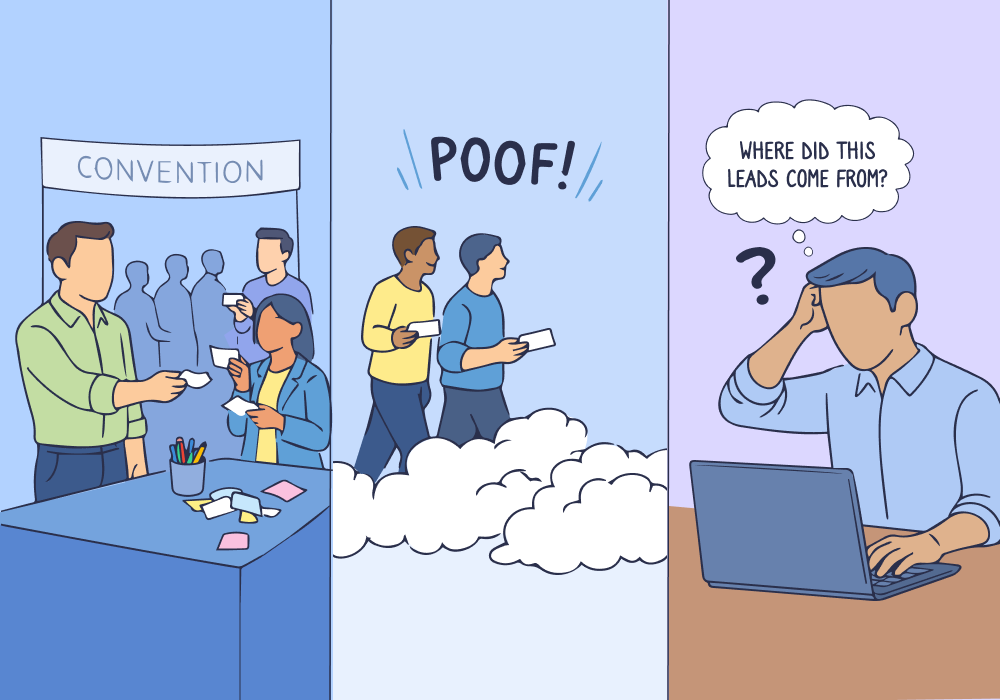
Two weeks after your agency's sponsored event booth, you're looking at a dashboard showing increased direct and organic traffic—with no way to tell whether the event is responsible.
Leads are coming in, but you can't prove the (expensive!) sponsorship drove any of it. Did this actually generate enough revenue to cover the cost?
You don’t know.
The event worked, but the attribution didn't. No attribution means no way to tell whether those event sponsorships are pulling their weight.
This article walks through how to build trackable conversion paths into your event presence so that first-touch attribution gets captured while intent is highest, and every downstream touchpoint stays connected back to the room where it started.
Note: Not a WhatConverts user yet? Start your free 14-day trial of WhatConverts today or book a demo with a product expert to see how we help prove and grow your ROI.
The Anatomy of a Lost Event Lead
Here's what typically happens after a sponsored event or conference:
- A prospect visits your booth and takes a business card
- They go home and put it on the back burner—interested, but not yet ready to book
- Three weeks later, they decide to reach out
- They search your brand name on Google and fill out a contact form
Your reporting attributes the lead to organic search. The event gets zero credit.
You got some leads, but how many? And what were they worth? Enough to make the $15,000 sponsorship worthwhile? No matter what your answer is, you’re guessing. And for a small business where event sponsorships represent a big chunk of the marketing budget, guessing is an expensive and risky habit.
Your Clients Have This Problem, Too
If you have service industry clients who also sponsor events, they likely have the same blind spot. And even if you don’t run their event marketing, that’s a problem for you, too.
When event leads later convert as an “organic” or “PPC” lead, your campaigns get the credit. That sounds like a good thing—until you're unknowingly increasing budget on keywords that are funneling warm event leads, while cutting spend on campaigns that are actually driving new business.
Solving event attribution for your clients keeps your campaign data honest—and opens a strategic conversation most PPC agencies never get to have.
The Fix: Bringing Digital Conversions into an In-Person World
The problem isn’t that attribution tools failed. It’s that no trackable action was initiated at the event. The prospect left the booth with your card and no mechanism that could follow them.
Here’s the problem: digital attribution follows digital actions—clicks, form fills, calls from a website. To track attribution from an in-person event, digital marketers need to use experiential design to bring those online conversion moments into the real world through tracking triggers like unique phone numbers, UTM-tagged QR codes, and SMS shortcodes.
There are two main strategies for doing this:
Strategy #1: Incentivize the Trackable Path
The Problem
When prospects leave an event and decide to reach out later, they'll default to whatever's most convenient—a Google search, a direct URL, a general phone number. None of those can be traced back to the event.
The Solution
Give prospects a means of contacting your company that tracks their conversion back to the event. An event-specific tracking number printed on a brochure or business card means that whenever a prospect calls or texts—even weeks later—that lead is automatically attributed to the event.
The Design Challenge
The lowest-effort path is always a Google search. If there's no reason to use the number on the brochure over just searching, it won't get used. The trackable path needs something attached to it that makes it worth taking.
How to Do It
Create uniquely trackable conversion paths for events. Print new collateral for different events so each gets its own tracked contact methods—unique phone numbers, SMS shortcodes, event-specific landing page forms, or discount codes for online bookings.
Attach an offer to the tracked path. Something like “Text ESTIMATE to 555000 for 10% off your first service” gives prospects a reason to dig out the brochure from the event instead of just Googling.
Add a deadline to increase urgency. "Call by [date] to lock in your event weekend discount" or "First ten form submissions get a free consultation" increases the likelihood that prospects convert before they lose your collateral.
Strategy #2: Build an In-Person “Pseudo-Conversion”
The Problem
If you want to start the tracked lead journey at the event instead of waiting until prospects convert, you need a trigger action they can take in person. Unfortunately, most event attendees aren’t ready to perform a “true” conversion (like a form fill or an appointment booking) while standing in front of a booth.
The Solution
Create a "pseudo-conversion"—a tracking trigger that opens the digital tracking window now, so that when a prospect converts days or weeks later, it's still tied back to the event. A UTM-tagged QR code is the clearest way to do this: the scan itself isn't a conversion, but it plants the attribution cookie that ensures the conversion gets credited to the event.
The Design Challenge
The trigger action has to offer the prospect something. Passive CTAs like “visit our website” or “follow us on social” ask prospects for their attention without giving anything back. Trade something they want in exchange for their engagement.
Examples
Give away something valuable. Offering a free or discounted service can help pre-qualify entrants, but at a busy in-person event sometimes you need to up the ante in order to catch even the most qualified buyer’s attention. “Scan to enter our end-of-season giveaway” is good, but “scan for a chance to win a $300 pair of headphones” is better.
Showcase something worth looking at. For visually-driven services—landscaping, pool installation, website design—a simple “scan to see our portfolio of this year’s best projects” can be compelling enough to earn engagement, especially at events where attendees have a few minutes to browse between activities.
Pitch it as a 30-second qualification tool. Especially for legal and medical industries, “scan to see if you qualify for a free consultation” trades immediate value for the interaction.
How WhatConverts Follows the Lead From There
Once a trackable first touch exists, WhatConverts does the heavy lifting.
Every time that prospect returns—through organic search, a direct visit, a call weeks later—WhatConverts connects that activity to the original event. The lead record shows the full customer journey, from first interaction at the conference to the final conversion.
Which means when it's time to evaluate whether the $15,000 sponsorship is worth renewing, you’ll have more than just a guess—you’ll have a lead report with attributed contacts, quote values, and closed revenue traced back to the conference.
Ready to connect event spend to closed revenue?
Start your free 14-day trial of WhatConverts today or book a demo with a product expert to see how we help prove and grow your ROI.
Get a FREE presentation of WhatConverts
One of our marketing experts will give you a full presentation of how WhatConverts can help you grow your business.
Schedule a DemoGrow your business with WhatConverts