







































 Amanda Pell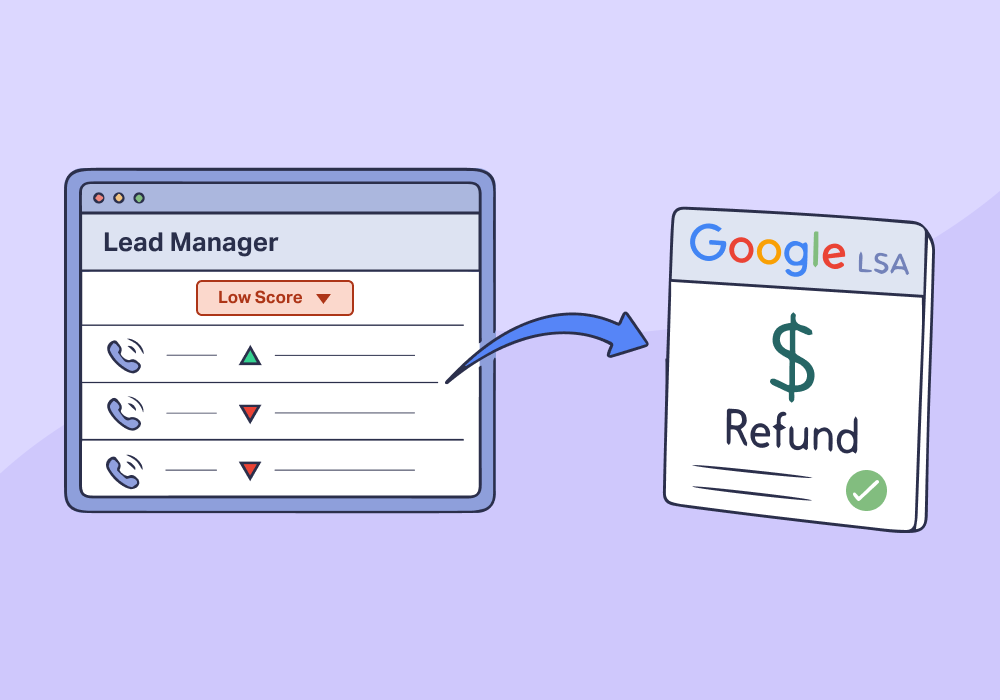
LSA refunds are supposed to be easy money. Google charges you for bad leads, the automated system catches them, you get a credit. Simple.
Except one agency's audit found Google's automated process only flagged 35% of credit-eligible leads—and refunded just 7%. When they manually submitted the rest, they recovered 3.5x more credits than Google's automation had issued on its own.
So LSAs still require manual review. But here’s the problem: to find credit-eligible leads, someone has to listen to every call. For a high-volume client with hundreds of leads a month, the labor cost is more than the LSA credits are worth.
That’s the LSA trap: the money's on the table, but it costs too much to pick it up.
This article shows how agencies can set up their own automated lead scoring to accurately identify and rate LSA leads at scale—recovering more credits without the manual overhead.
Note: Not a WhatConverts user yet? Start your free 14-day trial today or book a demo with a product expert to see how we help prove and grow your ROI.
The Real Problem: You Can’t Keep Up
The issue isn't that lead review is difficult; it's that it never stops.
Google Local Service Ads have tripled in search volume over the past three years. More volume means more unqualified calls—and more calls to screen before you can rate or submit a single one. The feedback window is tight, too. Leads flagged early are more likely to result in credits and influence future targeting.
So something has to give: either you spend hours each week reviewing calls, you rush through and miss credit-eligible leads, or you fall behind entirely.
None of those are good options.
The economics only work if you can dramatically shrink the review time. And that means cutting out the manual listening almost entirely.
What Happens When Lead Review Slips
When you can’t keep up, the problem goes from annoying to expensive. When leads go unreviewed and unrated—good or bad—Google fills in the blanks itself:
- Credits that should have been issued aren't
- Google assumes uncharged leads were good matches
- The budget starts to leak
- Performance begins to degrade
Now you’re not just dealing with bad leads—you’re paying for them, and telling Google to bring you more.
Bad Leads Degrade Targeting
This is the real consequence that most agencies miss: LSA doesn’t just charge you for leads. It learns from them.
If bad leads consistently go unflagged, the system treats them as acceptable. Over time, that changes what kind of leads you get.
So the issue isn’t just “we didn’t flag a few bad calls.” It becomes “we’re slowly training the account to send us more of them.”
The Fix: Score First, Listen Later
The insight is simple. Most credit-eligible LSA calls share the same characteristics:
- Short duration (under 60 seconds, not enough time for a real service inquiry)
- Missing intent keywords (no mention of "appointment," "quote," "schedule," "estimate")
- Signals of irrelevance: callers mentioning wrong numbers, existing customer issues, or out-of-scope requests
Instead of listening to every call to find these signals, you can flag them automatically—and only review the flagged ones.
That's the shift from "review everything" to "review only what's likely disputable." In practice, it collapses hundreds of calls into a short, high-confidence list.
How WhatConverts Automates the Process
WhatConverts's Lead Scoring and Lead Intelligence features handle the flagging automatically.
Lead Scoring lets you assign point values to leads based on specific criteria. For LSA rating purposes, a typical scoring setup might look like:
| Criteria | Points |
| Call duration < 30 seconds | −30 |
| Call duration > 60 seconds | +30 |
| Keywords: "quote," "schedule," "appointment" | +50 |
| Keywords: “wrong number,” “already a customer” | −40 |
| Visited a service page before calling | +15 |
Lead Intelligence then applies those rules automatically—scoring every incoming lead without manual input. No one needs to listen to calls to assign scores. The system does it as leads come in.
From there, it’s straightforward: filter by low Lead Score to surface calls most likely to be credit-eligible and review only those to confirm. High-scoring leads can be confidently rated as good matches without manual review, no listening required.
The result is complete coverage in both directions: bad leads flagged for credits, good leads reinforcing the signals that drive quality traffic. Instead of listening to 400 calls, you're listening to 20.
That's the 90% reduction in review time.
Learn More: Lead Intelligence: The Smarter Way to Score, Qualify, and Value Your Leads
Proof: 5 Fold Marketing Recovered $18,000
5 Fold Marketing, an Arizona-based agency, manages LSA campaigns for a large HVAC client generating hundreds of calls per month. Manually reviewing every call to identify low-quality leads wasn't sustainable at that volume.
Using Lead Scoring and Lead Intelligence in WhatConverts, 5 Fold automated the flagging process. Their team used transcript-based lead scores to filter down to only the calls most likely to be low quality. Review time dropped by 90%.
The result: $18,000 in LSA refunds recovered in 2023 for a single client account, with a 90% reduction in manual call review time.
The agency also discovered a secondary benefit: comparing Lead Scores to the client's close rates exposed sales process problems. High scores and good quote volume, but revenue was down—something was breaking after the sales handoff, and the data made it visible.
Read More: $18K in LSA Refunds: Automation Cuts Review Time by 90% [Case Study]
The Complete Workflow
Once Lead Intelligence is configured, the process runs on autopilot:
- Every LSA call is tracked and transcribed with full source attribution.
- Lead Intelligence scores each call against your qualification criteria automatically.
- Filter your Lead Manager by low Lead Score to surface calls worth a dissatisfied rating.
- Review only flagged calls—a fraction of total volume—to confirm before submitting.
- Rate consistently with confidence, training Google’s algorithm with accurate signals every billing cycle.
The manual bottleneck disappears. What used to take hours takes minutes.
Stop Letting Bad Leads Train the Algorithm
Accurate, consistent lead rating doesn't just recover individual credits. It continuously narrows the pool of callers Google targets—which means fewer wasted leads over time, better average lead quality, and a lower effective cost per qualified lead.
When the process is manual, most agencies either skip rating entirely or underinvest in it. When it's automated, it actually gets done—and when it gets done consistently, the algorithm gets smarter.
Ready to automate LSA ratings and get more out of your reporting stack?
Start your free 14-day trial of WhatConverts today or book a demo with a product expert to see how we help prove and grow your ROI.
Get a FREE presentation of WhatConverts
One of our marketing experts will give you a full presentation of how WhatConverts can help you grow your business.
Schedule a Demo
Grow your business with WhatConverts