












































 Amanda Pell
Marketers have never had more resources, more tools, more data, more AI capabilities.
Yet their confidence has never been lower.
Funnel's 2026 Marketing Intelligence Report reveals a striking disconnect: when asked to grade themselves, marketers gave themselves a mediocre 82% on average. That’s a B-.
For an industry stacked with martech platforms, AI tools, and increasingly sophisticated dashboards, that grade tells a revealing story. Teams are producing more output than ever, but struggling to prove that it meaningfully impacts revenue.
Something fundamental isn't connecting. And the problem isn't lack of effort—it's the inability to prove (even to themselves) that their marketing actually impacts the bottom line.
Data Volume Has Outpaced Decision Clarity
Modern marketing teams are not constrained by information. They are surrounded by it.
According to the report:
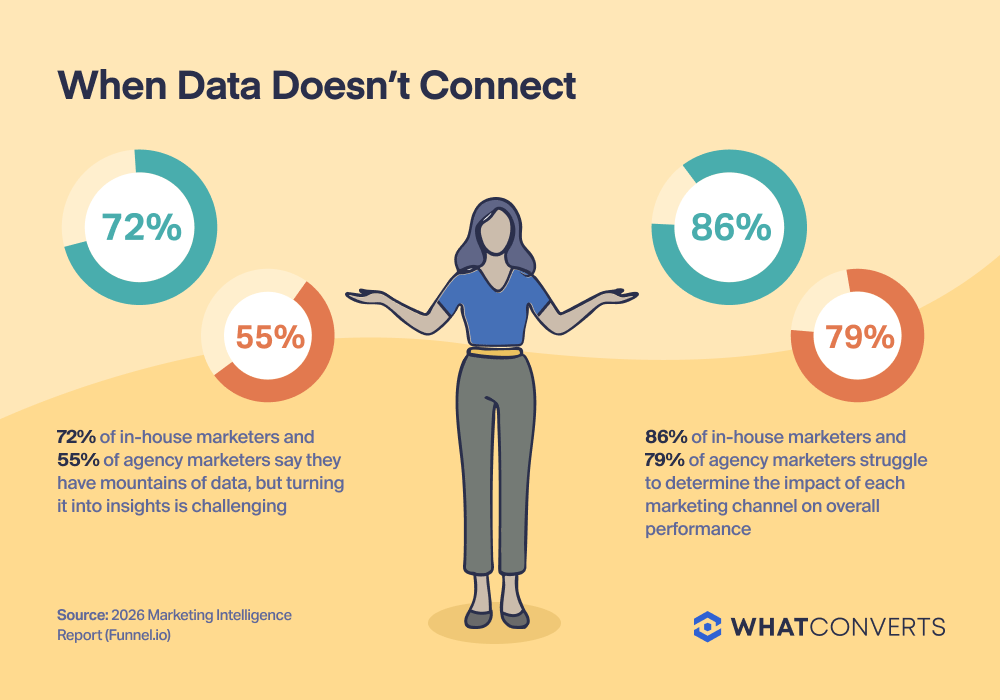
- 72% of in-house marketers and 55% of agency marketers say they have mountains of data, but turning it into insights is challenging
- 86% of in-house marketers and 79% of agency marketers struggle to determine the impact of each marketing channel on overall performance
One quoted marketer puts it bluntly: "We're drowning in information, but what's the insight? What's the action that needs to be taken?"
The tools promised clarity but delivered chaos.
Analytics platforms, CRMs, call tracking systems, and form tools each report accurately within their own boundaries. But when a client asks which campaign is actually driving revenue, most marketers can only offer educated guesses dressed up as data.
Effort-Based Reporting vs. Results-Based Proof
Marketing measurement continues to rely heavily on indicators of activity:
| What they do track: | What they can’t track: |
| Clicks generated | Which leads actually closed |
| Impressions delivered | What revenue each campaign generated |
| Forms and calls received | Which channels drive real customers |
Tracked metrics provide reassurance that campaigns are functioning and pipelines are moving. They fail to prove anything when it comes to actual business impact.
This creates what Funnel calls "progress without transformation"—teams producing impressive dashboards that reveal nothing about what to do next.
Worse, 41% of in-house marketers admit they don't analyze the "why" behind their results. They document what happened without investigating root causes or identifying next steps.
They're maintaining the status quo rather than driving growth.
When "Doing More" Doesn't Equal "Mattering More"
AI and automation now play a central role in campaign execution and optimization. Platforms promise efficiency, scale, and smarter decision-making.
The report shows mixed confidence in those promises:
- 39% of agency marketers and 23% of brand marketers say AI tools create repetitive, generic campaigns
- 47% of in-house marketers find it difficult to keep up with the data-driven aspects of their work
- Yet only 30% use automation to handle repetitive SEO and optimization tasks
AI promised to free marketers for strategic work. Instead, it's amplifying the measurement problem. When the inputs are messy and attribution is broken, AI just produces faster, more confidently wrong answers.
The Missing Link: Connecting Leads to Revenue
The gap between effort and confidence comes down to one problem: marketers can't connect their work to actual business outcomes.
Platform dashboards show conversions. But "50 new leads" means nothing without knowing:
- Which ones qualified
- What they were worth
- Which campaigns generated revenue versus noise
Without that connection, every campaign decision is a guess. Every budget allocation is a gamble. Every client conversation is defensible only through vanity metrics.
This is why confidence stays stuck at 82%. Not because marketers aren't working hard enough, but because they can't prove their work matters.
The Solution: Turning Data Into Confidence
Rather than adding another layer of reporting, the fix involves rebuilding the feedback loop between marketing effort and business outcomes so decisions are based on proof, not assumptions.
Here’s what that looks like in practice.
1. Restore visibility to individual leads, not aggregates.
Most reporting answers the question “Did something happen?” Confident marketers need to answer “What exactly happened, and why?”
That starts by seeing each call, form, and chat as a real interaction with context:
- Where it came from
- What campaign influenced it
- How the prospect engaged
When leads are visible individually (not buried inside blended metrics), patterns emerge that never show up in top-level reports. You can see which campaigns consistently produce real conversations and which ones quietly generate noise.
2. Separate meaningful data from activity noise.
More tools have made it easier to generate activity, but harder to tell what matters.
Confidence improves when marketers can clearly distinguish:
- Interactions that move toward revenue
- Interactions that stall, bounce, or go nowhere
This isn’t about labeling leads for the sake of organization. It’s about understanding which signals correlate with real outcomes and which ones distort decision-making. Once that distinction is clear, optimization stops chasing volume and starts prioritizing impact.
3. Connect outcomes back to the decisions that caused them.
This is where confidence either clicks or collapses.
When a lead turns into a booked job, a signed contract, or real revenue, that outcome needs to trace back to:
- The campaign that introduced the prospect
- The keyword or channel that influenced the action
- The budget decision that enabled it
Without that connection, marketers are left defending spend with proxies. With it, they can explain, plainly, which decisions paid off and which didn’t.
4. Let that clarity shape future decisions automatically.
Once outcomes are visible and trustworthy, they stop being historical artifacts and start becoming inputs.
Instead of reacting to last month’s numbers, confident teams feed real performance signals back into their optimization systems. Campaigns begin adjusting based on what actually produces results—not just what generates clicks, impressions, or raw conversions.
The result isn’t just better performance. It’s fewer second guesses, fewer defensive conversations, and far more certainty about where to invest next.
How WhatConverts Makes This Standard
Most platforms stop at conversion tracking. WhatConverts connects marketing to revenue.
- Multi-touch attribution shows the complete customer journey from first click to closed deal
- Lead qualification identifies which conversions actually matter to the business
- Value tracking assigns dollar amounts to opportunities, not just tallies
- Automated syncing sends qualified lead data back to Google Ads and Meta for smarter bidding
The result? Marketers who know, not guess, which campaigns drive growth. Agencies who can prove ROI with actual revenue numbers. Teams who optimize based on business outcomes instead of vanity metrics.
That's how confidence moves from 82% to certainty.
Measurement Determines Confidence
Marketing performance has advanced faster than marketing measurement.
As tools multiply and automation accelerates, confidence depends increasingly on feedback quality. Clear outcome signals support decisive action. Fragmented data encourages caution.
When every lead is captured, evaluated, and connected to value, performance discussions change. Optimization sharpens. Budgets become easier to justify. Confidence stabilizes.
That shift begins with measurement.
Turn lead data into revenue clarity.
Start your free 14-day trial of WhatConverts today or book a demo with a product expert to see how we help prove and grow your ROI.
Get a FREE presentation of WhatConverts
One of our marketing experts will give you a full presentation of how WhatConverts can help you grow your business.
Schedule a Demo
Grow your business with WhatConverts