








































 Amanda Pell
Marketing teams are being asked to do something impossible: deliver more work, across more channels, with the same (or fewer) people.
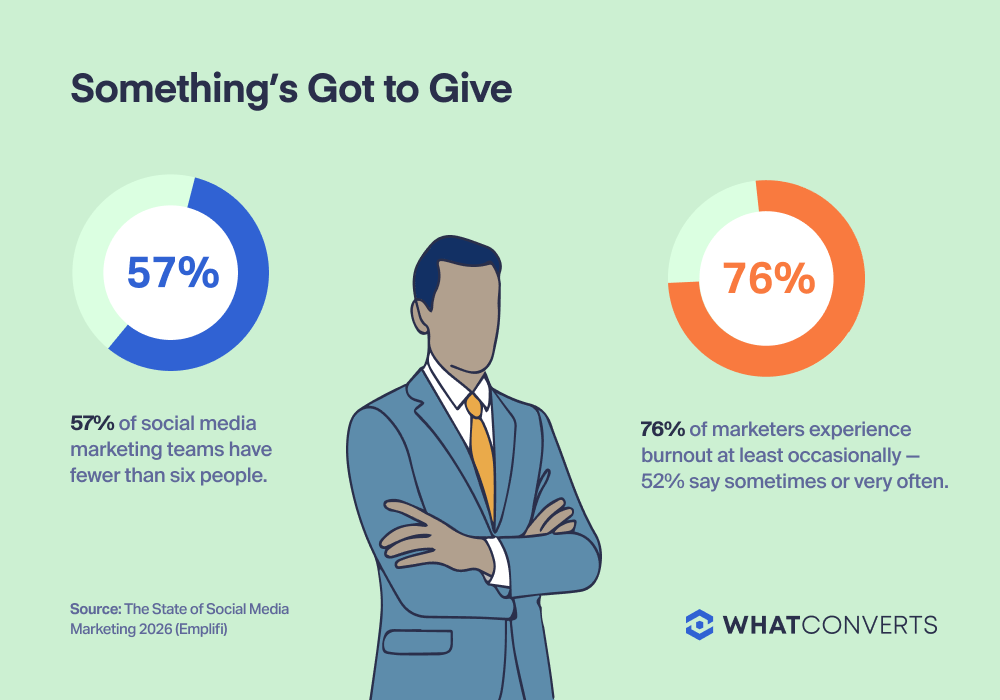
Teams are getting smaller: according to Emplifi, 57% of social media teams now have fewer than six people.
But while headcount is shrinking, expectations aren’t. Burnout is becoming standard operating procedure: 76% of marketers say they experience burnout at least occasionally—and over half say it happens sometimes or very often.
The issue isn’t motivation, skills, or productivity; it’s capacity.
If the workload grows and the team doesn’t, burnout is inevitable—unless you introduce tools that give time back by removing unnecessary manual work.
The Capacity Problem: More Demand, Same Resources
Marketing has always been demanding, but 2026 amplifies the strain.
Teams that once handled one or two primary channels now manage entire ecosystems: TikTok, Instagram, LinkedIn, paid search, email, video, and more. Expectations rise; budgets don’t. Fifty-six percent of teams operate with six people or fewer, yet the workload grows by the quarter.
The Emplifi report shows that marketers know exactly where the pressure lands:
- 45% of marketers say they need more headcount
- 41% want better cross-team collaboration
- 36% need more streamlined tools
But most teams won't get more headcount. Budgets are tight. Hiring freezes are common. So marketers are left doing more with less, and it's grinding them down.
When you're managing five platforms with three people, something always slips. Content gets rushed. Reports get delayed. Strategy gets sacrificed for execution.
The issue isn’t the workflow. It’s the simple fact that the team no longer has enough capacity to meet the demand.
Why Burnout Accelerates When Tools Fight You
Juggling tools doesn’t just waste time. It also multiplies effort.
A marketer running campaigns across Google Ads, Meta, call tracking, and analytics doesn't have "four tools." They have four dashboards, four export processes, four data formats, and four versions of the truth that rarely match.
Every question becomes a research project:
- "How many leads came from that campaign?" = Export from Google Ads
- "Which ones were qualified?" = Check the CRM
- "What did they say when they called?" = Log into call tracking
- "What's the ROI?" = Build a spreadsheet and hope the numbers align
None of that is the work marketers are hired to do. It’s just manual maintenance, and it pulls focus from everything that matters.
When attribution lives in one place, lead details in another, and reporting in a third, every insight demands manual labor. Every decision comes with doubt because the data never quite syncs.
The fix isn't working harder. It's working with tools that do more, so marketers do less.
The Fix: Platforms That Consolidate, Not Complicate
When the workload grows but the team doesn’t, the only way to keep up is to remove work that doesn’t move results. Marketers don’t need a new process—they need clearer information that reduces the work they already have.
Here’s what that looks like:
1. Start by making lead value visible
Teams lose time treating every lead the same because nothing distinguishes the good from the bad.
WhatConverts surfaces the signals that matter—what was said on the call, the service requested, the strength of intent—so value becomes obvious instead of something you hunt for.
2. Identify which efforts consistently produce valuable leads
Once value is visible, you can see which channels, campaigns, and keywords generate the leads that move revenue—not just the ones that create activity.
What used to require stitched-together exports now appears in one place.
3. Shift resources to what reliably drives outcomes
Once you can see which leads have real value and where they come from, you can redirect both time and budget toward the efforts that consistently produce meaningful results.
Teams stop spreading themselves thin across everything and start concentrating attention—and spend—on the work that actually moves revenue.
4. Remove the work created by unclear data
The biggest time drain isn’t the reporting itself—it’s retrieving, validating, and reconciling scattered information.
When WhatConverts handles value and attribution automatically, that background noise disappears.
One platform. Less chaos. More clarity.
When tracking, qualification, reporting, and optimization live in one system, marketers aren't juggling tools—they're driving results.
What Increasing Capacity Looks Like in Practice
Before streamlining their workflow, Nablasol, a performance-focused digital agency, was managing lead data across scattered systems. They had the insights they needed, but getting to those insights required time-consuming exports, manual reconciliation, and constant back-and-forth between tools.
As their client roster grew, so did the strain on the team.
After moving to WhatConverts, Nablasol gained a single place to track, qualify, and understand every lead. Reporting became faster, data became easier to work with, and the team spent far less time assembling information and far more time using it.
With clearer visibility and less manual effort, they were able to:
- 20% increase in qualified leads
- 25% lift in customer engagement for their client
- Significant time saved in reporting and analysis
These improvements didn’t come from adding headcount or expanding hours. They came from removing the work that had been slowing the team down. By consolidating into one platform, Nablasol reclaimed time, improved decision-making speed, and delivered stronger results for their clients.
That’s the real advantage of a unified platform: when the manual work disappears, the team finally has the time to do the work that moves results.
Read More: Tech Firm Enhances & Automates Agency’s Affiliate Conversion Tracking [Case Study]
The Bigger Picture
Teams are shrinking, but expectations aren't. And tool sprawl is making the gap worse.
The agencies that survive won’t be the ones with the biggest teams. They’ll be the ones with the smartest workflows—platforms that eliminate manual tasks, unify data, and let small teams punch above their weight.
When your tools handle tracking, qualification, reporting, and optimization in one place, burnout stops being inevitable.
It's not about doing more. It's about your tools doing more for you.
Stop fighting fragmented data and tool chaos.
Start your free 14-day trial of WhatConverts today or book a demo with a product expert to see how we help prove and grow your ROI.
Get a FREE presentation of WhatConverts
One of our marketing experts will give you a full presentation of how WhatConverts can help you grow your business.
Schedule a Demo
Grow your business with WhatConverts