


 Amanda Pell
When most people say "lead management," they mean sales-side lead management: nurturing a lead through the pipeline to close the deal. That's what sales CRMs are built to do.
It's also only half the job.
In reality, lead management starts with the initial marketing conversion and follows the lead through every brand interaction after it. That trail tells marketers which leads are most qualified and valuable, as well as which marketing engines produced them, so they can double down on the campaigns likely to generate more top-quality prospects.
By the time those leads reach sales, they've been filtered and cleaned, so reps can immediately prioritize lead nurture based on which prospects offer the most ROI.
This guide covers what lead management is, what both teams gain when it starts at the first conversion, and how to set up a lead tracking system that keeps every lead tied to its source and value.
What Is Full-Funnel Lead Management?
Lead management is the process of capturing leads, assessing their quality, and guiding them toward becoming customers. Most tools handle only the back end of that process: the lead already exists as a contact in a CRM, and it’s the sales rep’s job to score, assign, and nurture it to a close.
But a lead doesn't begin life when it hits the CRM. It begins as a call, form, or chat, triggered by an ad, a search, or a campaign that marketing built and paid for.
Full-funnel lead management covers that whole arc, from the first marketing conversion through the close, instead of picking the lead up halfway. That's the only view that connects what a lead becomes to the marketing that created it.
Related Reading: CRM Tools Aren't Just for Sales: Why Marketers Need CRMs Too
The Two Halves of Lead Management
Lead management consists of two connected processes that occur before and after the sales conversion.
Sales-side lead management picks up after a lead exists. The goal is to move that lead to a close: nurture it, answer questions, handle objections, track it through stages. This is the familiar half, and the CRM is its home.
Marketing-side lead management starts with the marketing conversion (an ad click, chat session, informational call, or form submission) and covers everything up to and through the moment the lead is handed off to sales. The goal is to gain visibility on two things:
- The nature of the lead (whether it’s qualified and how much it’s worth)
- What source produced it (which channel, campaign, keyword, and landing page brought them in).
This is the half that usually has no tool and no owner, so it either gets done in spreadsheets, or not at all.
| Marketing-side | Sales-side | |
| Starts | Before and at conversion | After conversion |
| Question it answers | What created this lead, and what's it worth? | How do we close this lead? |
| Lives in | Lead tracking / attribution | CRM / pipeline |
| Owner | Often nobody | Sales |
The two halves aren't rivals. They're a relay: marketing's half ends exactly where sales' half begins, at the handoff of a freshly converted lead.
The problem is that when the marketing half is missing, that handoff carries a name and a phone number and nothing else. With no source, no context, and no value, sales inherits a stranger.
Related Reading: Marketing and Sales Alignment: Bridging the Lead Handoff Gap
The Lead Management Process, End to End
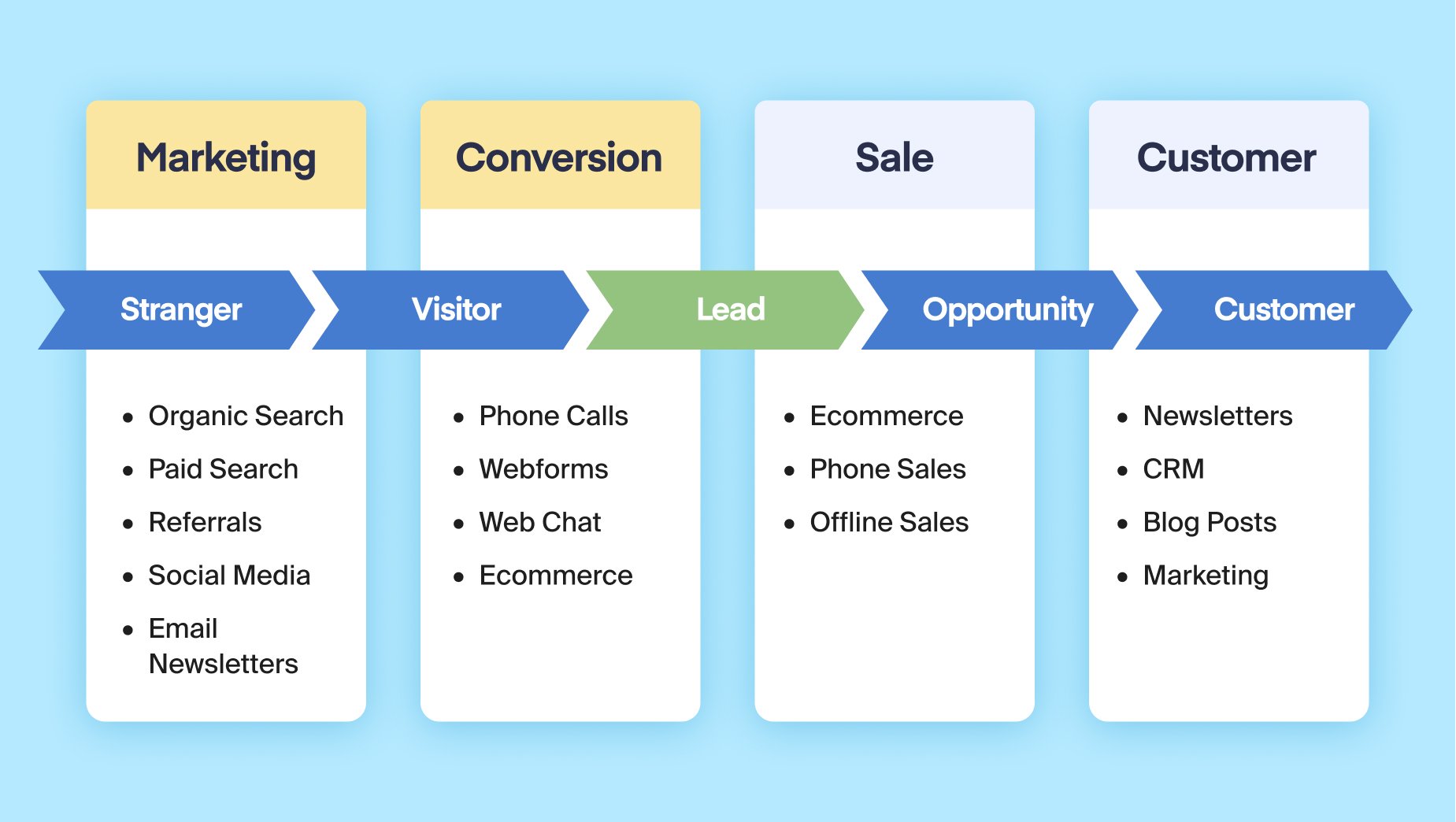
A lead moves through five stages on the way to becoming a customer, and the two halves of lead management map cleanly onto them.
- Stranger: Someone who doesn't yet know your business. Marketing reaches them through paid search, organic, referrals, and other channels.
- Visitor: They arrive on the site. Marketing's job is to move them toward a conversion action: a call, a form, a chat.
- Lead: They convert, and in converting they reveal what they want and what they're worth: the service they asked about, the budget they mentioned, the form they filled out. When lead management starts with marketing, this data is documented and used to prequalify leads, filter out nonstarters, sort opportunities by job size ahead of the sales handoff.
- Opportunity: Sales nurtures the lead, answers questions, and qualifies intent until a purchase becomes likely.
- Customer: The lead buys. The goal shifts to repeat business, upsells, and referrals.
Marketing operates in stages one through three, while sales operates in stages three through five. The overlap is where the lead handoff occurs, and the more information marketing collects (source, intent, and value), the less sales has to qualify from scratch.
That visibility drives optimization. Feeding those lead values back into Google and Meta teaches their bidding to chase the conversions that generate revenue instead of the cheapest ones. Budget shifts toward value over volume, and the targeting sharpens with every new lead the platforms learn from.
Why Starting at the First Conversion Pays Off for Both Teams
Managing leads from the first conversion isn't just a marketing convenience. It improves outcomes on both sides of the handoff:
Marketers Gain Visibility They Can Act On
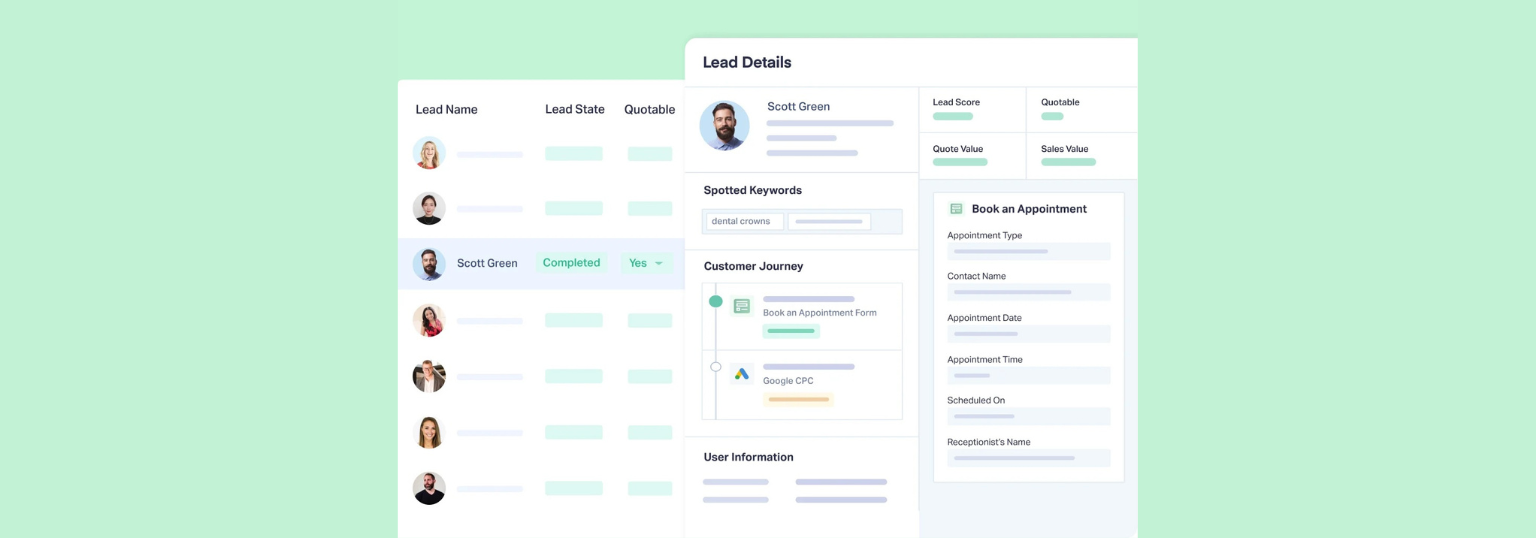
With every lead tied to its source, campaign, and keyword and tagged with a value, marketing can see which campaigns produce leads worth having, not just the most leads.
Sales Gains Better Leads (and the Context to Close Them)
Earlier qualifying keeps junk inquiries off reps' plates. And because each lead arrives with its history attached, what they searched for, which service they asked about, what they said on the call, reps open already knowing what the lead wants instead of starting cold.
Why a CRM Isn’t Enough
The benefits of end-to-end lead management are clear. The catch is that a CRM can't produce any of this. It manages leads it's been handed, but has no way of knowing what happened before the handoff, because that information was never collected. Something has to capture it at the source.
That's what a marketing lead management tool does. WhatConverts sits at the point of conversion, capturing every call, form, and chat, tying each back to the marketing that created it, and letting you qualify and value the lead before it reaches sales. The CRM still runs the sales half, but the marketing half finally has somewhere to live.
Related Reading: Why CRMs Can't Answer Marketing Questions
What This Looks Like in Practice
Say you're running marketing for a home services company that does siding replacement, spending across Google Ads, Bing, and Facebook, all pointing to a quote request form.
In most analytics, here's the full picture you get: how many form leads each channel drove last month.
| Channel | Form leads |
| 60 | |
| 42 | |
| Bing | 28 |
The conclusion is obvious: Facebook drives the most leads by a wide margin, so Facebook earns more budget.
Now here's the same month with WhatConverts, which tracks the marketing-side data that qualifies each lead and tags it with the value of the job requested:
| Channel | Form Leads | Qualified | Quote Value |
| 60 | 9 | $13,500 | |
| 42 | 26 | $92,000 | |
| Bing | 28 | 7 | $14,200 |
Now you see a completely different story: Facebook's 60 leads were mostly small repairs and nonstarters, and only nine were actually qualified. Google, on the other hand, drove fewer leads but far better ones, with 26 qualified and $92,000 in replacement quotes: nearly seven times Facebook's value.
If you were to pour budget into Facebook based on the first table’s data, you'd be funding the worst-performing channel.
That's the difference between counting leads and managing them. Same spend, but now you shift budget to Google, push those values back to the ad platforms so they bid toward the high-value jobs, and hand sales a list with the best leads already flagged.
Without it, all three channels look roughly the same, and you're optimizing on guesswork.
Related Reading: Send Quote Value with Google Ad Conversions
The Bottom Line
Lead management isn't just what happens in the CRM after a lead arrives. The more valuable, more overlooked half happens at the moment of conversion, where the lead is created and where its source and value can still be captured. Get that half right and marketing finally sees what's working while sales gets better leads with the context to close them.
If your leads are landing in your pipeline as strangers, it's because nobody's managing the marketing half.
Start your free 14-day trial of WhatConverts today or book a demo with a product expert to see how we help prove and grow your ROI.
Get a FREE presentation of WhatConverts
One of our marketing experts will give you a full presentation of how WhatConverts can help you grow your business.
Schedule a DemoGrow your business with WhatConverts