









































 Amanda Pell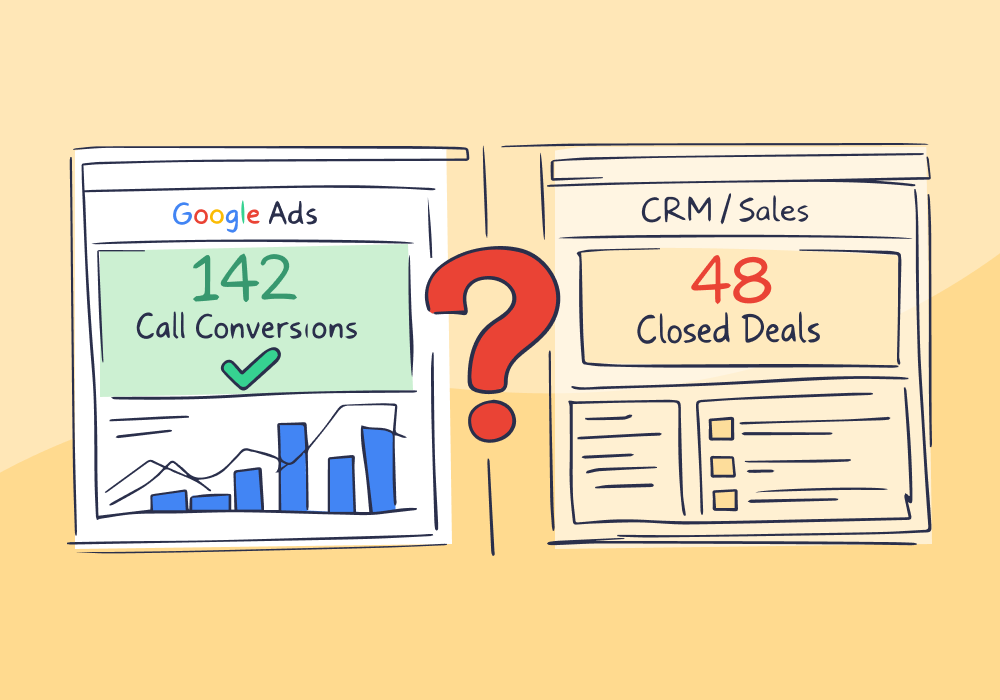
Google Ads reports 142 call conversions this month. Your client’s sales team reports 48 opportunities.
Which number should you believe?
Both are accurate—and that's exactly the problem.
Google Ads counts every call that meets its duration threshold. Sales counts every lead that turns out to be a real opportunity. These aren't conflicting measurements; they're just measuring completely different things.
And that 94-call gap between them is where optimization breaks down, client relationships erode, and budget decisions become guesswork.
This article explains why these numbers diverge, what each system actually measures, and how to bridge the gap so you can optimize campaigns based on pipeline generated instead of calls counted.
Note: Not a WhatConverts user yet? Start your free 14-day trial today or book a demo with a product expert to see how we help prove and grow your ROI.
The Numbers Aren't Wrong—They're Just Answering Different Questions
When Google Ads shows 142 conversions and sales reports 48 opportunities, the instinct is to ask which number is wrong. In reality, the answer is: neither.
Google Ads counts call events, while sales counts outcomes.
Those are fundamentally different measurements. And when nobody can reconcile them, three things break:
- Budget requests stall. You can't confidently ask for more spend when you can't prove which campaigns actually generate revenue.
- Client trust erodes. When marketing reports success but sales reports disappointment, clients question whether the agency understands their business at all.
- Optimization becomes guesswork. Without knowing which calls turned to opportunities, you're optimizing toward volume instead of value—spending more on campaigns that look good but don't perform.
The disconnect isn't that the data is wrong. It's that marketing platforms report what they can measure, and sales teams report what they can close, and those two datasets speak different languages.
For the complete breakdown of:
- How Google Ads call tracking actually works
- What it can and can't measure,
- What agencies need to think about when phone calls drive real revenue
Check out the full guide:
What Google Ads Is Built to Measure
Google Ads tracks what it can observe directly: user actions tied to ads.
A call conversion in Google Ads means a user clicked an ad, initiated a phone call, and met the call duration threshold (usually 60+ seconds).
That's where Google's visibility ends. Google Ads cannot natively observe:
- What was discussed during the call
- Whether the lead qualified
- Whether sales followed up
- Whether the prospect became a customer
This isn't a flaw. It's a design constraint. Google Ads optimizes toward actions it can measure immediately—clicks, impressions, calls initiated. It has no built-in mechanism to track what happens after the phone rings.
What Sales Teams Mean by "A Good Call"
Sales operates with a completely different definition of success.
For a call to "count" in sales terms, it typically needs to meet criteria like:
- Product or service fit
- Geographic fit
- Budget alignment
- Timeline urgency
None of these signals exist inside Google Ads by default.
A call can pass Google's duration filter and still fail every sales qualification test. When that happens, marketing reports a conversion, sales reports nothing, and the truth stays buried in the gap between platforms.
Why the Gap Grows as Spend Increases
Early in a campaign's lifecycle, keywords are tight, budgets are small, and most calls come from highly qualified searches.
As accounts scale, the mismatch compounds:
- Broader targeting pulls weaker intent. Exact match expands to broad. “Emergency plumber” becomes “plumber,” bringing in job seekers, price shoppers, and vendors alongside real buyers.
- More budget forces exploration. Growth pushes spend into tangential keywords that drive calls but rarely turn into real opportunities.
- Automation optimizes for calls, not opportunities. Without qualification or outcome data, Google learns who is likely to call—not who is likely to buy.
The result: conversion counts climb while deal closures stagnate, and nobody can pinpoint where the quality degraded. And because marketing optimizes in real time and sales outcomes surface weeks later, agencies often discover the quality problem only after budgets have already been shifted in the wrong direction.
The Assumption That Distorts Call-Based Reporting
The silent assumption causing this mismatch: "If a call happened, it probably mattered."
That assumption works when:
- Call volume is low enough to manually review every lead
- The business model has loose qualification requirements
- Sales teams convert at rates high enough to mask the waste
It fails when:
- Spend scales beyond manual review capacity
- Lead quality variance increases with broader targeting
- Optimization systems need accurate feedback loops to improve
And once that assumption is no longer accurate, neither Google Ads data nor sales anecdotes provide enough clarity to fix it.
Where Google Ads Visibility Ends
Google Ads can tell you:
- Which ads generated calls
- How many calls lasted over 60 seconds
- What keywords triggered those calls
It cannot tell you:
- Which calls were qualified
- Which calls turned into quotes or deals
- Which campaigns should actually receive more budget
This isn’t a reporting problem. It’s a tracking architecture problem.
Ad platforms measure actions. Sales systems measure outcomes. When those systems aren’t connected, marketers are forced to optimize with incomplete feedback—chasing more calls instead of better ones.
Until call events are tied to sales outcomes, optimization will always stop at volume.
Closing the Gap Between Calls and Revenue
Calls aren’t the problem. Counting them in isolation is.
If you want to optimize campaigns based on what actually becomes a lead opportunity—not just what rings—you need visibility beyond the ad platform.
Google Ads Call Tracking: What Agencies Need to Know breaks down how Google tracks calls, where that visibility stops, and what kind of tracking setup connects marketing performance to real revenue—so optimization decisions are based on opportunities created, not calls counted.
Start your free 14-day trial of WhatConverts today or book a demo with a product expert to see how we help prove and grow your ROI.
Get a FREE presentation of WhatConverts
One of our marketing experts will give you a full presentation of how WhatConverts can help you grow your business.
Schedule a Demo
Grow your business with WhatConverts