











































 Amanda Pell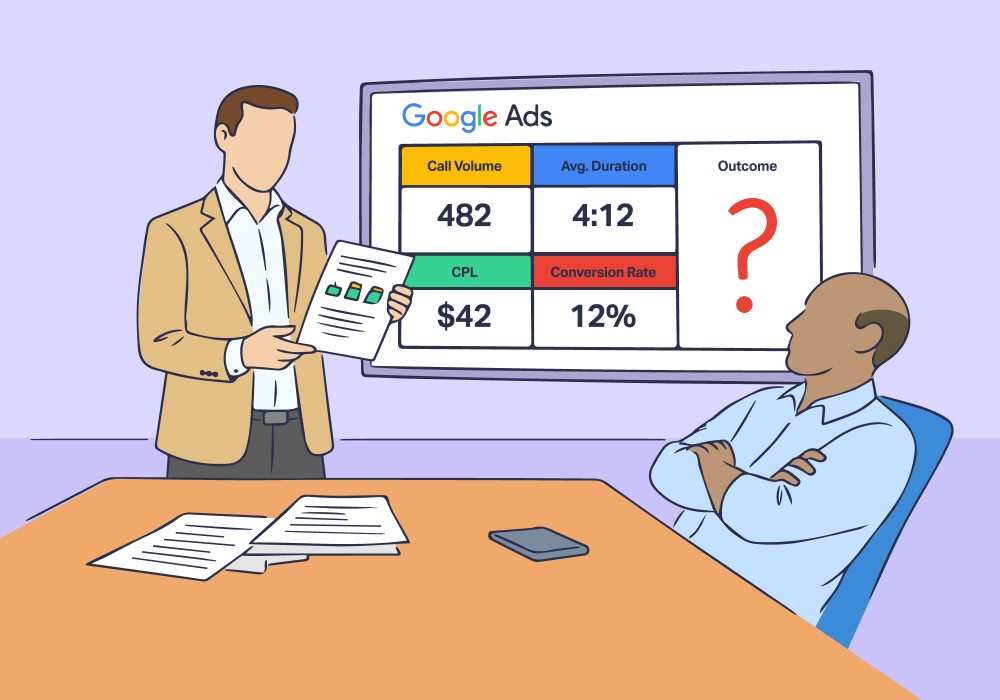
Call-driven campaigns rarely look broken, even when they are.
They generate lots of activity: phones ring, leads come in.
The problem doesn’t show up until later, when the client asks a question that sounds simple: what did those calls actually turn into?
Because the truth is, you don't know. You know the calls happened, and you know which campaigns drove them. But you can't connect those calls to revenue, and that’s where your defense starts to break down.
This article shows why phone-heavy Google Ads accounts are uniquely difficult to defend in client reviews—and what you need in order to turn invisible conversations into demonstrable business impact.
Note: Not a WhatConverts user yet? Start your free 14-day trial today or book a demo with a product expert to see how we help prove and grow your ROI.
Why Calls Draw More Scrutiny Than Forms
Form leads leave evidence. Someone can read the submission, review it later, and decide whether it was worth the spend.
Calls are different.
They’re live, expensive, and disappear the moment the conversation ends—unless something captures what actually happened. Without a tracking tool, you rely on human memory to determine how the call went, which can be inaccurate.
Clients also hold calls to a higher standard. They assume calls:
- Signal stronger intent
- Should convert at higher rates
- Justify higher costs
So when results stall, calls get questioned first. Not because they’re worse, but because no one can see inside them.
For the complete breakdown of:
- How Google Ads call tracking actually works
- What it can and can't measure,
- What agencies need to think about when phone calls drive real revenue
Check out the full guide:
The Limits of Google Ads Call Reporting
Google Ads is good at reporting call activity. It shows volume, duration, and source.
What it doesn’t show just happens to be the same thing clients ask about in reviews: outcomes.
It can’t tell you:
- Why the person called
- Whether the call was qualified
- If it turned into a quote or job
- What revenue came from it
You can say, “This campaign drove 52 calls.” But when the follow-up is, “How many became real opportunities?”, most marketers have to fumble for an answer with no data to back it up.

Why Call-Driven Reviews Break Down
Most agencies experience the same pattern: early on, clients feel like call volume equals progress. Phones ringing creates momentum, and clients are happy.
Later, the questions change:
- “Are these calls actually qualified?”
- “Is call quality improving or declining?”
- “Should we put more budget behind this?”
Without call-level outcomes, every answer sounds conditional:
- “We think quality is good…”
- “Sales says they’re decent…”
- “We’ll need to follow up…”
Even when performance is solid, the lack of proof makes it feel shaky.
That’s the difference between performance and proof.
No Proof = No Accountability
In a client review, the problem isn’t just that you can’t prove quality.
It’s that you can’t challenge sales’ version of events.
When a campaign drives form submissions, there’s a record. You can look at the message, see what the person asked for, and decide whether the lead was legitimate.
Calls don’t give you that.
So when sales says, “The leads are fine,” you have to take their word for it. And when sales says, “The leads are bad,” you have to accept that too.
There’s no evidence either way.
The issue could be any number of sales-side problems:
- Calls going unanswered
- Rushed or poorly handled conversations
- Qualified callers being misrouted or turned away
- Follow-up never happening
But without documentation of what actually happened on those calls, marketing has no way to separate a lead-quality problem from a sales-execution problem. Regardless of what the actual problem might be, your agency is left holding the bag.
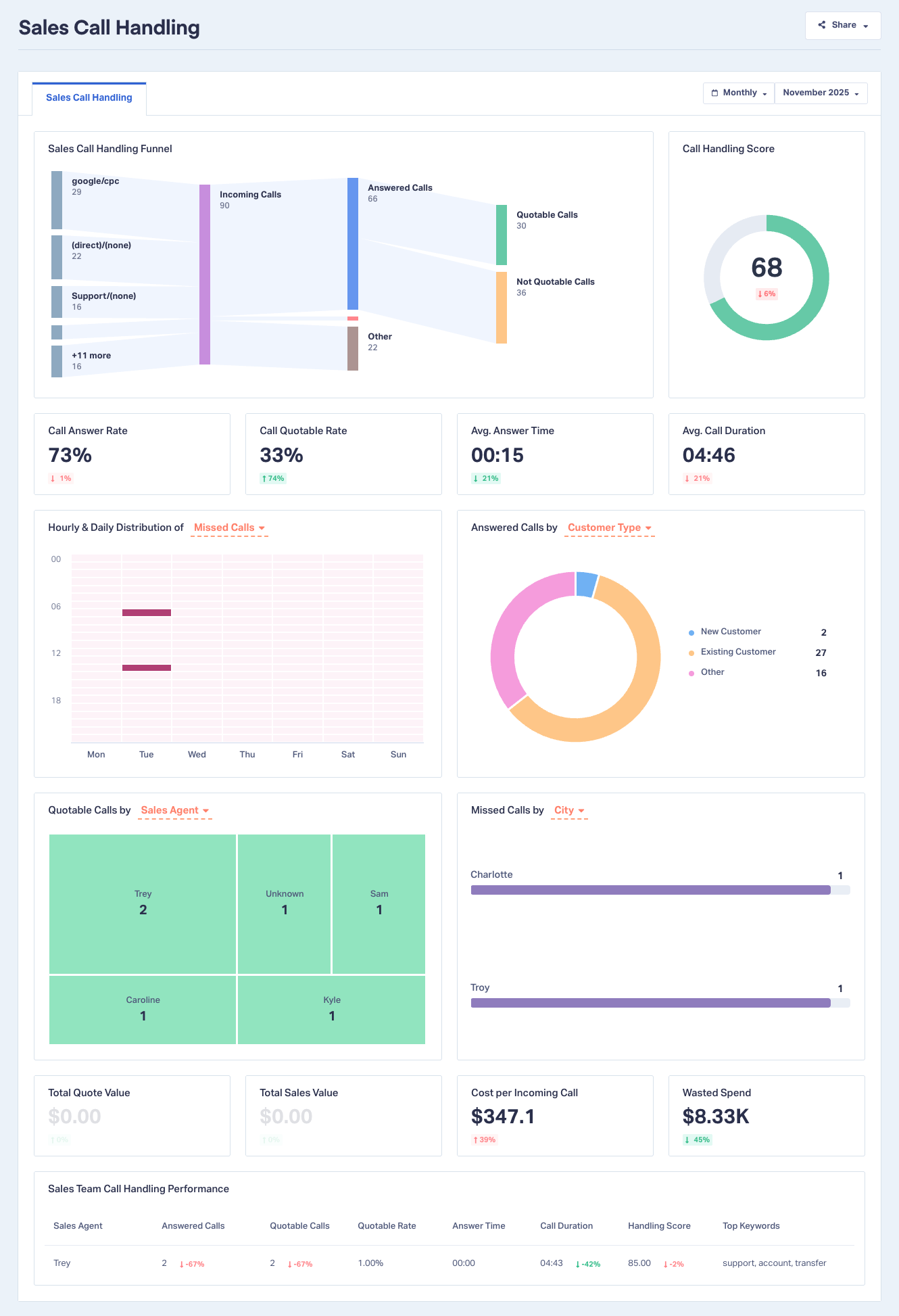
Read More: Introducing the Sales Call Handling Report: See Where Great Leads Are Won—or Lost
How Agencies Make Call-Driven Campaigns Defensible Again
Agencies that successfully defend call-driven campaigns do one thing differently: they document what happens after the phone rings.
Instead of relying on sales feedback in client reviews, they rely on call-level evidence.
That means three concrete practices:
- Every call is captured. Calls are recorded and transcribed so call quality is no longer a matter of opinion.
- Each call is classified by outcome. Calls are marked as qualified, unqualified, existing customer, or misrouted based on what actually happened during the conversation.
- Outcomes stay tied to marketing. Every call remains connected to the campaign and keyword that drove it, so results can be traced back to spend.
This is exactly what WhatConverts is built to do.
Instead of relying on sales feedback in client reviews, agencies can point to the calls themselves:
- Which were answered
- Which were qualified
- Which turned into quotes or jobs
- Which died in the sales process
At that point, the conversation changes. Marketing no longer has to accept the claim that “the leads are bad.” They can show what actually happened.
What Changes When Calls Become Explainable
Once calls are recorded, qualified, and tied to outcomes, the review changes completely.
Instead of, “We generated 48 calls.”
You can say: “We generated 48 calls. Twenty-nine were qualified sales conversations. Eleven turned into quotes. Four closed, worth $62,000 in booked revenue.”
Now the discussion isn’t about whether calls are “good.” It’s about whether to scale what’s working.
That’s the difference visibility makes.
Learn how Google Ads call tracking actually works and where visibility gaps typically show up.
Ready to make call-driven campaigns easier to defend?
Start your free 14-day trial of WhatConverts today or book a demo with a product expert to see how we help prove and grow your ROI.
Get a FREE presentation of WhatConverts
One of our marketing experts will give you a full presentation of how WhatConverts can help you grow your business.
Schedule a Demo
Grow your business with WhatConverts