


 Amanda Pell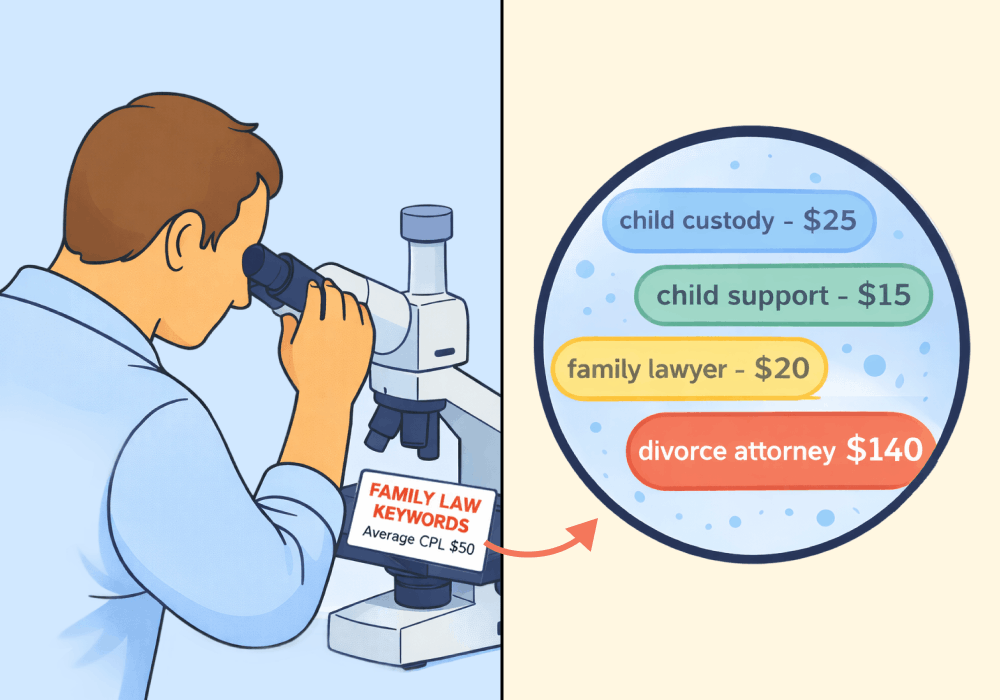
Legal PPC campaigns tend to bundle related practice area keywords together. Makes sense on paper—divorce and custody are both family law. Why not run them in the same campaign?
Answer: because "related" doesn't mean "same price." Services that appear similar can operate as completely different markets, with wildly different CPLs sitting underneath a single blended number that accurately describes neither.
When those CPLs are different enough, a blended number doesn't just obscure performance—it actively misdirects budget. This article shows how to use keyword-level attribution to see what each keyword group is actually producing, so you can make budget decisions based on real data instead of averages.
Note: Not a WhatConverts user yet? Start your free 14-day trial of WhatConverts today or book a demo with a product expert to see how we help prove and grow your ROI.
A Blended Number Obscures Two Very Different Markets
Keywords that look similar on paper can attract very different types of searchers, which also means they can come with very different costs per click. Run them together, and those cost differences get buried in a single average that doesn’t accurately represent either group.
Family law is a good example. Divorce and custody keywords both fall under the same practice area—the kind of grouping that makes intuitive sense when building a campaign. But legal PPC agency Webrageous found they operated at very different costs.
In one account, divorce keywords ran 16% higher CPL than custody. In another, the gap was large enough that the agency shifted 90% of spend toward custody keywords specifically to keep overall CPL from climbing. A third account showed divorce keywords costing nearly double what custody keywords cost per lead.
This is one agency's experience across a handful of clients—not a universal rule. But it shows exactly how grouped keywords can mask what's actually happening: one group efficient, the other expensive, and the blended number making both invisible.
The Budget Decision Problem
When divorce and custody keywords share a campaign and a CPL, decisions about where to put money get made on aggregate data. That creates two specific failure modes.
Underfunding one group. If custody keywords are delivering leads at lower cost, but that cost is masked by the higher-CPL divorce keywords pulling the average up, you can't see it. The campaign looks average. Custody's efficiency is invisible, and you never know to scale it.
Overfunding the other. If divorce keywords are expensive enough to drag the average up—but the blended number still looks acceptable—you keep spending without realizing how much that case type actually costs to acquire. The divorce keywords aren't getting cut. They're being subsidized.
The Webrageous data shows the CPL gap that can exist between keyword groups that look like they belong together. What it can't show is how many campaigns are running that same gap right now, invisible inside a blended number nobody has thought to separate.
Why This Problem Stays Hidden Without Keyword-Level Tracking
Campaign-level reporting is the norm. It's what Google Ads surfaces by default, and it's usually what gets exported into client reports.
But campaign-level data can't answer the questions that actually matter:
- Which keyword groups are producing leads worth their cost?
- Which groups are being underinvested relative to what they're producing?
- Where should budget go next month?
None of those questions are answerable from a single blended CPL. You'd need to know what each lead came from—which keyword triggered the call, what the caller was asking about, and how that maps to actual case type.
That requires keyword-level attribution. Not keyword-level click data—lead-level data tied back to the specific keyword that drove each conversion.
The distinction matters. You can see which keywords are generating clicks in any Google Ads dashboard. What you can't see is which keywords are generating qualified leads for divorce cases versus custody cases—and what each of those leads actually cost.
Keyword-Level Attribution Changes What You Can Optimize
WhatConverts tracks every inbound lead—call, form, or chat—back to the exact keyword that drove it. For a family law account, that means you can see:
- CPL by case type. Not a blended number. Separate CPL for divorce keywords versus custody keywords, pulled from real lead data.
- Lead quality by keyword. Which search terms are generating qualified consultations versus tire-kickers? Which custody keywords are converting at a lower cost than your overall CPL suggests?
- True budget allocation. Once you can see each keyword group's actual economics, the question of where to put more budget has a real answer.
The Webrageous data shows what's possible when agencies actually separate keyword performance and make decisions accordingly. One client dramatically shifted budget toward custody keywords after seeing the cost difference clearly. Another kept divorce spend intentionally limited for the same reason.
Those are good decisions. But to make them, you have to be able to see the split in the first place.
Stop Making Budget Decisions on Averaged Data
A blended CPL isn't wrong because the math is bad. It's wrong because it answers a question nobody's actually asking.
No client wants to know what their leads cost on average. They want to know which keyword groups are worth scaling and which ones are quietly draining budget. That requires data at the keyword level—not the campaign level.
Ready to see CPL by keyword group—not just by campaign?
Start your free 14-day trial of WhatConverts today or book a demo with a product expert to see how we help prove and grow your ROI.
Get a FREE presentation of WhatConverts
One of our marketing experts will give you a full presentation of how WhatConverts can help you grow your business.
Schedule a DemoGrow your business with WhatConverts