








































 Amanda Pell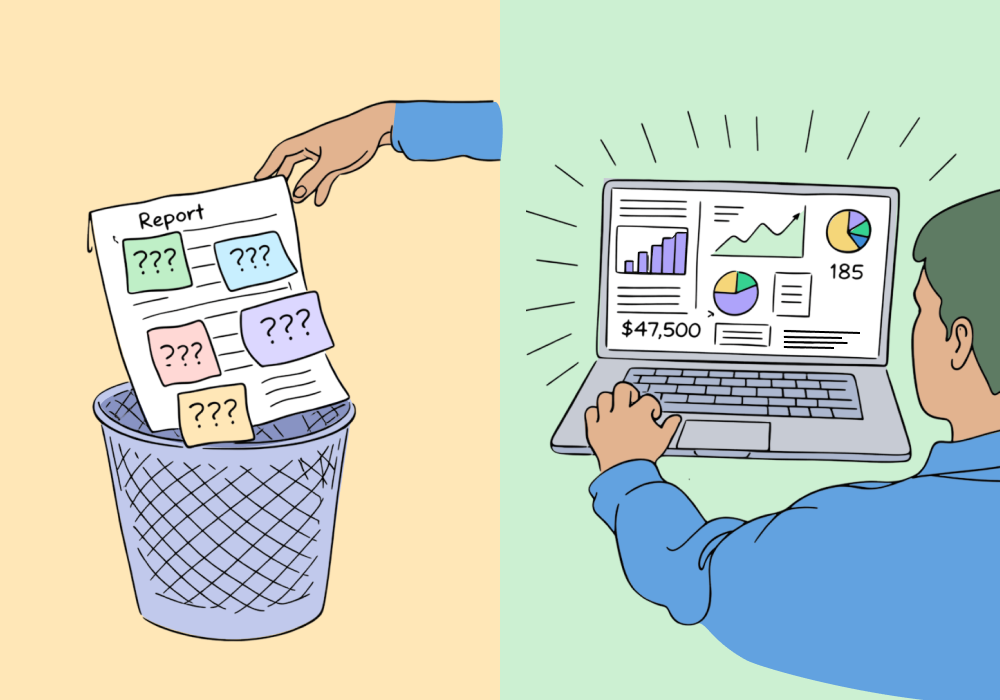
Client churn rarely happens because the work was bad. It happens because the client stopped believing the agency knew what was going on.
And nothing accelerates that doubt faster than a report that can't answer a follow-up question.
Send a monthly PDF. Client reviews it Thursday. By Friday, they want to know why form submissions dropped in week two, or whether the leads from that paused campaign ever closed. The report doesn't contain that answer—and there's no way to dig into the data behind it. So they email you, wait a day, and sit with the uncertainty in the meantime.
That's not a reporting inconvenience. That's a retention problem.
This article breaks down exactly how static reporting erodes client confidence—and what agencies are doing instead to keep clients informed and renewed.
Note: Not a WhatConverts user yet? Start your free 14-day trial today or book a demo with a product expert to see how we help prove and grow your ROI.
When Reports Become a Dead End
Static reports—PDFs, scheduled dashboards, exported spreadsheets—are built for a moment in time. They answer the questions you anticipated. They don't answer the ones your client actually asks.
Here's what that looks like in practice:
A client reviews their monthly report. It shows 87 leads at a $58 CPL. Looks solid. But they notice their Google Ads budget spiked in week three and want to know if the leads that week were lower quality. They ask.
You don't have that breakdown in the report. So now you're:
- Logging into Google Ads
- Cross-referencing the lead manager
- Pulling a custom date range
- Writing up a response
That's 45 minutes of reactive work—for one follow-up question. Multiply that by five clients per month, each with two or three questions the report didn't cover.
You're not managing campaigns. You're putting out fires.
The Real Cost: Confidence, Not Time
The time drain is real. But the bigger problem is what clients feel while they're waiting.
When a client asks a question and can't get an instant answer, they start doing math in their head. If my agency doesn't have this data at their fingertips, do they actually know what's working? Am I paying for expertise or guesswork?
That skepticism doesn't announce itself. It just accumulates quietly until a competitor knocks, or the contract renewal conversation gets awkward.
Agencies think clients leave over results. Often, they leave over confidence—the feeling that their agency doesn't have complete command of their account.
A static report is proof you looked at the data once. An interactive report is proof you live in it.
The Manual Workaround (And Why It Breaks)
Most agencies patch this with process. They build out elaborate reporting decks, add narrative commentary, and send a follow-up Loom. The goal: anticipate every question before it's asked.
Here's the problem with that approach:
- It doesn't scale. Adding more narrative to a static report still produces a static report. The question your client asks on Thursday is never the one you wrote commentary for on Monday.
- It adds hours, not answers. Loom walkthroughs and follow-up emails are manual. Every one of them is time you're not billing.
- It still requires a waiting period. The client still has to wait for you to respond. The trust erosion still happens.
Process can reduce the friction. It can't eliminate the fundamental gap between a locked report and a live question.
What Interactive Reporting Actually Fixes
The solution isn't a better PDF. It's reporting that can hold a conversation.
When clients can filter their own data—segment by lead type, zoom into a date range, drill down to individual leads—questions answer themselves. They don't need to wait for you. They don't need to doubt you. They just look.
With WhatConverts, agencies share live client portals with real-time visibility into leads, sources, and performance—without losing control of the narrative. Clients can explore; agencies set what they can see.
Instead of emailing you and waiting a day for answers, clients can find out on their own:
- "Which leads from last month were actually qualified?" → Filter by quotable leads in the Lead Manager
- "Did that Google Ads campaign drive anything valuable?" → Sort by quote value by source
- "What happened with that lead we discussed?" → Pull up the individual lead detail, including the call recording
That shift changes the relationship entirely. The agency stops being a gatekeeper of data and starts being the architect of a system the client trusts. That's a much harder position to walk away from.
Proof: Retention Starts with Visibility
Midwest agency Make The Turn was generating real Google Ads leads for a custom sporting goods client. The client was skeptical—and their existing reports made it worse. Lead counts came in, but quality was a mystery.
"We were just showing them these mystery numbers on a sheet," the agency said, "not knowing if these were real, quality leads and what the end result of these calls were."
After switching to WhatConverts, Make The Turn gave clients a live, white-labeled dashboard with named leads, purchase values, and campaign attribution—updated in real time. The results:
- 67% lead-to-MQL conversion rate from PPC
- Sales team closing deals faster in under 90 days
- Reduced churn through a client-facing lead dashboard
The results didn't change the relationship. The transparency did.
Read More: 67% Lead-to-MQL Rate Builds Client Trust Through Data Transparency [Case Study]
From Report Recipient to Informed Partner
Clients don't churn because results slipped. They churn because they stopped trusting the partnership. And static reports—no matter how polished—quietly undermine that trust every time they fail to answer a follow-up question.
The fix isn't a design overhaul. It's a fundamental shift in what reporting is for: not a deliverable you send, but a window your client can always look through.
When choosing your reporting stack, the question isn't just what data it covers. It's whether clients can answer their own questions without waiting for you. For a full breakdown of what to look for—and how today's top tools compare—see our guide to the best marketing reporting software for agencies.
Ready to stop losing clients to unanswerable follow-up questions? Start your free 14-day WhatConverts trial and give clients the reporting they can actually use—or book a demo to see how agencies are turning live data into lasting retainers.
Start your free 14-day trial of WhatConverts today or book a demo with a product expert to see how we help prove and grow your ROI.
Get a FREE presentation of WhatConverts
One of our marketing experts will give you a full presentation of how WhatConverts can help you grow your business.
Schedule a Demo
Grow your business with WhatConverts