


 Amanda Pell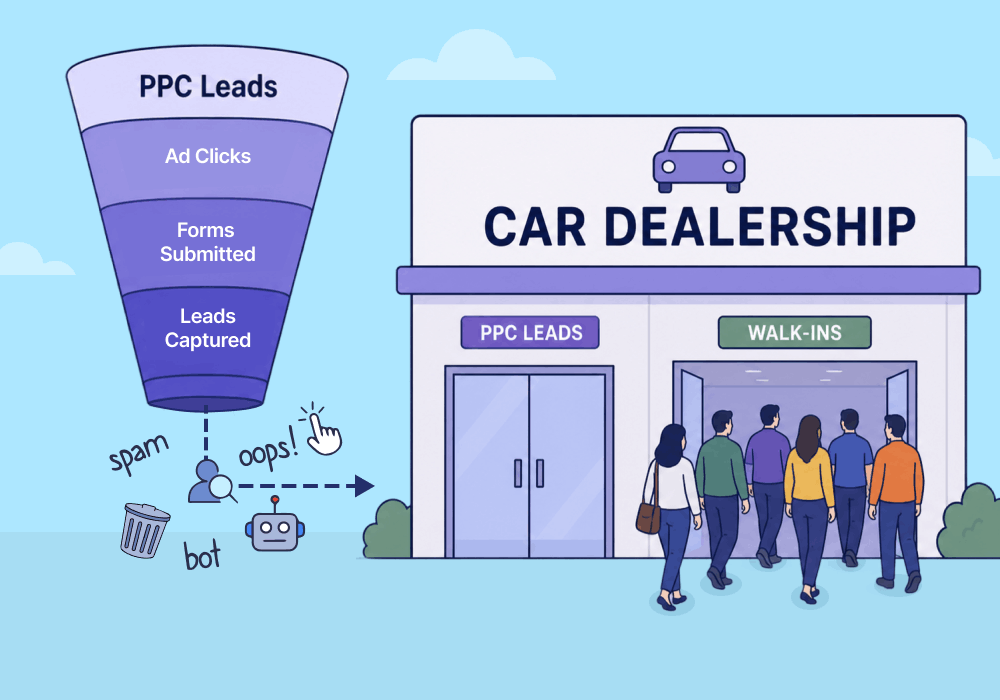
Every PPC account has top-of-funnel junk clicks that waste budget and inflate lead counts. Automotive has a second problem layered on top: a "hole" in the funnel that makes those junk clicks look like real sales.
Normally, when leads convert but drop off before the bottom of the funnel, the data shows it: high lead count, lower sales.
In automotive, that drop-off point is also an entry point. Walk-in buyers close at the bottom of the funnel and fill the gap those leads should have left, so your sales count stays high and the drop-off never shows.
The result is high leads and high sales at once, which makes campaigns full of non-buyers look like winners and is exactly why no one goes looking for the problem.
In this article, we'll break down how this hole distorts your lead and revenue data, and how to fix it so your campaigns get measured on real buying activity.
Note: Not a WhatConverts user yet? Start your free 14-day trial of WhatConverts today or book a demo with a product expert to see how we help prove and grow your ROI.
The Two-Sided Distortion Auto PPC Marketers Can't See
Most campaign performance problems tilt one way: too many junk contacts making CPL look worse than it is, or too little credit going to digital when offline sales close. Dealerships get both at once.
Top of Funnel: High Activity, Low Intent
Car buyers spend weeks researching before they're close to purchasing. They check inventory, request prices, and compare trims across multiple dealerships. A lot of the contacts your campaigns generate are price shoppers and window-browsers.
These researchers convert; they just don’t buy. So they count as leads and make your campaigns look good, but they aren’t real potential customers. So your Smart Bidding algorithm, which is optimizing for highest volume at lowest CPL, targets more of these unserious leads, and your reporting doesn’t show the problem.
Bottom Funnel: Walk-In Sales with No Trackable Lead
At the other end of the funnel, you have the opposite problem: buyers research online and show up in person without ever filling out a form or making a trackable call. When those walk-ins close, the dealership has a sale with no digital attribution. Campaign reporting absorbs the credit anyway.
Now a campaign appears to drive revenue it didn't drive. Budget shifts toward what "worked." The cycle accelerates in the wrong direction, and your campaign is held afloat by walk-in buyers you didn’t actually generate and those leads could stop flowing at any time.
What Happens When Both Distortions Run Unchecked
To see how that plays out, consider a typical month across three campaigns. Here’s what a typical month might look like:
| Total Leads | CPL | |
| Campaign A | 55 | $218 |
| Campaign B | 62 | $194 |
| Campaign C | 88 | $136 |
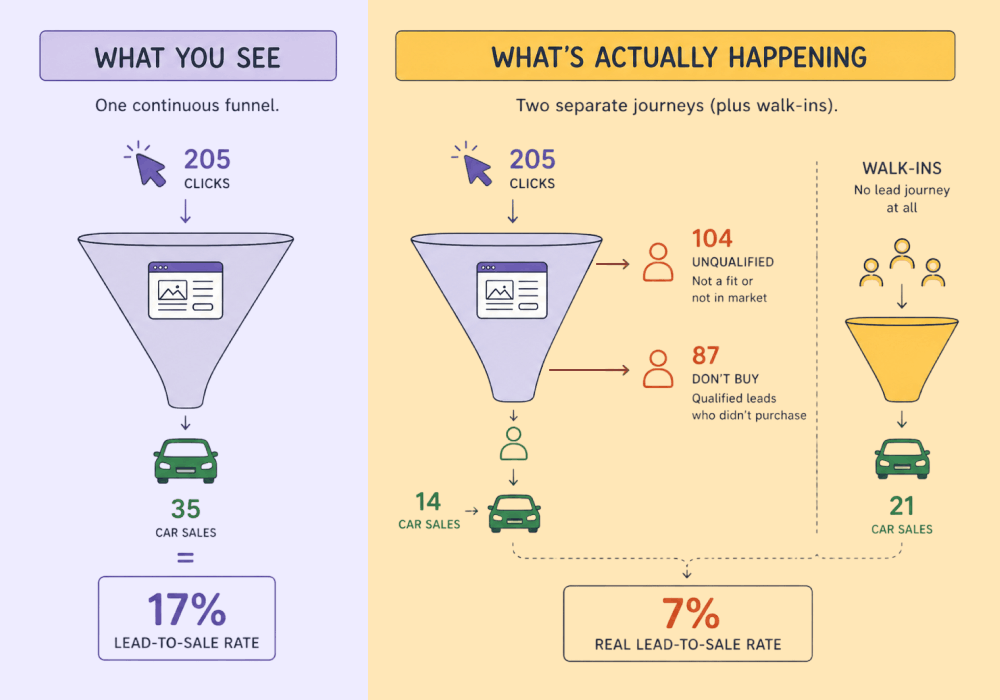
The dealership closes 35 sales this month, which is a 17% lead-to-sale conversion rate. Based on these numbers, it looks like Campaign C was the highest performer. It had the most leads at the lowest CPL.
Now let’s look at the same month with true full-funnel attribution tracking. Here’s the actual picture:
| Qualified Leads | True CPL | Attributed Sales | Cost per Customer | |
| Campaign A | 38 | $316 | 8 | $1,499 |
| Campaign B | 34 | $354 | 4 | $3,007 |
| Campaign C | 29 | $413 | 2 | $5,984 |
Turns out that 21 of those sales were walk-ins with no digital lead journey. Remove them and the true lead-to-sale rate drops to 7%. Still not bad for the auto industry, but nowhere near what you were originally reporting.
Even more importantly, Campaign C wasn’t your winner. Campaign A was and it brought in 4x more sales at a quarter of the cost per customer.
The Fix: Keep Track of Which Leads Are Yours
The answer isn’t to try to close the hole at the bottom of the funnel. You want your business to keep receiving walk-in sales. The answer is to find a way to tell the difference between which leads are yours and which aren’t.
To do that, you need to track individual leads from the top of the funnel all the way to the sales outcome.
WhatConverts makes this possible by tracking each individual ad click, form fill, and call and tying it back to its source. Each conversion also launches a single tracked lead journey that documents all actions from that point forward, all the way to the point of sale.
That means at the end of the month, you can take full credit of the specific leads (and sales) your marketing generated, while keeping sales from other sources (like walk-ins) separate.
Then Double Down Confidently on What Works
When you can see exactly which leads are yours and what campaigns they came from, you no longer have to wonder which sources are driving real leads. You can calculate the exact amount of revenue each campaign drove, increase ad spend on what’s working, and strategically grow your profit while cutting waste.
Ready to see what your dealership PPC data looks like when you can see the full funnel?
Start your free 14-day trial of WhatConverts today or book a demo with a product expert to see how we help prove and grow your ROI.
Get a FREE presentation of WhatConverts
One of our marketing experts will give you a full presentation of how WhatConverts can help you grow your business.
Schedule a DemoGrow your business with WhatConverts