


 Amanda Pell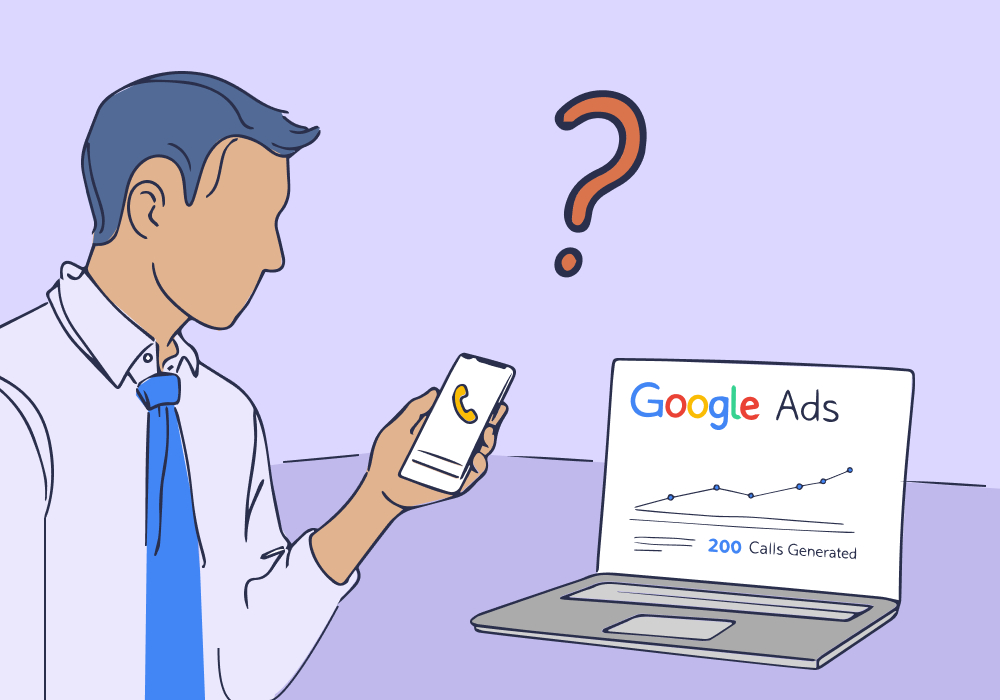
Your call-driven Google Ads account has 87 conversions this month. Cost per conversion looks solid at $62. Call duration averages 4:23.
But you still can't shake the feeling something's off.
Not because performance is bad—it’s not. The call volume is there. The problem is you have no idea if those 87 calls were qualified prospects or time-wasters. Google Ads tells you the phone rang, but it can’t tell you if anyone booked.
So every budget decision, every optimization move, every client update carries a layer of doubt. You’re steering blind.
This article explains why call-heavy accounts feel harder to manage than form-driven ones—and what visibility gap needs to close before these accounts start feeling predictable.
Note: Not a WhatConverts user yet? Start your free 14-day trial of WhatConverts today or book a demo with a product expert to see how we help prove and grow your ROI.
Why Call-Heavy Accounts Feel Different
Form-driven Google Ads accounts operate with concrete evidence. Someone submitted their name, email, service interest, and message. You can review every submission. You know exactly what each lead wanted.
Call-driven accounts work differently.
Google Ads reports the call happened. It reports duration. It reports source attribution. But it can't report whether the caller was qualified, what they needed, or if they booked.
The conversion exists as data. But the outcome remains invisible.
Which means you're managing campaigns based on activity, not results.
What Google Ads Shows You
Google Ads call reporting is accurate for what it measures:
- Total call conversions
- Call duration by campaign
- Time-of-day patterns
- Source attribution (campaign, ad, keyword)
This data answers important questions. Which campaigns drive volume? Which keywords generate longer calls? When do most calls happen?
But it doesn't answer the question that determines whether you scale, pause, or pivot: were those calls worth the spend?
The Gap Between Data and Decisions
You're running three Google Ads campaigns for a home services client. Monthly budget: $18,000.
| Calls | Cost per Call | |
| Campaign A | 42 | $71 |
| Campaign B | 28 | $103 |
| Campaign C | 61 | $49 |
Standard optimization says shift budget toward Campaign C—lowest cost per call, highest volume.
But what if Campaign B's 28 calls produced 19 booked jobs while Campaign C's 61 calls produced 11? The "expensive" campaign with lower volume just became your most valuable source.
Without outcome visibility, optimization becomes guesswork disguised as data analysis.
Why This Creates Day-to-Day Uncertainty
The instability isn't dramatic. Accounts don't crash. Performance doesn't collapse.
It's subtler. You look at your dashboard and think:
"These numbers are good... I think?"
"Should I increase this campaign's budget?"
"What if half these calls are tire-kickers?"
Every strategic decision carries hesitation because the data stops before the outcomes begin. You're flying with instruments that only show altitude and speed—not whether you're headed toward the destination or away from it.
For the complete breakdown of:
- How Google Ads call tracking actually works
- What it can and can't measure,
- What agencies need to think about when phone calls drive real revenue
Check out the full guide:
Related Reading: The Best Way to Track Calls from Google Ads
When Automation Amplifies Uncertainty
Smart Bidding and automated strategies make this worse.
Google's algorithms optimize toward what they can measure. If the only signal is "call happened," the system learns to generate more calls. It can't distinguish between a qualified prospect and a wrong number. It can't tell the difference between a $200 service call and a $5,000 installation.
The algorithm becomes very good at driving volume while remaining completely blind to value.
Which means as automation increases, so does your uncertainty about whether it's actually working.
Why Sales Feedback Doesn't Close the Gap
Most agencies try to solve this by asking sales teams which leads were good.
The feedback arrives three ways:
- Anecdotal: "Most of the Google Ads leads this month were pretty solid."
- Delayed: You get qualification updates 2-3 weeks after the call, long after bidding decisions were made.
- Inconsistent: Different team members qualify differently, making patterns impossible to identify.
Sales feedback helps explain what happened. But it can't be reconciled with Google Ads data in a way that informs real-time optimization.
Accounts That Are Hard to Trust
This creates a specific kind of operational friction.
Your call-driven accounts never quite feel stable. Every recommendation includes mental caveats. Every budget increase requires extra justification. Every client question triggers a small moment of doubt about whether the data supports your answer.
You're not managing poorly. The account isn't underperforming. You're just operating without the visibility layer that turns reporting into confidence.
The Real Issue Isn't Reporting Volume
Adding more dashboards doesn't fix this. The problem isn't insufficient data—you have conversion counts, durations, and attribution.
The problem is the data stops before outcomes begin. You can see calls happened. You can't see what happened on those calls or after them.
Without that visibility, call-heavy accounts will always feel less stable than they actually are.
From Activity Reporting to Outcome Clarity
Call-driven Google Ads accounts don't need to feel unpredictable.
They need reporting that extends beyond the conversion event itself—tracking not just that calls happened, but what those calls produced. Which campaigns drive qualified prospects versus wrong numbers. Which keywords generate high-value service requests versus price-shoppers.
That's not a Google Ads limitation. It's a tracking gap. And closing it turns uncertainty into operational confidence.
Understanding how Google Ads call tracking actually works, what it can measure on its own, and where agencies typically need additional visibility is the first step toward making call-heavy accounts feel as stable and predictable as their form-driven counterparts.
Google Ads Call Tracking: What Agencies Need to Know explains how to build the complete visibility layer that makes call-driven campaigns feel as reliable as any other marketing channel.
Start your free 14-day trial of WhatConverts today or book a demo with a product expert to see how we help prove and grow your ROI.
Get a FREE presentation of WhatConverts
One of our marketing experts will give you a full presentation of how WhatConverts can help you grow your business.
Schedule a DemoGrow your business with WhatConverts