


 Amanda Pell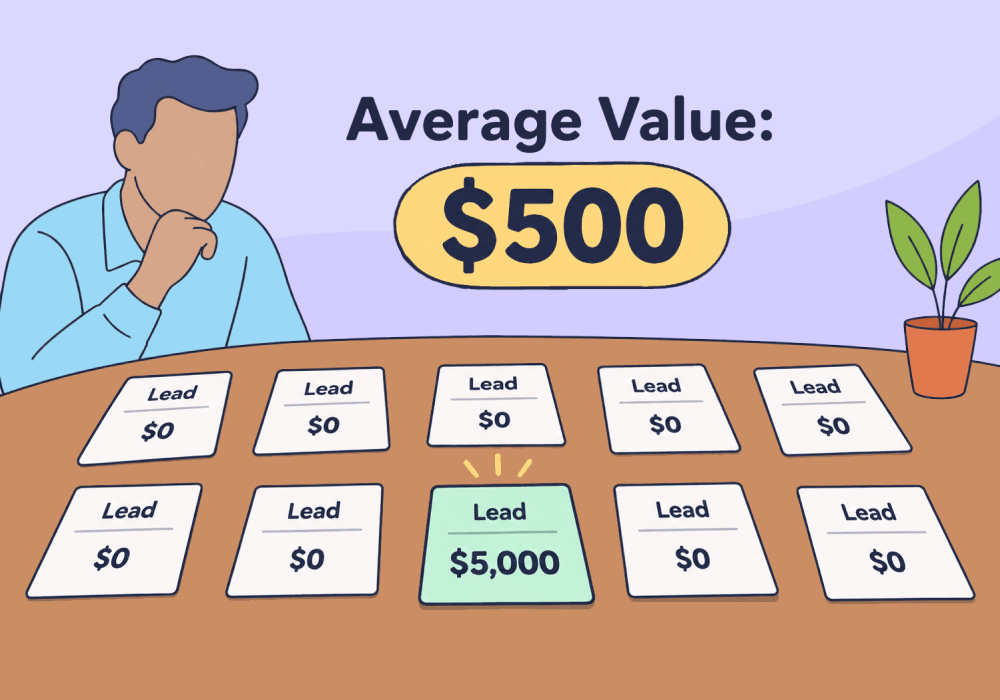
Most marketing relies on trust: you can prove you drove traffic, conversions, and leads, but ultimately you have to trust that these things are translating to revenue down the line. Very few marketers are able to assess or prove the value of their individual leads.
That’s not a problem so long as your campaigns are doing well enough and nobody asks too many questions. But “we’re successfully driving leads” isn’t a valid defense when it’s met with “we don’t believe the leads you’re driving are valuable.”
The only way to prove that marketing is valuable is by proving the leads are valuable, on an individual lead-by-lead basis. Most marketers aren’t equipped to do that, but they could be.
This article explains how to track leads on an individual basis and document their entire journey from ad click to final sale, so that marketers can not just assess the value of each one, but prove it as well.
Note: Not a WhatConverts user yet? Start your free 14-day trial of WhatConverts today or book a demo with a product expert to see how we help prove and grow your ROI.
You Can’t Value a Lead You Aren’t Tracking
Most tracking doesn’t actually track leads. It tracks conversions: calls, form submissions, texts, or chats. Google Ads counts the ad clicks and shows you which campaigns they came from and whether they resulted in a call.
Who the lead was and what happened after that call remain a mystery.
Standard call tracking platforms are similar: while they offer a little more information about the call itself (like contact information and the call transcription), the tracking ends with the session.
Unless the lead finalizes the purchase over the phone and it gets recorded in the transcription, whatever happens next gets lost.
So you’re left with total lead counts and partial lead journeys. You might be able to surface a handful of sales values from purchase calls, but you can still only tie that value to the marketing campaign that launched that specific session. If the lead originally found you a week ago via a different channel, that information is lost.
To See Lead Value, You Need the Lead Journey
The only way to tie specific values to individual leads is to track the entire lead journey. From the moment a prospect first clicks on your ad, every interaction from that point on needs to be tied to that same person. Let’s follow one HVAC lead’s journey to understand why:
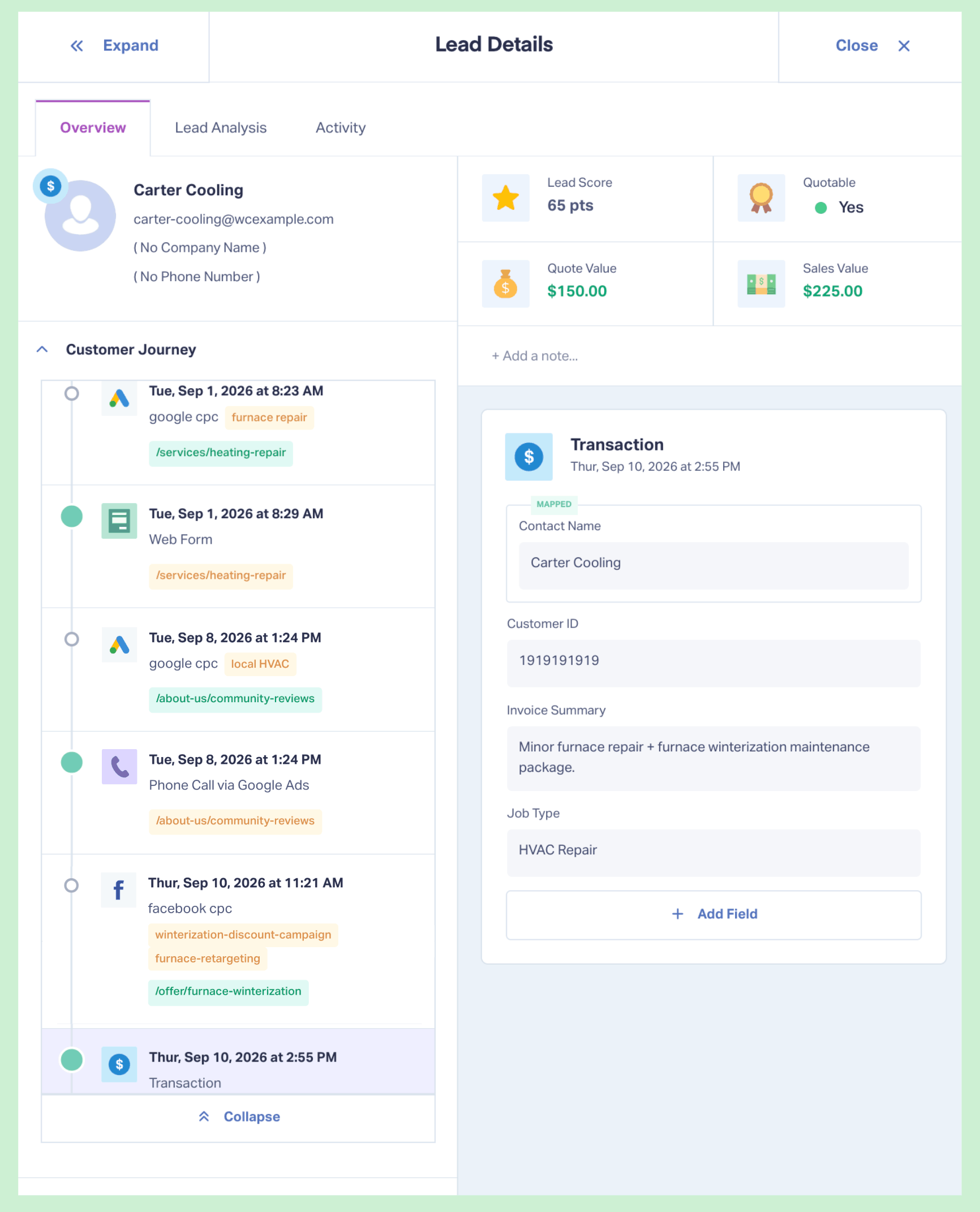
It’s early autumn, so getting his furnace repaired is just one item on our prospect’s list of things to do. He starts by doing a casual “furnace repair near me” search from his laptop on his lunch break. He visits your site, submits a quote request form for a $150 repair job, and then forgets about it when he’s called back to work.
Related Reading: Eliminating the Guesswork from Customer Journey Marketing
The following week a cold snap hits and he decides to get serious. He searches “best HVAC providers in my area” and hits click-to-call ads to talk to three different companies, including yours. He hangs up without committing to anything.
A few days later, he comes across a Facebook Ad in a retargeting campaign you’re running, offering 25% off a $300 pre-winter furnace maintenance and repair package. He clicks, calls, and books the job.
What You See Isn’t What You Get
Without end-to-end lead tracking, the data on this lead is scattered across the four corners of the earth:
- The initial quote request is tallied as one of 100 form leads attributed to your “furnace repair” Google Ads campaign, tied to the $150 repair quote
- The phone conversation is tallied as a separate call lead attributed to your “best HVAC providers” Google Ads campaign, with no clear quote
- The final sale is attributed to your Facebook retargeting campaign, and Meta Ads’s last-click attribution model takes full credit for the $225 sale
So now you’ve counted three leads and $375 in quote value for a single lead that was actually worth $225.
Multiply this across the hundreds of conversions and leads you’re generating each month across devices and platforms, and it’s not even worth attempting to evaluate individual lead value. So most marketers assume lead valuation is impossible, and they simply stop trying.
Related Reading: Why Fragmented Dashboards Kill ROI: More Lead Types, More Problems
The Solution: Simple, Automatic Multi-Channel Lead Journey Tracking
Not only is individual lead valuation possible, it’s actually pretty easy. Here’s how it works:
1. A first-party tracking script on your website creates a single home for all of your data.
When the prospect submits that first quote request, the tracking script automatically documents:
- All of the form field data (name, contact information, service requested)
- The marketing source behind the conversion, including source, medium, channel, campaign, and keyword and ad (in this case: a local Google Ads seasonal campaign with keyword “furnace repair near me”)
- The GCLID associated with this lead
How It Works: What Is the WhatConverts Tracking Script?
2. Subsequent conversions are tracked to the same journey, not counted as separate leads.
When the prospect hits that click-to-call ad, the tracking script matches the prospect’s phone number and GCLID to the data that was collected from the first form lead. Instead of being counted separately, the script tracks:
- The marketing source behind the call (in this case: a local Google Ads “best HVAC providers” campaign)
- The call recording and transcript
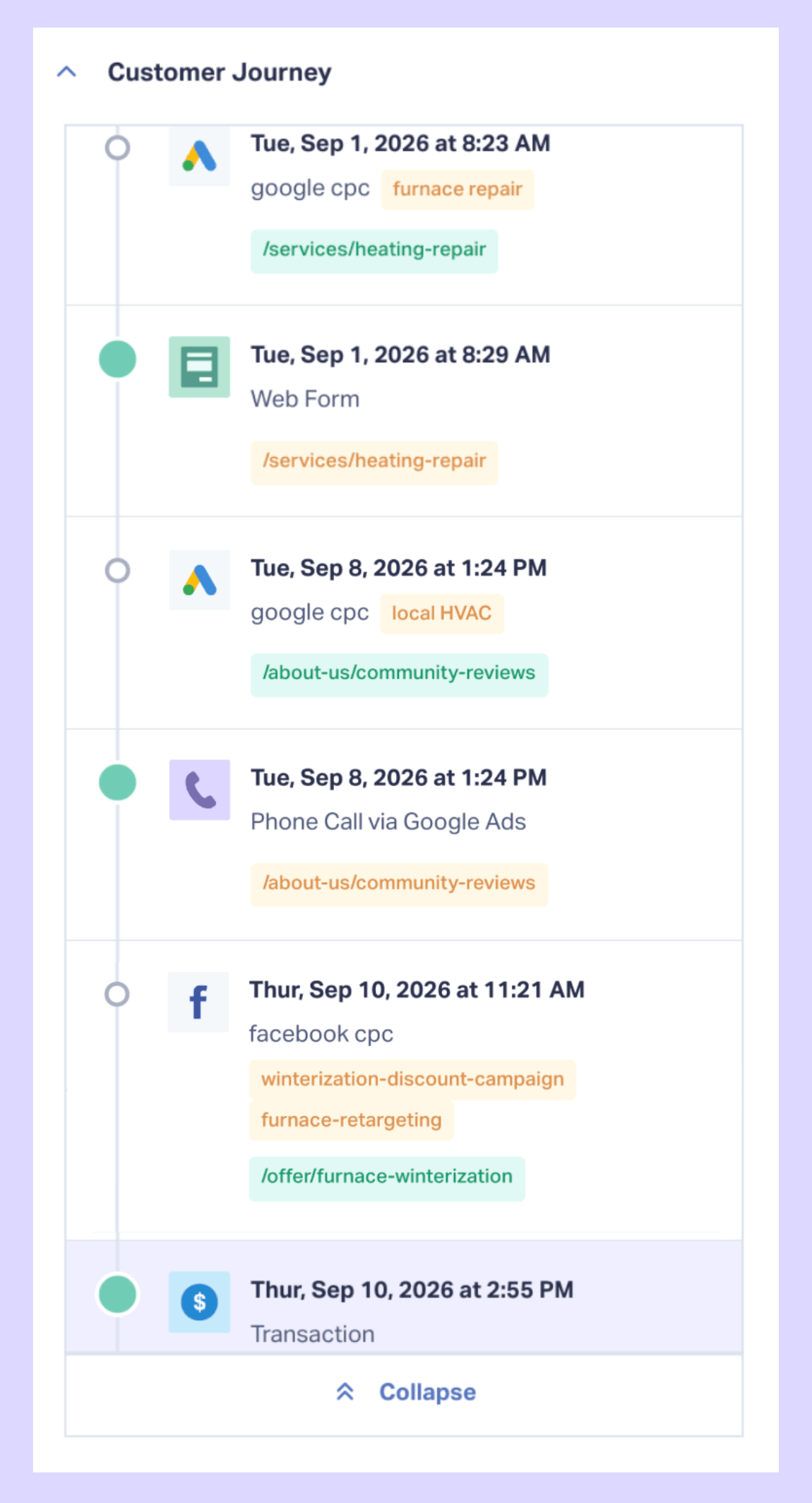
Instead of creating a brand new call lead, the conversion is added as a touchpoint on the prospect’s existing lead journey. When the lead eventually clicks on the final retargeting ad, the script adds that data as a third touchpoint on the lead journey instead of defaulting to giving full credit for the sale to the last-click platform.
Feature Highlight: Customer Journey Tracking
3. Marketers can manually or automatically add quote values to individual leads.
With all of the conversions and touchpoints for a single lead tracked as part of one continuous journey, marketers can assess value accurately:
- The quote value associated with the initial form submission was $150
- After upselling with a discounted maintenance package, the sale value was $225
Marketers can choose to evaluate leads individually and input value data manually, or they can set up rules to add values automatically, like “IF service requested is ‘furnace repair,’ THEN set quote value to $150” or “IF marketing source is Facebook Ads AND call duration is >30 seconds, THEN update quote value to $225.”
4. Reports are calculated using real lead values, not guesstimates.
When lead value is accurate to the individual lead, this unlocks a completely new level of campaign reporting that proves the ROI on marketing campaigns to stakeholders and enables more accurate and detailed campaign targeting for future growth.
Without individual lead value, marketers can only report on:
- Number of leads generated
- Estimated quote value driven (using a single, static average lead value)
- Cost per conversion or lead
These things can then be segmented by campaign or marketing channel.
With individual lead value tracked, marketers can report on:
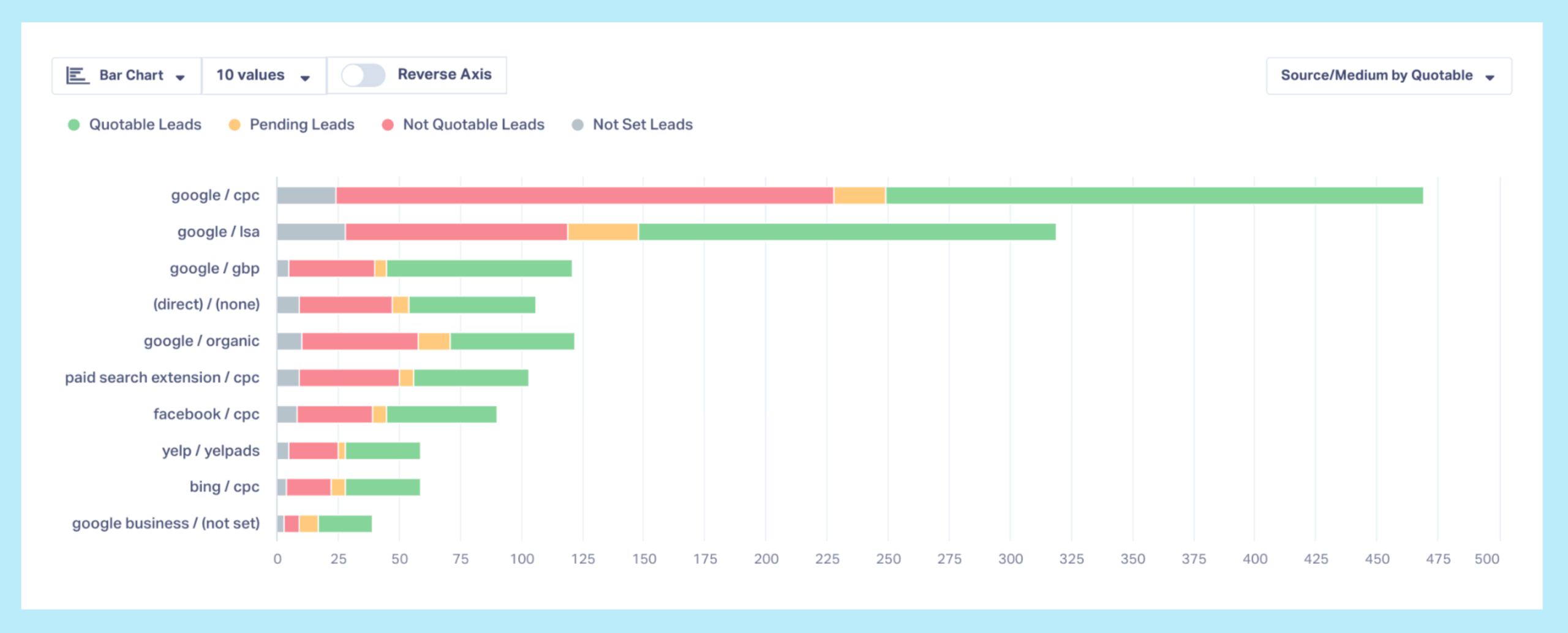
Quotable Leads Generated
Filter out all leads with no quote value or a quote value of $0 to measure campaigns by actual prospects driven. Segment by campaign or channel to understand the difference between campaigns that drive lead volume and campaigns that drive lead value.
Related Reading: How to Calculate Cost Per Qualified Lead: Why CPL Isn't Enough
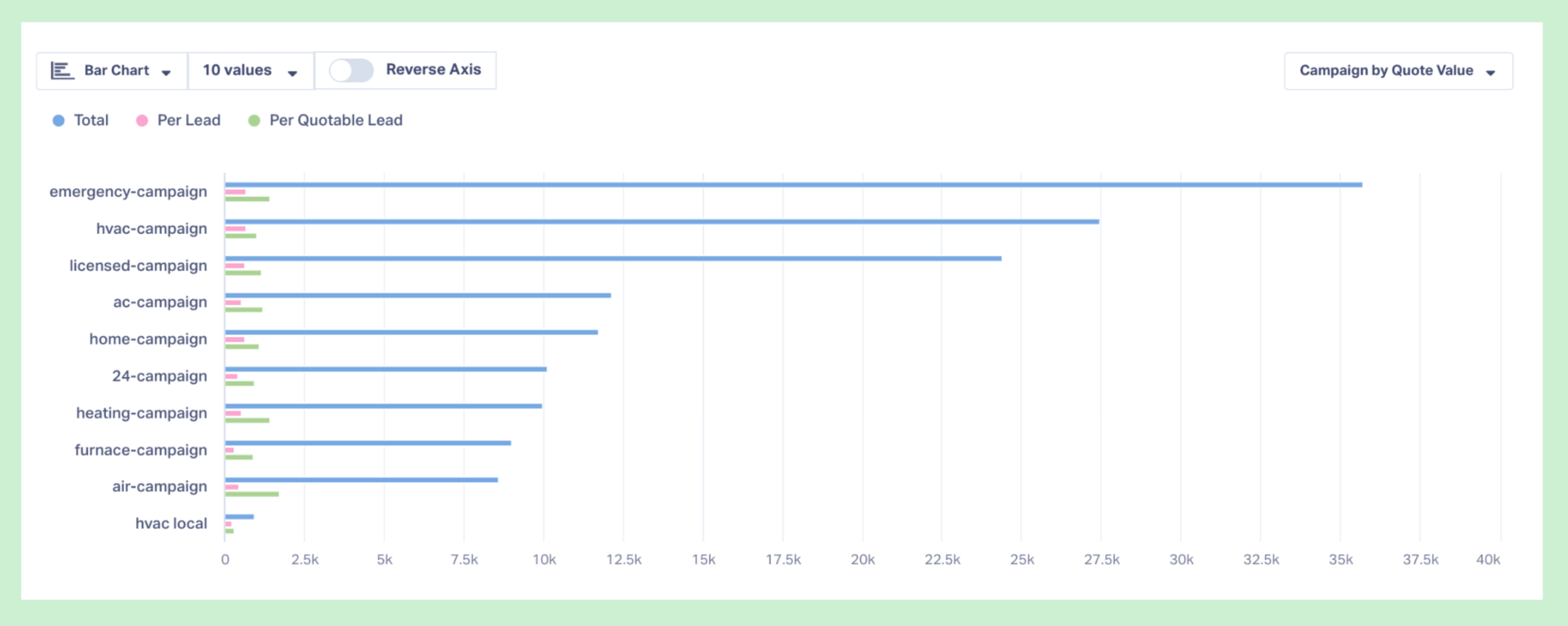
Quote Value (Total or Average Per Lead)
When all you have is a benchmark job value, every campaign is measured by volume: if the average job is worth $500, then Campaign A with 50 leads is worth $2,500 and Campaign B with 100 leads is worth $5,000.
When you track individual lead value, campaigns can be measured both by total value generated and by the size of the deals they bring in. So you can see that Campaign A with 50 leads actually brought leads worth $1,000 on average for $50,000 total, while Campaign B is attracting small $150 jobs for a total of $15,000.
Stop Guessing What Your Leads Are Worth
When every touchpoint ties back to the same person, you can stop reporting an average job value and start reporting what each lead is actually worth.
That changes what you can prove to a stakeholder. Instead of defending your spend with benchmarks and estimates, you can show them which campaigns brought in $1,000 jobs, which ones filled the report with $150 ones, and exactly how much revenue your marketing put in motion.
Give every lead a value, and each campaign can finally be judged on the dollars it drives rather than the clicks it collects. Marketing stops being a cost your clients take on faith and becomes a number you can stand behind.
Ready to put a real value on every lead?
Start your free 14-day trial of WhatConverts today or book a demo with a product expert to see how we help prove and grow your ROI.
Get a FREE presentation of WhatConverts
One of our marketing experts will give you a full presentation of how WhatConverts can help you grow your business.
Schedule a DemoGrow your business with WhatConverts