




































 Alex Thompson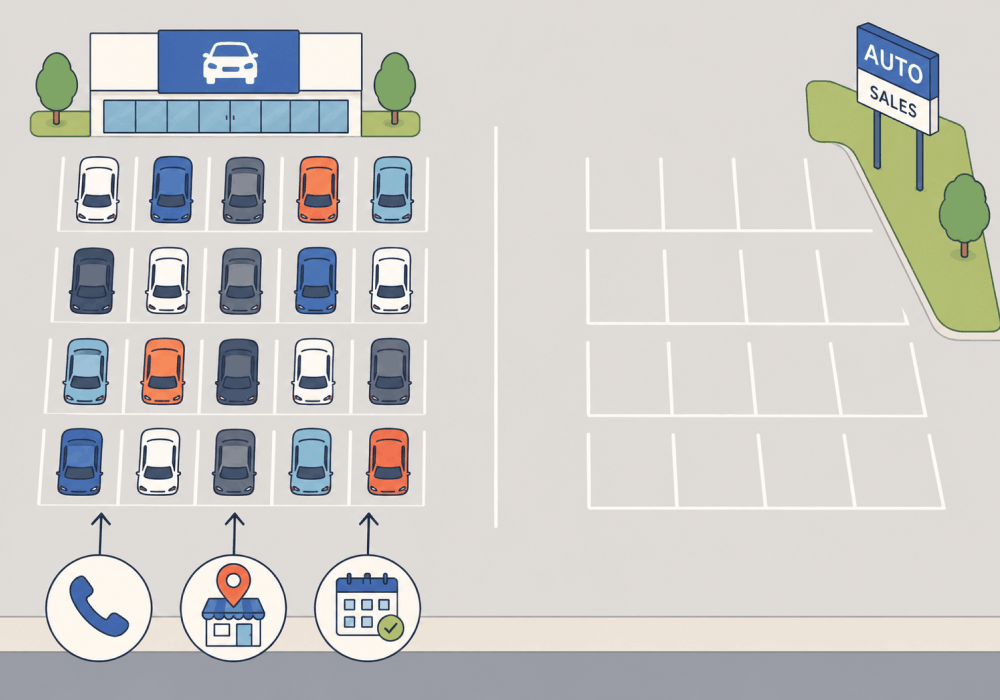
If you've ever flipped on a local channel, you know there are an unlimited number of car dealership advertising ideas: giant inflatable gorillas, costume-clad salesmen, a neverending variety of wacky waving inflatable tube men.
But for every killer creative, a savvy marketer (and their client) need to know three things: did it earn calls, did it bring in prospects, and did it lead to a confirmed appointment. If you can't answer any of those, you're not doing your job, and churn is around the corner.
The tricky part is most marketing platforms are set up to track clicks and impressions, not the three KPIs that actually matter.
This article shows you the fix. You'll get a list of testable advertising ideas (including links on how to implement) along with the tracking tips you need to know what actually works.
Three Signals Tell You Which Ideas Actually Fill the Lot
The car dealership advertising ideas that fill a showroom are the ones you can tie to a booked visit, not the clicks or call counts most reports stop at. A click may never set foot on the lot. A month's call count mixes ready-to-buy callers with price shoppers and wrong numbers, so "140 calls" says nothing about filled parking spots.
But when you measure campaign success on real qualified leads (think calls, in-person visits, and booked appointments), that's when you can make budget decisions that actually push the needle.
Close rates are why the visit beats the click. Dealership phone leads close at roughly 3.5 times the rate of form leads: 24.8% against 7%. Walk-ins close near 41%, per a 2025 study of dealership close rates. Calls run hot too: at least 28% of sales-department callers go on to buy, across a 307,000-call Marchex study.
When you aren't measuring campaigns on these three outcomes, Google Ads optimizes toward whatever you do count. So feeding it cheap clicks or unqualified calls trains bidding to fetch more of the same. In the end, you're left defending spend on leads that never show.
The idea belows are how you break free from that cycle. When they're tested and tracked correctly, they give you the data you need to make better marketing decisions and grow your ROI.
| What the idea should drive | The signal that proves it | What it's not |
| A call | ✅ A tracked, qualified call | ❌ A raw call count |
| A walk-in | ✅ A modeled store visit | ❌ An impression |
| A booking | ✅ A confirmed appointment, fed back | ❌ A form fill alone |
A closer look at why a call Google marks as a conversion still might not be a real lead.
Related Reading: Google Ads Says a Call Is a Conversion—Sales Might Disagree
Call-Driven Ideas Prove Themselves Through a Tracked Call
When a campaign's whole job is to make the phone ring, judge it by qualified, attributed calls, not by the raw count.
The phone-driven ideas:
- Click-to-call search ads. A tap-to-dial number on a high-intent search ad puts a ready buyer at the desk in one step. (Set up call assets.)
- Vehicle Ads with call assets. A call button sits next to the exact listing a shopper is viewing. (Turn on Vehicle Ads.)
- Service and parts offers. A brake special or tire deal gives the fixed-ops side a reason to ring. (Build a promotion asset.)
Each proves out the same way: a call tied to the exact campaign and keyword, counted only when it runs long enough to signal intent. A duration floor around 60 seconds separates a ready buyer from a 10-second wrong number. A short call isn't always junk, so check the recording first.
Say a brake-service ad pulls 140 calls in a month. Tracking ties each to the ad and disqualifies the ones under a minute. You report 88 qualified service calls, not 140, and defend the spend on the number that maps to verified prospects.
Sorting that by hand is the chore. A call-tracking tool like WhatConverts ties each call to the campaign that produced it and lets you qualify by what the call actually was, so a 12-second price check never lands as a lead.
Each call ties back to the campaign and keyword that produced it; qualifying by what the call actually was keeps wrong numbers and quick price checks out of the booked-intent count.
To measure each idea above based on calls, be sure to wire up the tracking with our guide to Google Ads call tracking.
See how every call ties back to the exact campaign and keyword that drove it, and how a length filter keeps price checks out of your booked-intent count.
Feature Highlight: Call Tracking
Walk-In Ideas Are Proved by a Measured Store Visit
Some campaigns put bodies on the lot without a call or form first. Judge those by Google's modeled store-visit conversions. But always read it as a directional signal and never as an exact count.
The foot-traffic ideas:
- Streaming and connected-TV spots. Local awareness in front of cord-cutters, aimed at the in-market shopper. (Add the Google TV network.)
- Waze and local-inventory ads. Your lot and live stock shown to people already driving nearby. (Run a Performance Max store campaign.)
- Weekend sales events. A dated, urgent reason to come down this Saturday. (Schedule a promotion asset.)
- Reviews and an accurate Business Profile. The trust signals a used-car shopper checks before deciding to visit. (Get more Google reviews.)
None asks for a call or form first, so the proof is the visit itself. Google models store visits from opted-in location data on a 30-day window, reported only past volume and privacy thresholds, per Google's documentation on how store visits are modeled. Being near the lot doesn't count, and you supply the value yourself: in-store close rate times average sale.
Connected TV earns its spot because the audience is real: streaming now makes up roughly 47% of U.S. TV viewing, per Nielsen's The Gauge.
Say a used-car dealer runs a two-week connected-TV flight with refreshed Business Profile photos and reviews. You read store-visit conversions the week after, once enough accrue to be stable, and value them on the lot's close rate. You report a directional lift tied to the flight, and keep that modeled value out of bidding.
Treat it as a directional signal, not a receipt. Just like any model, it's not going to be perfect 100% of the time.
| What counts as a store visit | What doesn't count |
| ✅ Ad-exposed✅ Location sharing on✅ Later entered the store | ❌ Just nearby❌ Exact revenue❌ An instant single-visit read |
| Wait for volume. The trend needs roughly 100 store visits before it is stable enough to trust. | |
Booking-Driven Ideas Prove Out With a Confirmed Appointment
When a campaign's payoff is a booked slot, the form fill isn't the proof. The confirmed appointment is. Feeding it back into Google Ads is what lets you tell which ideas book visits.
The booking-driven ideas:
- Lead-ad sales events. Facebook and Instagram forms tied to a dated event, built to capture intent fast. (Create a lead ad.)
- Test-drive booking offers. An ad whose call to action is a scheduled time behind the wheel. (Add an appointment request to the form.)
- Inventory ads tuned to vehicle-detail-page views. Spend pushed toward shoppers who go deep on a specific car. (Track VDP views with the Meta pixel.)
A form fill alone won't prove a visit; forms pull browsers along with buyers. The appointment confirmation is the real signal. The move that makes it count: you import that confirmed appointment back into Google Ads as an offline conversion, so bidding sees which ideas produced bookings, not just clicks. Google's Enhanced Conversions for Leads marks a qualified-lead goal apart from a converted one.
Say a dealer runs a weekend lead-ad sales event. One vendor reports these events pulling 300-plus leads and 150-plus appointments apiece (Willowood Ventures, vendor-reported). The gap between a form and a booked slot is what you filter for. You report the confirmed appointments, feed those back, and bidding starts favoring the creatives that booked them.
Doing that feedback reliably is where a tool earns its place. WhatConverts sends the qualified, valued conversion, the confirmed appointment, to Google Ads through its native integration, so bidding leans toward ideas that book visits, not ones that just collect forms.
| 1Noisy lead-form fills come in. |
| 2You confirm which became real appointments. |
| 3You send each confirmed appointment back to the ad platform as a conversion. |
| 4Bidding starts favoring the ideas that book visits. |
Four Mistakes That Make a Good Idea Look Like a Failure
Most "that idea didn't work" verdicts are measurement mistakes, not idea failures. Four of them cause nearly all the false negatives.
- Cheap looks efficient. A low cost-per-click campaign reads as your winner, so you scale it and lead quality drops. The platform was only chasing whatever you fed it; point bidding at qualified, booked signals instead.
- A modeled visit looks confirmed. Read store visits as exact and a flat number reads as failure, while a pre-assigned value can inflate ROAS and mislead bidding. Treat the number as directional and don't bid on it.
- A full call log looks like demand. A high count says nothing until you strip the wrong numbers and price checks. Qualify by what the call was before it counts.
- A two-day readout looks like a verdict. Dealership sales cluster fast: about three-quarters close in the first three days. After that the rate drops hard, from roughly 12.4% on days 1 to 3 to 2.3% on days 4 to 7 (Foureyes). Judge an idea before that window and you'll misread it.
Fix the measurement and most "failed" ideas turn out fine, or bad for a reason you can finally name. The table below pairs each mistake with the belief it creates and the fix.
| The mistake | What it makes you believe | The fix |
| ⚠️ Chasing cheap clicks | The low-CPC campaign is the winner | ✅ Point bidding at qualified, booked signals |
| ⚠️ Trusting modeled visits | A flat visit number means it flopped | ✅ Read it as directional, don't bid on it |
| ⚠️ Counting every call | A high call count means demand | ✅ Qualify by what the call was first |
| ⚠️ Judging too early | A two-day dip means it failed | ✅ Wait out the buying window before judging |
Common Questions About Measuring Dealership Ads
A few questions come up on every dealer account. Here are the three you'll hear most, each answered first.
How do you know if car dealership advertising actually works?
You tie each idea to a booked visit: a tracked call, a measured store visit, or a confirmed appointment, instead of judging it on clicks. Front-end numbers count activity, not whether someone walked in or called ready to buy.
Can Google Ads track in-store visits from a car dealership?
Yes, through modeled store-visit conversions, but they're estimates, not exact counts. Google builds them from opted-in location data and reports them only past volume thresholds, and being near the lot doesn't count as a visit.
How do you track phone calls from car dealership ads?
With call tracking that assigns a unique number to a campaign or keyword and records the call, so each one ties back to the idea that produced it. Qualify by call length so price shoppers and wrong numbers don't pad the count.
Judge Every New Idea by the Visits It Can Prove
Go back to that client asking which ideas filled the lot. You don't have to guess now.
Run every idea, the ones on this list and any new one a client brings you, through one question: which signal would prove this drove a real visit, and is that signal moving? Judge campaigns on booked showroom and service-bay visits, not clicks. That's the difference between defending a number that walked in and a number that just spent the budget.
Ready to start grading your dealership ads by the real leads they bring in, not the clicks they buy?
Related Reading: PPC Call Tracking: The Key to Google Ads ROI
Get a FREE presentation of WhatConverts
One of our marketing experts will give you a full presentation of how WhatConverts can help you grow your business.
Schedule a Demo
Grow your business with WhatConverts