






































 Amanda Pell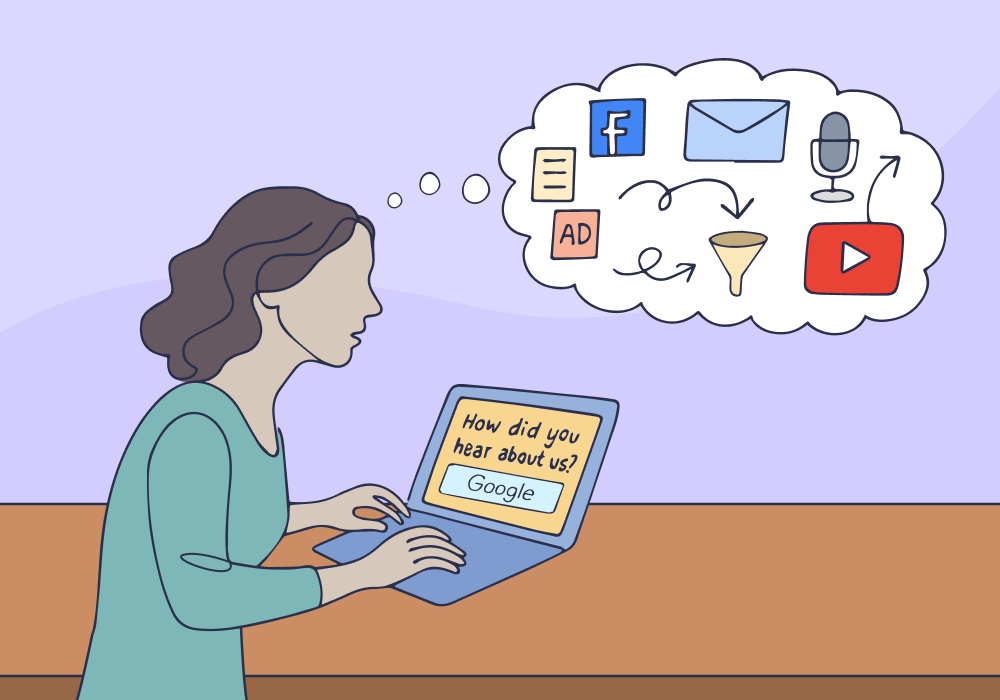
A prospect fills out your form, ready to request an $8,000 HVAC replacement. Then they see: “How did you hear about us?”
They pick Google because they remember searching for HVAC repair last week. Come reporting time, most people chose Google and almost no one chose the billboard—so your client cuts the billboard budget.
But here's what actually happened: they saw the billboard three weeks ago, heard a radio spot while driving to work, saw a Facebook ad at lunch, and then searched on Google.
Your form captured the last thing they remembered, not the path that brought them there. That billboard played a major role in bringing you those leads, but since they only remember the Google search, that impact is overlooked.
The only fix is attribution that works automatically—not through guesswork.
The Real Problem: Human Memory Can’t Power Marketing Attribution
People don’t track their own customer journeys. They live them, forget them, and only recall the final moment when they took action. That single action becomes the whole story.
A memory is not a marketing log, and relying on it turns every report into a work of speculative fiction.
The dropdown question fails for one simple reason: Humans are unreliable narrators. Here’s why.
People remember actions, not exposures.
Research shows that it takes around eight brand exposures to achieve full brand recall. They won't necessarily remember those early impressions; they’ll remember the Google search that happened after those impressions. Your display campaign gets zero credit.
Recency bias rewrites the journey.
The closer a touchpoint is to conversion, the more important it feels. Everything that happened more than 48 hours earlier dissolves.
Self-reported attribution cannot be trusted because human recall is biased, incomplete, and inconsistent. And that problem gets expensive fast.
When Memory-Based Attribution Fails, Budgets Break
Imagine your client invests $5K/month in billboards on Highway 101. After three months, they ask: “How many leads did it generate?”
You look at the form data: Zero people selected “billboard.” So the client cuts it.
Then branded search volume drops 30%, direct conversions slow, and lead flow collapses.
The billboard was working; it just wasn’t being remembered—or at least, it wasn’t being remembered consciously.
This is what happens every time attribution relies on the customer instead of the data:
- Awareness channels become invisible
- Multi-touch journeys get flattened
- Budget shifts toward whatever the prospect remembers, not what actually works
Or in plain English: marketers lose credit, campaigns lose funding, and performance tanks—all because attribution was built on a guess.
How Real Attribution Actually Works
Attribution should be recorded, not remembered.
Every time a prospect interacts with your marketing—clicks an ad, visits your site, watches a video, opens an email—that touchpoint gets logged. When they convert, the full journey is already captured.
That's how WhatConverts tracks attribution. Every lead gets tied back to its complete marketing history:
First-touch attribution shows which campaign started the relationship. This is the billboard moment, the initial Facebook ad, the direct mail piece that introduced your brand.
Multi-touch attribution reveals the full journey. See every campaign, keyword, and ad the prospect encountered before converting. Understand which channels work together to drive results.
Last-touch attribution identifies what closed the deal. Was it the Google Ad? The retargeting campaign? The phone call after a form fill?
Instead of asking leads to remember their journey, the system records it automatically. Every impression, click, and visit gets attributed to its source—no guesswork, no memory bias, no gaps.

What You See When Attribution Is Accurate
With proper tracking, patterns emerge that self-reported data would never reveal.
A home services company runs Google Ads, Facebook, and direct mail simultaneously. Their form dropdown shows most leads saying "Google."
But when they track the actual journey, they discover:
- 60% of "Google" conversions came from leads on a direct mailer list
- Facebook retargeting closed 40% of leads who first clicked a Google Ad
- Direct mail drove zero direct conversions but generated 3x more branded searches
The form data said "kill direct mail." The real attribution said "direct mail is fueling profitable search conversions."
That's the difference between asking and tracking.
How Sector45 Proves Offline ROI Without Relying on Memory
Sector45 works with cosmetic surgery clinics that advertise everywhere—online, in magazines, on radio, even on billboards. Before WhatConverts, the agency had no reliable way to prove which offline channels drove real appointment requests because patients rarely remembered where they first saw the practice.
By assigning unique phone numbers and URLs to every offline placement, Sector45 let WhatConverts capture the actual responses each ad produced—no self-reporting, no guesswork. They quickly uncovered that some of the highest-value leads came from channels patients never mentioned at all.
The result: clients finally saw how offline marketing contributed to real revenue, with some campaigns delivering ROI as high as 100:1. And Sector45 didn’t get that clarity by asking patients to remember anything—they got it by tracking the behavior that followed.
Read More: Sector45’s Secret to Client Retention: Evolving from Vendor to Partner [Case Study]
From Guesswork to Certainty
Proper attribution eliminates the "how did you hear about us?" question entirely. You don't need to ask because you already know.
With WhatConverts, marketers capture every touchpoint automatically:
- Track calls, forms, chats, and transactions back to their marketing source
- See complete customer journeys from first impression to final conversion
- Understand which channels work together versus which stand alone
- Make budget decisions based on proven performance, not prospect memory
Stop asking leads to do your attribution for you. Start tracking it automatically and see what's really driving results.
Ready to replace guesswork with certainty?
Start your free 14-day trial of WhatConverts today or book a demo with a product expert to see how we help prove and grow your ROI.
Get a FREE presentation of WhatConverts
One of our marketing experts will give you a full presentation of how WhatConverts can help you grow your business.
Schedule a Demo
Grow your business with WhatConverts