


 Alex Thompson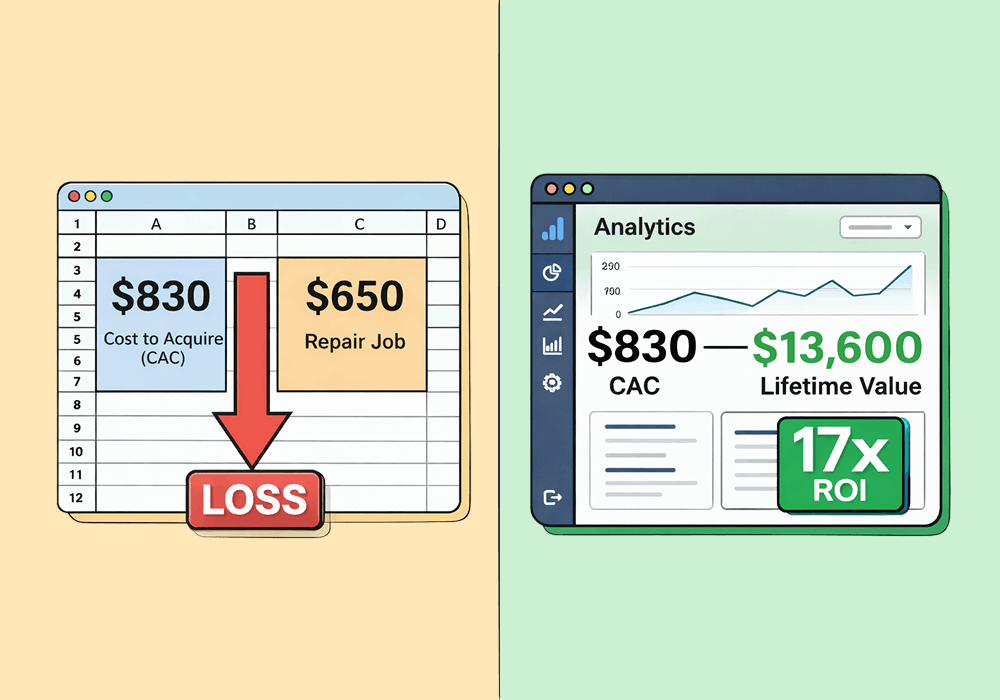
There is a central paradox in the home services industry: If you judge marketing by the first job, HVAC marketing almost always looks overpriced. If you judge it by the customer lifetime value (CLV), it looks underfunded.
Here is the exact scenario playing out in client meetings every day: Your agency generates a $250 lead. It results in a basic minor repair. After labor, parts, and the cost of the truck roll, the client looks at the spreadsheet and declares that your marketing "lost" them money.
This causes clients to panic and demand a cheaper Cost Per Lead (CPL).
But if you’re optimizing for CPL, you’re targeting the minnows (low-intent, low-value leads) and missing the whales (homeowners with aging systems).
Here’s what to do instead.
Note: Not a WhatConverts user yet? Start your free 14-day trial of WhatConverts today or book a demo with a product expert to see how we help prove and grow your ROI.
The Vertical Math: The 17x ROI Reality
To protect your retainer and stop your clients from chasing toxic, cheap leads, you must move them away from tracking the "First Job" and force them to look at the long-tail economics of an HVAC customer.
Let's break down the exact math of a Paid Search lead with a CAC of $830.
As you can see, year one usually brings in low value. But the high-value purchases tick up years down the line.
| Timeline | Service Type | Value |
| Year 1 | Initial Service/Repair (Acquisition) | $650 |
| Years 2 | Maintenance & Upsell Opps (+20-40%) | $1,200 |
| Year 3 | Full System Replacement | $10,500 |
| Years 3+ | Referrals & Continued Service | $3,000 |
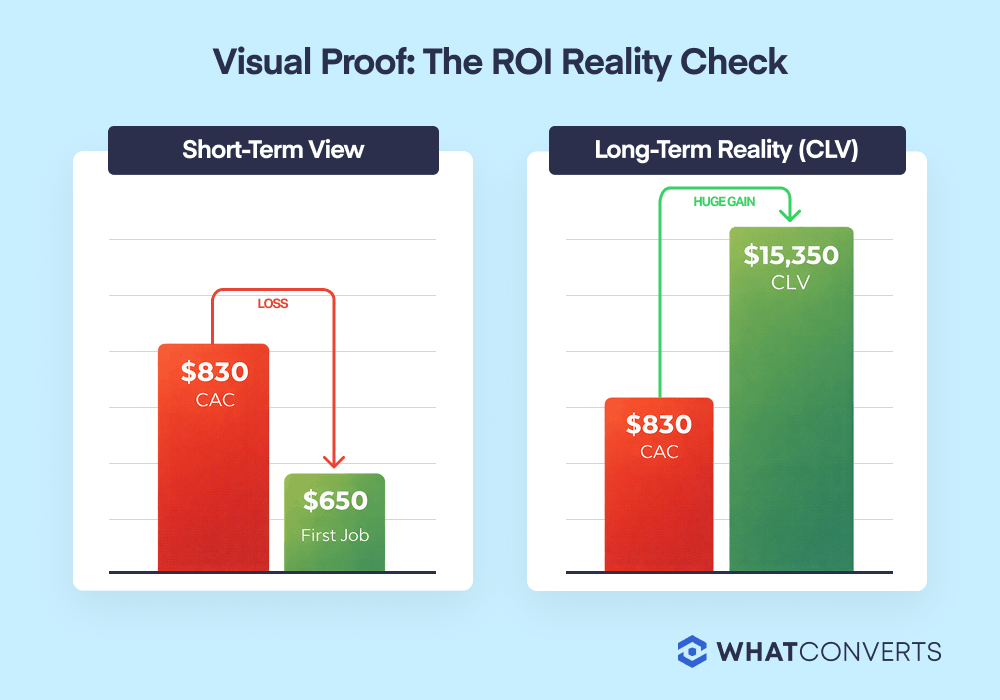
| Total | Industry Standard CLV (2025) | $15,350+ |
According to 2025 industry data, the average Customer Lifetime Value (CLV) for a residential HVAC client is now $15,340.
So a single $830 acquisition cost isn't a $180 loss on a repair; it is the purchase of $15,350 in Lifetime Value.
This isn't just theory—it’s the exact math the client’s competitors are already using to confidently outbid them on Google Ads.
The "Whale" Filter: Why Cheap Leads are Often Toxic
When a client demands a lower CPL, the agency is forced to bid on lower-intent keywords or broader match types.
The danger of low CPL is that $50 leads often come from high-density, low-income areas or renters who physically cannot authorize a $10,000 system install. The agency hits the "Lead Goal," but the client’s technicians report that there are "no sales opportunities".
However, high-intent, non-branded search leads (like "AC installation near me") typically carry a CPL of $149, resulting in an average cost per paying customer of $804.
While $804 feels "expensive" compared to a $50 lead from a renter, it is a necessary filter to acquire a homeowner capable of authorizing a $10,000 installation.
Lead tracking transparency is key for uncovering that insight. With it, you can see the exact source and value of leads, showing that "expensive" leads are actually premium filters for homeowners.
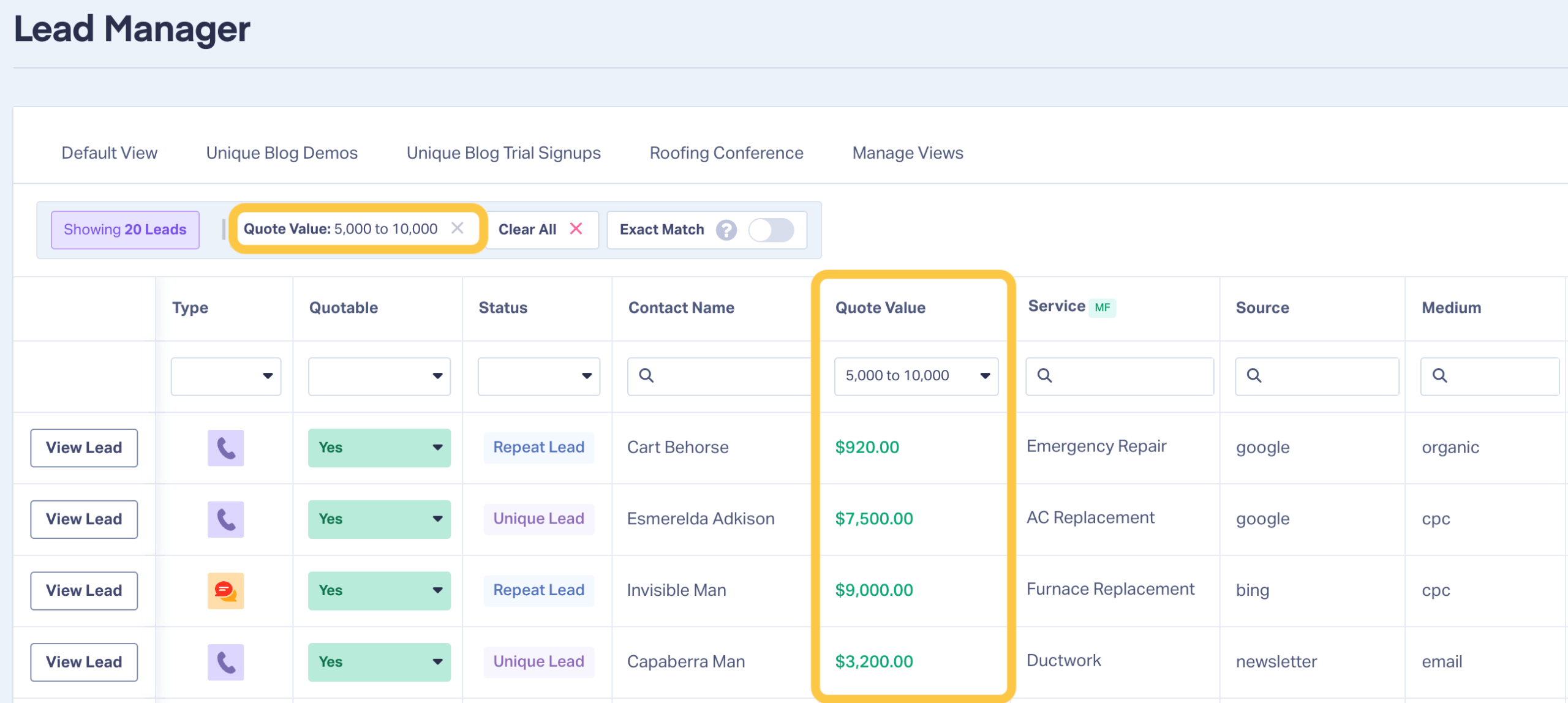
Lead value is a simple and effective way to spot which leads bring in the most revenue and understand where they're coming from. Filtering your leads by value in WhatConverts is as typing in your value range.
The "Maintenance Plan" Multiplier
Maintenance agreements are the backbone of HVAC valuation. That’s because they increase retention and offer better opportunities to upsell.
In fact, McKinsey research highlights that focused retention and service excellence can increase on-site upselling opportunities by 20% to 40%.
If you want to move from being viewed as a "discretionary expense" to an indispensable "business builder," you must prove that your marketing is generating this recurring revenue stream. By using call tracking and AI conversation analysis, you can pinpoint the exact moment a marketing-generated lead signed a maintenance contract, definitively claiming credit for that recurring value.
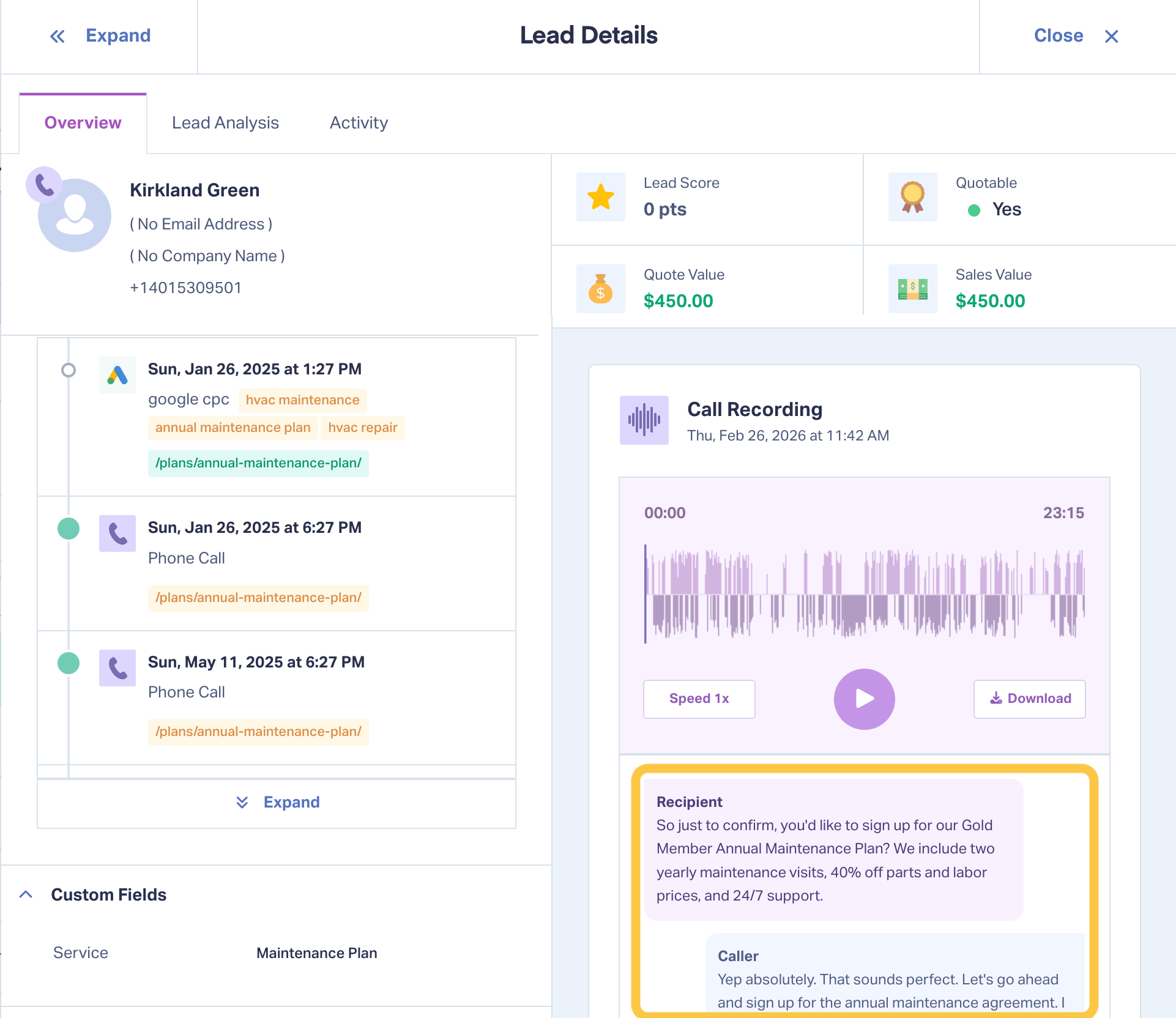
Understanding what marketing causes leads to turn into maintenance plan customers is key to getting the credit your marketing deserves. You can easily search for key phrases used on calls in WhatConverts.
The "Attribution Decay" Warning
It’s great to know this math exists, but you need a way to prove it.
The problem is that standard 90-day browser cookies are completely useless when the "big sale" (the $10,500 system replacement) happens 3 years after the first ad click. If your data is siloed, this 17x ROI is just a theory.
You need an unbroken line of attribution. By capturing the lead data (source, keyword, landing page) in a "Truth Layer" like WhatConverts and syncing it to the client's CRM, you defeat cookie decay. When that $10k replacement happens in Year 5, the agency can definitively claim credit for the original Paid Search click from Year 1.
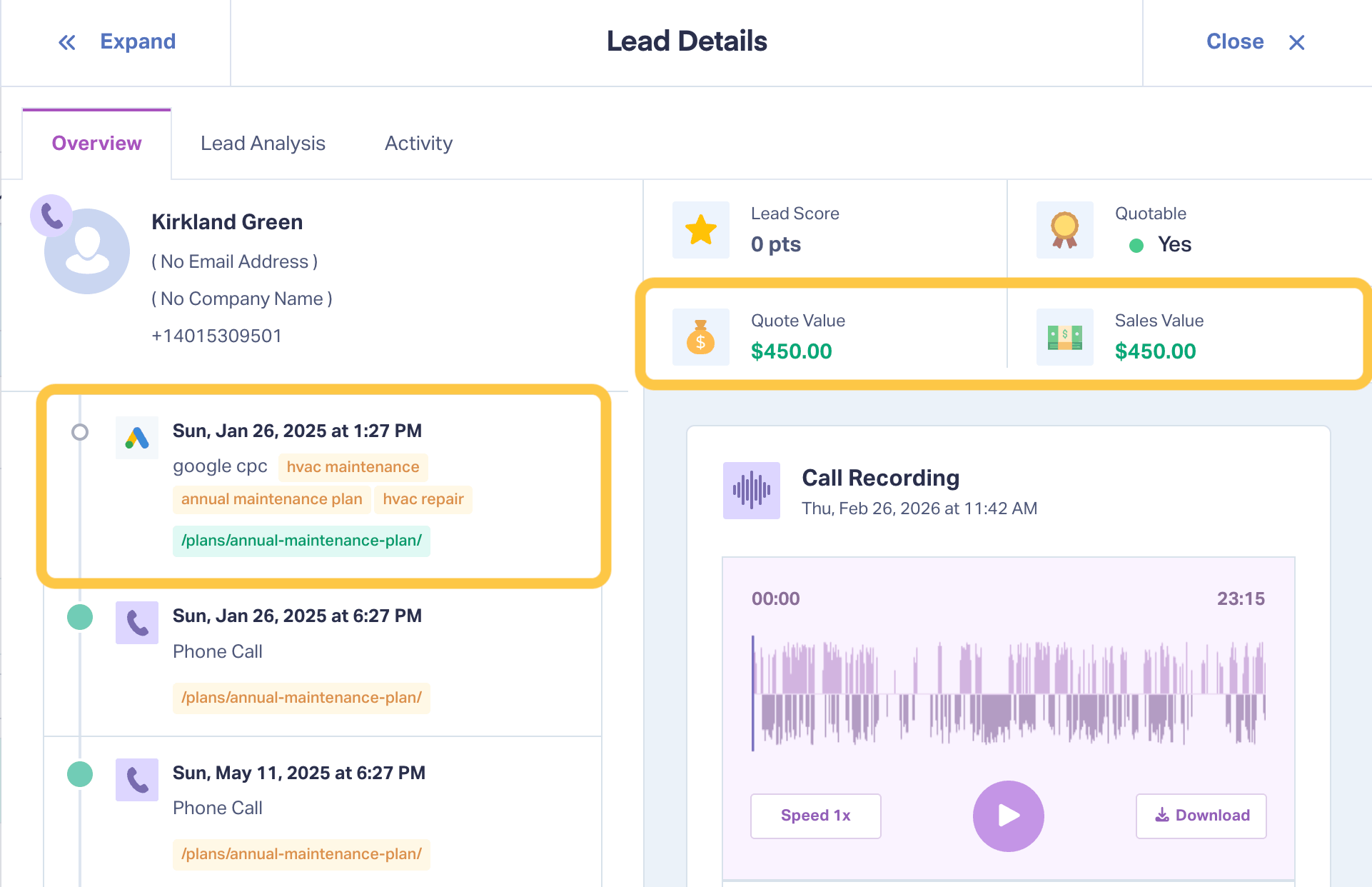
The key to understanding what marketing works is closed-loop attribution that ties revenue to the marketing that brought it in. WhatConverts syncs sales value with many CRMs, including Jobber (great for HVAC companies).
The Transparency Pivot: Visualizing the Long-Game
To move your HVAC clients out of the "Cost-Per-Lead" panic cycle, you have to change what they are looking at.
If you send them standard reports (messy PDFs focused on clicks), they will treat your marketing like a standard expense. When you upgrade them to a Customer Lifetime Value (CLV) dashboard and give them an "open door" to listen to the calls and see the homeowner data, they stop panicking about the $250 CPL. They start treating it like an investment.
Here is how the shift looks in practice:
| Feature | The Standard Report (The Old Way) | The CLV Dashboard (The New Way) | The Agency Benefit |
| The Core Mindset | Views ad spend as an expense for "Job #1" | Views ad spend as acquiring a 5-year revenue stream | Shifts clients from cutting costs to investing for scale. |
| Primary KPI | 30-Day Cost Per Lead (CPL) | 3+ Year Customer Lifetime Value | Justifies high front-end CPLs to clients. |
| Optimization Focus | Maximizing total lead volume (attracting "minnows") | Maximizing system replacements & maintenance plans | Proves you are actively filtering for high-value "whales." |
| Format & Delivery | Static, monthly PDFs showing clicks and impressions | Real-time, 24/7 access to pipeline and Sales Value | Eliminates client panic over a single "expensive" ad click. |
Asset: The 17x ROI Client Defense Script
The next time a client calls to complain about high CPLs or wants to pause an "expensive" HVAC campaign, copy and paste this script:
"I agree that spending $830 to acquire a customer for a $650 repair looks like a loss on today's spreadsheet. But our tracking shows that acquiring this specific type of homeowner yields an average Lifetime Value of $15,000 over the next 7 years through maintenance, replacements, and referrals. We aren't losing $180 today; we are buying a 17x guaranteed return for the business. If we turn this campaign off, we are simply handing that $15,000 to your competitor."
Conclusion: Optimize for the Whale
If you optimize purely for the cheapest CPL, you are actively filtering out your most profitable future customers.
Stop reporting on "Jobs" and start reporting on "Acquired Assets". Implement a long-tail attribution strategy today to definitively prove your agency's true worth to your HVAC clients.
Start your free 14-day trial of WhatConverts today or book a demo with a product expert to see how we help prove and grow your ROI.
Get a FREE presentation of WhatConverts
One of our marketing experts will give you a full presentation of how WhatConverts can help you grow your business.
Schedule a DemoGrow your business with WhatConverts