


 Alex Thompson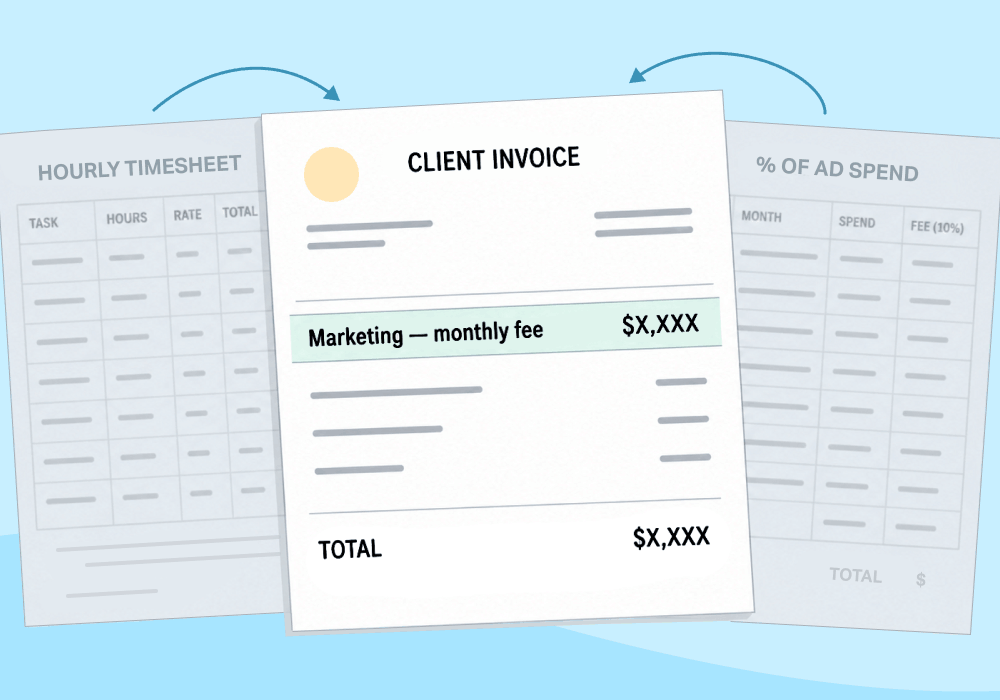
You run lead generation for home-services clients, and you’ve heard the advice a hundred times: stop billing for hours, start charging for value. It removes your earnings cap, opens the door to scaling your agency, and pays out based on results, not tasks.
Then you sit down to write the invoice, and the advice stops exactly where you need it most. Most agency owners making the switch run into this problem:
“Everyone tells me to charge based on value, but nobody tells me what that actually looks like as a monthly invoice I can put in front of a client.”
This article solves that problem. A Revenue Retainer sets your monthly fee as an agreed share of the revenue your marketing drives, forecast a year ahead and divided by twelve. By the end you’ll be able to explain it to a client and decide whether to offer one this year.
“Charge for Value” Has Never Told You What to Put on the Invoice
The advice to price on value is incomplete. It tells you to stop billing for hours, and stops short of showing you what to bill instead. Marketers know the model exists. The industry even names it in standard agency-pricing guides: “value-based recurring pricing,” where clients pay a share of the value delivered every month. The problem is “difficulty quantifying exact ‘value’ each month” (RivalFlow). How are you supposed to set each month’s invoice when the value earned keeps moving?
The numbers show it’s a real issue too. In Consulting Success’s survey, 39% of consultants said they’d never tried value-based pricing because they don’t know how. They believe it works. They just don’t know how to build the number.
The rest of this article covers what number goes on the invoice and how you build it. (WhatConverts has also covered another angle on pricing to the value you show.)
Nobody in that survey was arguing against value pricing. They just couldn’t produce the number it runs on.
| Why consultants haven’t tried value pricing39%of consultants have never tried value-based pricing, because they don’t know how.Consulting Success survey |
| What consultants say is hard: “difficulty quantifying exact ‘value’ each month.” (RivalFlow) |
The Problem with Hourly Pricing
Let’s look at the two most common pricing models for agencies, starting with the most common: hourly. Hourly billing has a ceiling you can calculate, because revenue equals your rate times the hours you can sell. ConsultFees runs the math. At $250 an hour and 25 billable hours a week, a consultant tops out near $325,000 a year at peak capacity.
The only levers left are hiring or raising rates, and both move the ceiling instead of removing it. The chart below shows the shape. Revenue climbs with hours, then goes flat, because there are only so many hours in a week. The value you create keeps rising past what you can bill.
Then it gets worse, because the model punishes the skill it should reward, a problem ConsultFees calls the efficiency penalty. A junior consultant needs 30 hours for a job and bills $6,000. A senior does the same job in 10 hours and bills $2,000. Ten years of skill earned $4,000 less.
Pricing consultant Jonathan Stark argues hourly billing works against both sides’ financial incentives and breaks trust. The billable hour, he says, was never built to price professional services. It was borrowed from factory-floor cost accounting.
Hourly is clear, and a client always understands it. What it doesn’t do is connect your pay to your results, which is what billing for tasks costs an agency over time.
The better you get at this work, the less hourly billing pays you for it.
The Problem with Percentage of Ad Spend Pricing
What about pricing on a percentage of ad spend? That model has its own problems. A percentage of ad spend ties your fee to the client’s budget. Spend goes up, you earn more. Spend goes down, you earn less. Results never enter the math, so your incentive and your client’s point in opposite directions from the day you sign.
In one line, Credo explains both sides: the client is “incentivized to… spend as little as possible,” while the agency’s goal is “to get your clients to spend more.” You end up pulling one way while the client pulls the other.
Let’s put it in dollars. 15% of a $50,000 budget is $7,500 a month. Optimize the account so the client hits the same result on $35,000, and your fee drops to $5,250 (AlwaysOnward). Your best work cuts your own pay.
Is the model always wrong? No. Credo says it holds up under tight guardrails: the client gives written approval before any spend increase, the agency eats overspend, and reporting ties spend to profit. All three guardrails peg the fee to results rather than to budget size, so the version that works is already a results-based fee under another name.
Percentage-of-spend pricing is common, too. WordStream’s 2019 survey found 34% of agencies priced this way, most charging 10% to 20%. Home services was among their top three client verticals. The table below sets all three models side by side.
Both models tie your fee to your own inputs, which is why neither one moves when you make the client more money.
To make matters more complicated for agencies, ad costs keep climbing too. See why that pressure will force every agency to prove ROI outright, or lose the client.
Related Reading: Rising Ad Costs Will Force Agencies to Prove ROI—or Lose Clients
Charging a Percentage of the Value You Create Is a Proven Model, Just Not in Agencies Yet
Before you introduce a new number to a client, you need to know it isn’t an experiment. Pegging a fee to a share of some number is one of the oldest plays in professional services, and a revenue-share retainer applies that play in a new setting.
Whole industries already price on a percentage of the number that matters
Start with franchising. Franchise royalties are a share of the franchisee’s gross revenue, calculated before profit or expenses and collected for the life of the deal. The franchisor’s income rises only when the franchisee’s revenue rises, which is the same structure as a fee built on a share of client revenue. Forbes lays out how franchise royalties are calculated on gross revenue.
Recruiting does something similar. Placement fees run as a cut of first-year salary, split across milestones. Top Echelon’s worked example on a $75,000 role at a 25% fee pays 5% up front, 10% at shortlist, and 10% at hire. One number, paid in stages.
Real estate and consulting run the same play, on sale price and on revenue growth. The tiles below line up all four.
Fixed, forecast-based pricing isn’t new either, and neither is a slow rollout
Setting a fixed number ahead of time has its own history. Ron Baker of the VeraSage Institute began pricing accounting work fixed in advance in 1989. He sold certainty the way a fixed-rate mortgage does, by telling the client exactly what’s coming. He cites AICPA data showing 30% to 60% of accounting firms now value-price, “way up from 15 years ago.”
Marketing shows the same drift on the advertiser side. The ANA found 82% of surveyed marketers now use fee-based, non-hourly compensation, up from 68% in 2016. That shift runs strongest among the largest advertisers, and it still points the whole market the same way.
Be honest about the pace, though. Law is the most recorded case of a whole field moving off the billable hour, and the move is real but slow. Alternative fee arrangements climbed to roughly 20% of firm revenue after 2008, then plateaued around 2014, even with clients asking for more.
The decades-long shift away from the billable hour points the right way while showing how long it takes. Adopting a better model is a multi-year move rather than a switch you flip.
You’re not inventing a pricing model here. You’re borrowing one that four other industries already run.
The Revenue Retainer: One Monthly Number, Built From the Revenue You Can Forecast
A Revenue Retainer is a monthly agency fee built from one number. Forecast the revenue your marketing will drive over the next twelve months, agree on a share of it, and divide by twelve. The fee grows only when the revenue you create grows. Ad budgets and billable hours don’t enter the calculation.
This answers the blank invoice from the top of the article. The four steps below build the number.
| 1 Baseline attributable revenueTrailing 12 months of revenue your marketing can be shown to have driven. |
| 2 Forecast twelve months outProject that baseline forward, folding in growth and seasonality. |
| 3 Agree on a percentageA share of that forecast, agreed with the client. |
| 4 Divide by twelveSplit the annual figure into twelve equal payments. |
| The resultOne predictable monthly feeOne predictable amount each month, agreed a year ahead. |
Step 1, the baseline. Take the revenue your marketing can be shown to have driven over the trailing twelve months. Not leads, not spend, revenue.
Step 2, the forecast. Project that baseline forward twelve months, folding in growth and seasonality.
Step 3, the percentage. Agree with the client on what share of that forecast your fee will be. This article doesn’t set that share, because the right one depends on your market and how much risk you’re carrying. The precedents above run from 8% to 20%.
Step 4, the division. Split the yearly figure into twelve equal payments. The client gets one predictable monthly fee, and your cash flow stays steady.
The fee tracks what you produce for the client, rather than what you spend or how long you take. You can collect it as one ongoing share, the way a franchise royalty works, or split it across milestones, the way a recruiting fee works.
The baseline is the number most agencies can’t produce yet
Every step after the first is arithmetic. Step 1 is the hard one, because setting the baseline means tracing which revenue your marketing drove, lead by lead and call by call, back to the campaign that produced it. Most agencies can’t do that today, and it’s the practical reason value-based pricing stalls.
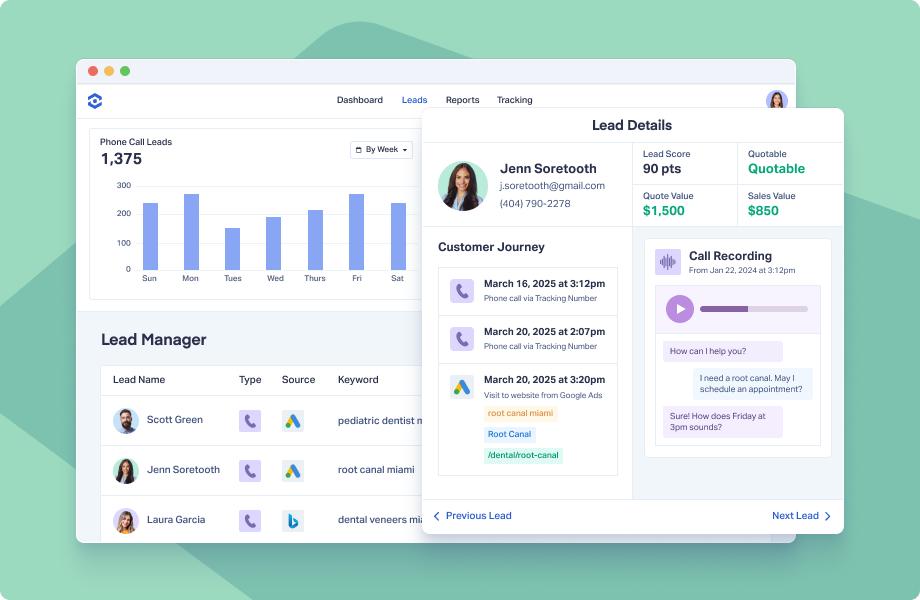
The baseline a Revenue Retainer is built on: the actual revenue your leads can be shown to have driven. This is the number Step 1 needs.
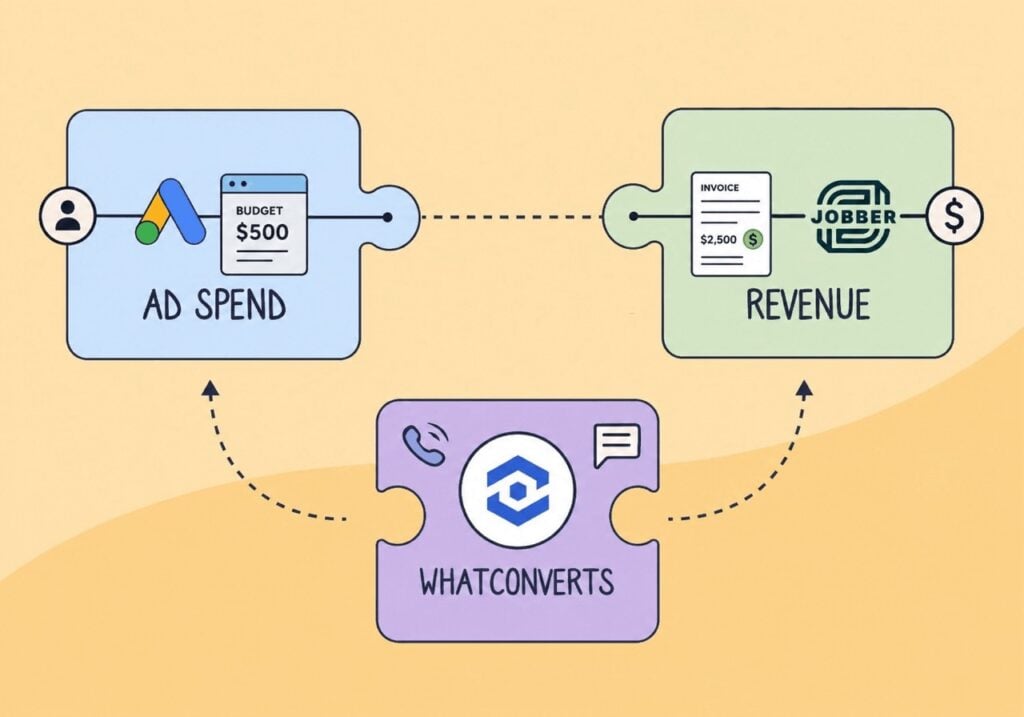
Lead tracking is what supplies it. WhatConverts ties each lead and call to the revenue it became, so the baseline is a figure you can defend rather than an estimate you hope holds up. Pull that piece out and the model has no number to stand on, which is why proving which revenue your marketing actually drove comes first.
Step 1 is the only step that needs a tool. The other three are arithmetic you can do in a spreadsheet.
What a Revenue Retainer Looks Like on a Real Invoice
Now the same model with real numbers. Say you run marketing for a roofing client with a trailing-twelve-month, marketing-attributed baseline of $2.4 million. Forecast a 15% rise and you’re near $2.76 million. Agree on a share of that forecast, then divide by twelve. What lands on the invoice is a single line: “Marketing, monthly fee: $X,XXX.”
Set that line beside the alternatives. An hourly bill changes every month and needs explaining every month. A cut of a $50,000 ad budget pays you to spend more of the client’s money. The revenue-share line holds steady and moves only with the forecast you both agreed to.
Home-services revenue share isn’t hypothetical, at least in one vertical. A 2026 guide shows commercial HVAC agencies charging 8% to 15% of closed contract value, with attribution windows of 180 to 365 days and clawbacks if a customer cancels early (Sure Shot Systems). Treat that as the best vertical-specific data point available, and note that it covers HVAC only. Don’t carry 8% to 15% over to roofing or plumbing without saying where the range came from.
Producing that invoice takes more than a spreadsheet guess. It means forecasting from a real baseline, then reporting the fee each month against the revenue your marketing drove, which is the job revenue reporting does.
The client sees one line on the invoice. Behind it sits a revenue figure out of their own business that they can check any month.
Deciding Whether a Revenue Retainer Fits Your Agency
The model is right for some agencies and wrong for others, so here are both cases. You’re ready to offer a Revenue Retainer when four things are true: you can produce a trustworthy attributed-revenue baseline, you have enough history to forecast from, the client is willing to share revenue outcomes, and your attribution is solid enough to stake a fee on. The checklist below lets you choose in about ten seconds.
You’re not ready when any one of those is missing. No attribution, no meaningful history, or a client who won’t open their books each mean not yet. The HVAC guide sets the same bar bluntly: pure revenue share needs “a proven funnel with documented conversion rates,” plus real history of at least six months of leads and closes.
Skip that, and you’re either pricing the risk too low or gambling on volume over quality. “Not yet” is a legitimate result of this decision, and it’s a cheaper one than a fee you can’t defend six months in. Every item on that ready list rests on attribution, because you can’t price on revenue you can’t trace, which is why value-based marketing built for agencies starts with tracking.
Say you clear the bar. Three decisions still sit in front of you: how to move an existing client onto the model without a hard cutover, what share to charge, and how to defend your forecast the way an appraiser defends a valuation.
If you’re missing the attribution, fix that one thing before you price anything.
Not ready to move a whole book at once? See four low-risk ways to start with a single client.
Read the Article – You Don't Have to Jump All at Once: A Practical Path to a Revenue Retainer
You Finally Have a Number to Put on the Invoice
You started with advice you couldn’t act on: charge for value, with no invoice attached. Now you have the method the advice skipped. Baseline the revenue your marketing drove, forecast it forward, agree on a share, and divide by twelve.
What the client sees is one visible number, tied to the outcome you produce rather than to the hours you burn or the budget they set. You can offer it this quarter, or fix your attribution first. Either way, you’re deciding from the number now, not the slogan.
Ready to build a Revenue Retainer number from your own client’s data instead of the composite example?
Get a FREE presentation of WhatConverts
One of our marketing experts will give you a full presentation of how WhatConverts can help you grow your business.
Schedule a DemoGrow your business with WhatConverts