


 Alex Thompson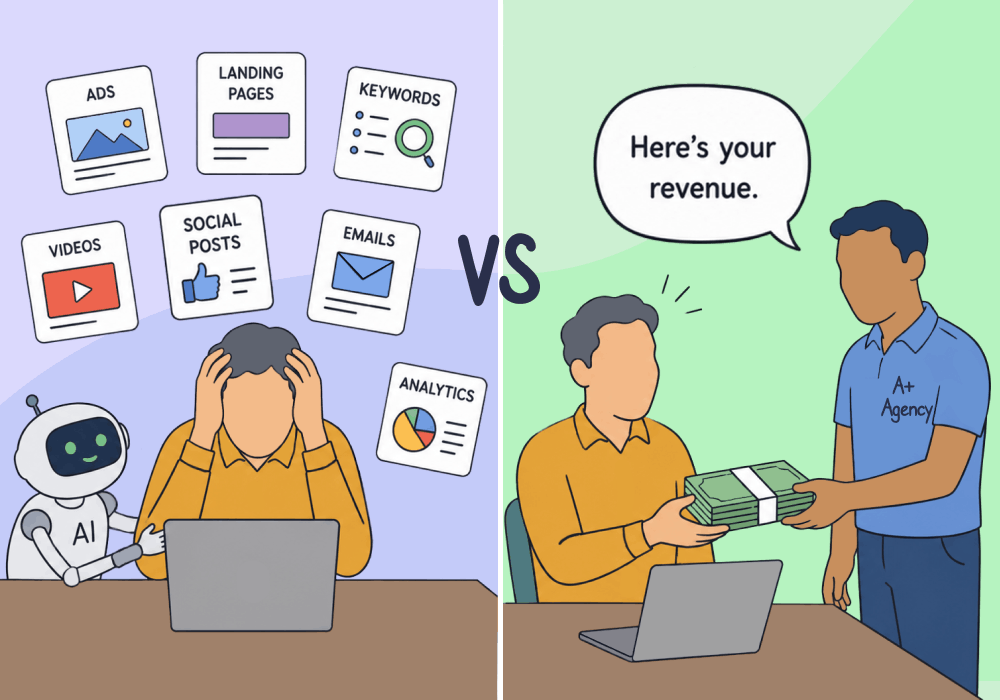
Google's own tools now handle most of the work agencies bill for inside a PPC account:
- Smart Bidding sets the bids.
- Performance Max runs whole channels.
- AI Max builds the targeting and writes the ad copy.
Your clients can see this happening too. Sooner or later one of them asks the obvious question: "What are we paying you for, when we can do it all ourselves now?"
AI can do the task. What it can't do is produce a proven, source-tied revenue number and then stand behind that number in front of a client.
A source-tied revenue number is one specific thing: the dollars a client actually invoiced, matched back to the campaign, ad and keyword that brought the job in. It takes a real click, a real booked job and a real paid invoice before it exists. That number is what a home-services client is buying when they hire you.
In this article, we'll cover what Google automated, what clients are already doing about it, why revenue is the outcome you can still own, and what makes that number so hard for a machine to fake.
Google Now Runs the Tasks You Used to Bill For
Here's a typical PPC scope of work:
- Bid management
- Keyword targeting
- Ad copy
- Campaign builds
Every one of those line items now has a Google feature that does it automatically. The before/after below shows where each of them went.
| Who runs the auction nowThe work you used to bill for moved inside Google | |
| Before · your scope of workBid adjustmentsKeyword listsAd-copy variantsCampaign builds | Now · inside Google's platform→ Set by Smart Bidding→ Matched by AI Max→ Rewritten automatically→ Assembled by Performance Max |
| All four jobs now run inside Google's platform. | |
Start with bidding. Smart Bidding sets a fresh bid for every single auction. It weighs device, location, time of day, remarketing history, query-versus-keyword matching, and the search-partner site, all at once. Google's own Smart Bidding guidance describes that as "a wider range of parameters than a single person or team could compute."
Targeting and creative went the same way. "Keywordless" was Google's own word for the direction of Search and Performance Max back in 2023. Today AI Max matches queries you never targeted, and rewrites your ad assets when Google decides it helps (Search Engine Journal).
Campaign builds are affected too, with Performance Max assembling a campaign across Search, Display, YouTube and Shopping from a single set of inputs.
So when your retainer says "we manage your campaigns," it names four jobs the platform now does for itself.
A client reading that scope of work is reading a list of things Google now does on its own, with the ad spend they already pay for.
Want to see exactly which parts of the job AI has taken over, and the moves that keep you ahead of the shift instead of behind it? We broke it down here.
Related Reading: Marketers: How to Adapt to Google Ads Automation & AI
Clients Already Know, and They're Moving Budget Away From Task-Sellers
Your clients can see the automation too, and the spending data shows they've started acting on it.
Gartner's 2025 CMO Spend Survey of large brands found that 39% of marketing leaders plan to cut agency budgets. Another 22% say generative AI has already let them lean on agencies less "for creativity and strategy building" (Gartner).
Agency owners report the same thing from the inside. SparkToro surveyed agency owners in 2025. The share calling AI "a significant threat to the agency business model" climbed from 44% to 53% in a single year (SparkToro).
We made the fuller case for that risk in the AI risk agencies can't afford to ignore.
PPC churns faster than any other service line
PPC gets hit hardest of all. One agency studied its own book and put paid-media churn at 49% a year, the highest of any service line it offers. The reason it gave: paid media is "easily commoditized with transparent performance metrics that enable rapid comparison shopping." The same study names AI-driven in-housing as the biggest new churn factor of the year (Focus Digital).
Say you're running about $40K a month across a few HVAC and roofing clients. One of them emails: "Google's AI basically runs our ads now. Remind me what I'm paying you for?" You can point to your process and your hours. Neither one tells the client how much revenue came out of the $40,000 they spent, and that figure is what the question is really asking for.
Every month you can't answer that question with a revenue figure, the client has one more reason to test the market.
The fresh 2026 data behind this shows why proving ROI is becoming the line between the agencies that keep budgets and the ones that lose them. See what it found.
Related Reading: Half of Marketers Predict Proving ROI Will Be a Struggle in 2026
Outcomes Were Always the Real Product, Not Tasks
So what do you sell when the task sells itself? You sell the outcome. For a home-services client buying leads, that outcome is revenue: booked, invoiced jobs that came from your campaigns.
Some agencies have already made the switch. Alex Vacca runs the outbound firm ColdIQ, and he frames the change around what you end up competing with (Forbes). Price on volume, and your competition is a $500-a-month AI tool. Price on the pipeline you generate, and your competition is what it costs the client not to have that pipeline.
Price on volume, and your competition is a $500-a-month AI tool. Price on the pipeline you generate, and your competition is what it costs the client not to have that pipeline.
Venture capital has a name for this split. Sequoia calls it copilot versus autopilot:
- A copilot sells a tool to someone who stays on the hook for the result. It gets paid out of the software budget.
- An autopilot sells the result itself. Because it replaces work a person would otherwise do, it gets paid out of the client's labor budget, and labor budgets are, in Sequoia's words, "in most professions, orders of magnitude larger."
Selling the task keeps you in the software budget, which is the smaller of the two. Investors backing agencies that sell outcomes have been pointing at that split for the past year. This isn't only a startup game. WPP, the largest ad holding company on earth, is moving client billing away from hours worked and toward fees tied to outcomes (Ad Age).
Nick LeRoy made the same case in Search Engine Land, from the angle of accountability. His argument is that clients pay for a person who will stand behind the result, so the deliverables that last are the ones judged by outcomes rather than effort.
WPP, ColdIQ and Sequoia are describing the same move from three directions. The fee follows the result the client got.
See what changes once you price the result instead of the task.
Proving the Revenue Is the Catch Most Agencies Can't Yet Meet
There's a catch here, and it's a real one. You can't simply tell a client "we made you money." They've heard that line from every agency they've ever fired. To a client, an unproven revenue claim and an unproven task claim sound the same, so the claim only lands if you can show the invoices behind it.
Your best leads make that harder still. In home services, a call that becomes a $12,000 roof replacement can carry a higher cost per lead than a call that books nothing, so a cost-per-lead report ranks the good call last. That call moves to the top of the list only when the report carries the job's value next to its cost, which is what it takes to prove the real value behind an expensive-looking lead.
Attaching that value is where most agencies get stuck, and the survey data says most of the industry is stuck in the same place.
In HubSpot's 2026 survey of 1,500-plus marketers, "measuring the ROI of marketing activities" ranked as the single biggest challenge, named by 33% (HubSpot). That put it ahead of keeping up with platform changes, and ahead of winning leads.
The Search Engine Journal report that mapped the keywordless shift reaches the same conclusion. It calls first-party, CRM-verified revenue data "the foundation of the entire AI-era measurement stack."
A third of all marketers name this as their single biggest challenge, so solving it is also what separates you from the agencies you bid against.
Why a Revenue Number Is Hard for a Machine to Produce
That difficulty is also what makes the number worth something. A revenue figure needs a real click, a real booked job and a real paid invoice before it exists, and software can't supply any of the three. The diagram below puts the two claims side by side.
| The gap between a task claim and a revenue claim |
| What you can show today“We ran your ads.”Impressions, clicks, CPL. All task metrics a dashboard can print. |
| ↓ |
| The record that ties a lead to its invoiceTied to the campaign that produced it, checked against the invoice. |
| ↓ |
| What the client actually wants“We made you $X.”Validated, source-attributed revenue. |
"We ran your ads" is a task claim, and any dashboard can print it. "We made you $X" means tying spend to real revenue and checking that revenue against what the client invoiced.
Lead tracking is what closes that gap. It stamps every call, form and chat with the source, campaign and keyword that produced it, then keeps that stamp attached while the lead turns into a quote and then an invoice.
That open gap is also what task-based pricing really costs an agency. Every month the gap stays open, you bill for the work rather than for the revenue the work produced.
The fix is better tracking, not better campaigns.
There's a way to tie a real sales value to every lead you already track, so "we made you $X" stops being a guess. Here's how it works.
Feature Highlight: Value Leads Software
AI Can't Own a Validated, Source-Attributed Revenue Number
The thing you can own has a name: a validated, source-attributed revenue number. It's the revenue your marketing produced, traced back to the campaign that produced it and checked against what the client invoiced. A machine can't own that number, for two reasons.
The first reason is proof. AI can generate a thousand ad variants before lunch. It cannot generate an invoice, because an invoice records money a real customer actually paid. The number only exists when a real click connects to a real booked and invoiced job. Remove any one of those three and there is nothing left to report.
The second reason is accountability. When a result goes wrong, "nobody gets to blame the AI," as LeRoy put it (Search Engine Land). A person owns the number and answers for it in front of the client.
Proof and accountability together are what your client has been paying for all along. What they get for the money is the marketing source, the booked job, and the invoiced dollar, tied back to the campaign that started it.
Software can generate the ads, the bids and the targeting. It can't generate the invoice, and it can't sit in the meeting when the client asks about it.
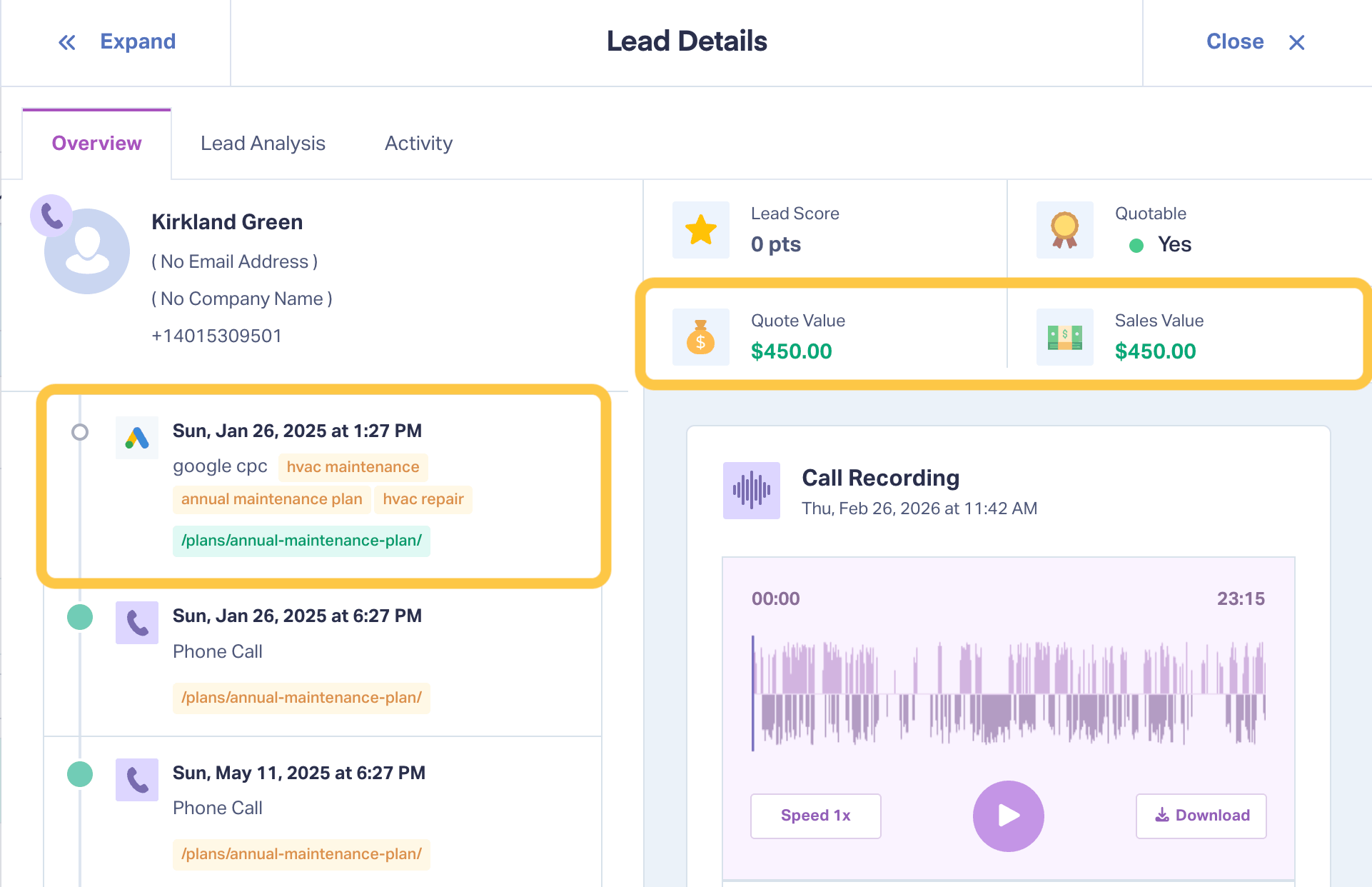
In WhatConverts today, every lead is tied to its marketing source and a real sales value. That is the raw material a validated revenue number is built from.
Even Google's own automation depends on this number
Google's own automation needs the same invoiced-revenue figure. Google recommends judging Smart Bidding over at least 30 conversions, or 50 for Target ROAS, before you trust it (Google's own guidance, not a third-party estimate).
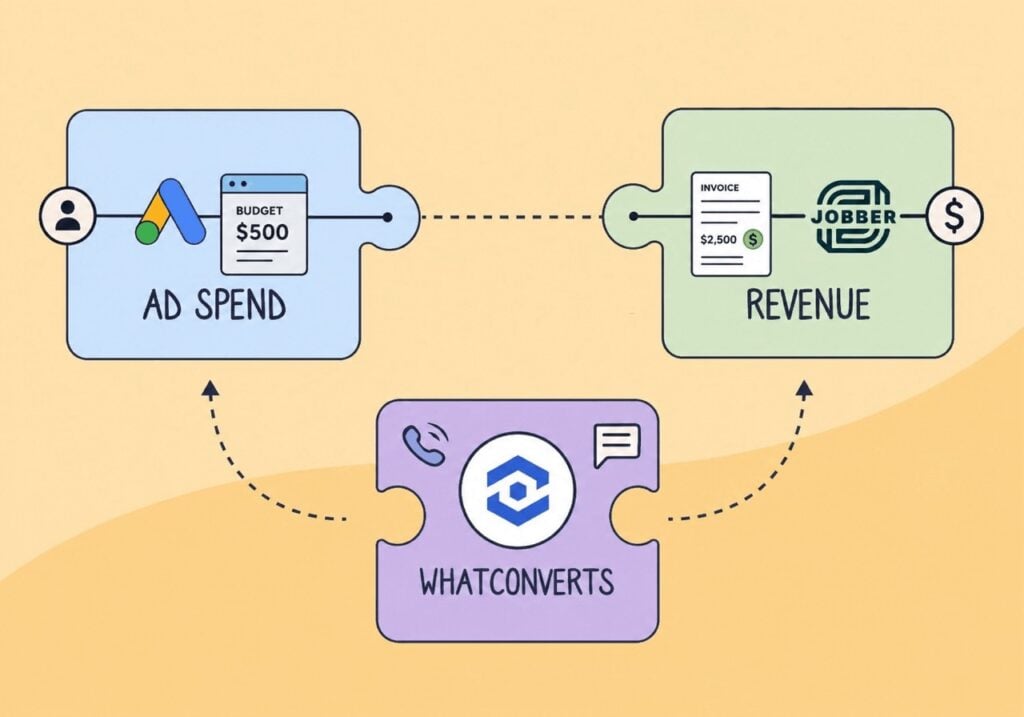
Once you can answer "which leads became real, invoiced revenue," you can send those values back into Google Ads as conversion data, rather than counting every call as the same event. Smart Bidding can then optimize toward the calls that turned into paid jobs, instead of toward call volume. Google can't work that out on its own, because the invoice is created in the client's business, outside the ad platform, weeks after the click.
This also stays a marketing question rather than a sales one. A CRM records who bought and what they paid, but it doesn't record the campaign, ad or keyword that brought them in. Connecting revenue back to the marketing that produced it, then checking it against the invoice, is the part that belongs to you.
Google needs this number too, so producing it makes the automation work better for your client rather than just tidying up your reporting.
What to Tell the Client Who Asks Why They Still Need You
Go back to that email: "Google's AI basically runs our ads now. Remind me what I'm paying you for?"
Here's the answer. Google runs the tasks, and you produce the number that says what those tasks earned. The client is paying for that number, because it's the only part of the arrangement that tells them whether the spend worked.
That means you can stop defending your hours, and stop defending work Google now automates. Point at the revenue instead: dollars invoiced, tied back to the campaign that brought the job in.
Knowing what to own is the first step. The flow below shows the sequence that follows it, where each step depends on the one before:
| Five steps, in orderOwn your revenue figure, then grow the agency |
| 1 Connect your marketing to the revenue it produced.The invoiced revenue behind each campaign. |
| 2 Prove an ROI you can stand behind.A figure the client can check against their own invoices. |
| 3 Earn the client's trust.The client can see what the spend earned. |
| 4 Defend and grow the budget.The revenue figure supports the budget request. |
| 5 Grow the agency.Fees set on the revenue you produce. |
Every step in that sequence depends on the same link: your marketing tied to the revenue it produced, checked against the client's invoice. Building that link is what the next article in this series covers.
See how a lead keeps its source through the CRM handoff and all the way to the paid invoice.
Ready to prove your marketing pays for itself instead of defending the hours behind it?
Get a FREE presentation of WhatConverts
One of our marketing experts will give you a full presentation of how WhatConverts can help you grow your business.
Schedule a DemoGrow your business with WhatConverts