


 Alex Thompson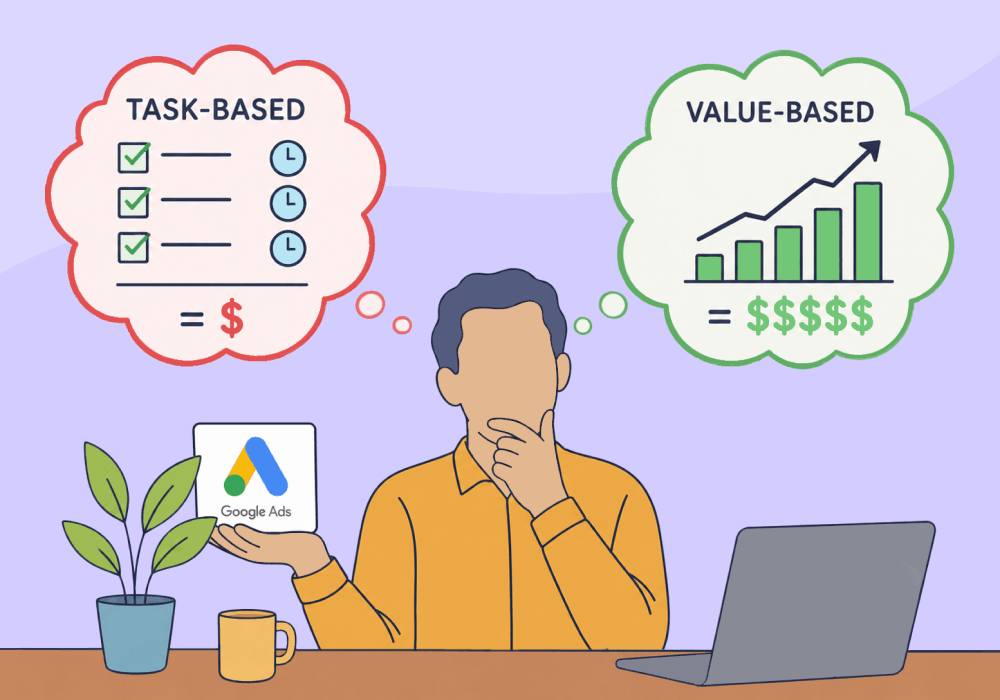
You run Google Ads for home-services clients: roofers, HVAC companies, plumbers. You already believe value-based pricing beats billing for hours or taking a cut of ad spend.
What you probably can’t tell is how much pricing on your own costs is costing you right now. It could be a rounding error. It could also be a second income you’re handing your clients for free.
Most owners who stay on cost-based pricing already believe in the alternative. What stops them is practical, because value pricing runs on a number they can’t produce yet.
In this article, we’ll put that gap in real dollars, name the one thing that makes the switch possible, and give you a way to check whether you’ve underpriced your own agency.
Cost and Value Pricing Start From Opposite Ends
Cost-based pricing sets your fee from your own costs plus a markup. Value-based pricing sets it from the revenue your work creates for the client. The difference matters because one approach is capped at your expenses, while the other rises with the growth you drive.
- Cost-plus pricing starts with you: your hours, your overhead, a markup, and that’s the quote. As the CPA Journal notes, it overprices in weak markets and underprices in strong ones.
- Value-based pricing starts with the client’s outcome. You price what the result is worth to them, your costs and competitors aside. It’s the case Ron Baker has made for decades: price the customer, not the services.
Picture three landscapers bidding the same yard.
- The first charges by the hour. He’s pricing his inputs.
- The second gives one flat price for the job. He’s pricing his outputs.
- The third learns the homeowner plans to sell next year and pitches the best curb appeal for that sale. He’s pricing the transformation, and he charges the most, because he’s the only one who showed what the work was worth.
A task-based agency asks what a job cost to deliver. A value-based agency asks what the revenue it created is worth. The third landscaper asked the second question, and his was the highest bid of the three.
Most agency proposals start from the agency’s own costs, which is why the fee doesn’t move when the campaigns do.
| Cost-basedStarts from YOUR costsYour hours + overhead → a markup → your feeThe ceiling is your own costs | Value-basedStarts from the CLIENT’S outcomeRevenue you create → your share → your feeRises when the client’s revenue rises |
| Price the inputsby the hour | Price the outputsone flat price | Price the transformationa share of the result |
Pricing on Cost Leaves Most of Your Value on the Table
Pricing on cost leaks most of the value you create, and the leak is measurable in dollars. Start with the raw power of price itself. A business has three levers it can pull to lift profit: raise the price, cut variable costs, or sell more volume.
McKinsey found that for an average large company, a 1% price change moves profit more than cutting costs does, lifting operating profit about 8% at steady volume. A 1% improvement in variable costs returns roughly two-thirds as much, and 1% more volume returns less than a third as much.
Price is the strongest of those three levers, which means you can’t out-work a pricing leak by signing more clients, and you can’t save your way out of one by trimming costs. The correction has to happen at the price.
Now the leak itself. Under the legal industry’s 2025 benchmarking, only about 2.4 of a lawyer’s eight billable-model hours ever get paid, which leaves roughly 70% of a working day unbilled. Agencies lose value the same way, through work that gets done and never reaches an invoice. 57% of owners lose $1,000 to $5,000 a month to scope creep.
What the gap looks like in a roofing shop
Say you run campaigns for a roofing client on a flat $4,500-a-month retainer. Storm season hits. The booked-job revenue you’re driving climbs from about $40,000 in a slow month to $200,000 at the peak, and your invoice reads $4,500 the whole way up.
So the better your campaigns perform, the wider the gap between the revenue you create and the fee you collect. At the peak you’re producing $200,000 of booked work for the same $4,500 you charged in the slow month. Measured per dollar of revenue you create for them, your best-performing client pays you the least.
That’s the math many agencies have already felt without ever putting a number to it. The gap stays invisible because the fee is pegged to tasks rather than to the revenue those tasks produced.
Take your best client. Add up the revenue their campaigns produced last month, then divide it by what you invoiced them. That percentage is what you currently charge for value.
A flat fee against six months of rising campaign revenue.
See why the tasks agencies bill for are being commoditized, and the one outcome that stays yours to own.
Four Reasons Agencies Stay Stuck
What keeps agencies on cost-based pricing usually isn’t doubt that value pricing works. It’s four practical obstacles, and the fourth is the one this article is about.
- Fear of losing clients stops most increases, yet two-thirds of the firms that did raise prices lost no clients and stayed just as profitable (2025 benchmark).
- Inertia: the model is wired into how an agency runs, and Baker notes that changing it touches everything, so anyone paid by the hour resists.
- A positioning gap in disguise: if a prospect is weighing you on scope and price, Haus Advisors says that’s a positioning gap, not a pricing gap.
- No proof of the value you created. You can’t charge for value you can’t demonstrate you produced. Firms that think they’ve switched have often just renamed an hourly estimate as a fixed package.
That fourth obstacle sits underneath the other three. Real value pricing starts from the client’s revenue number, so if you can’t see that number, you can’t price against it however convinced you are.
You can talk yourself past the first three. The fourth one you either have the data for or you don’t.
Value Pricing Needs a Number You Can Prove
Every guide says the same thing: price what the outcome is worth to the client. To price the outcome, though, you have to be able to see it, and most performance agencies can’t. The outcome sits downstream of everything a performance agency tracks. The booked job, the signed contract and the paid invoice all land after the click and after the lead.
Google Ads never sees any of those three. The client’s CRM does see them, but it credits the last sales rep who touched the deal rather than the campaign that created the opportunity, which is why the CRM can’t hand you the number.
So the obstacle was never conviction. It was a missing number: the revenue your marketing can be proven to have created.
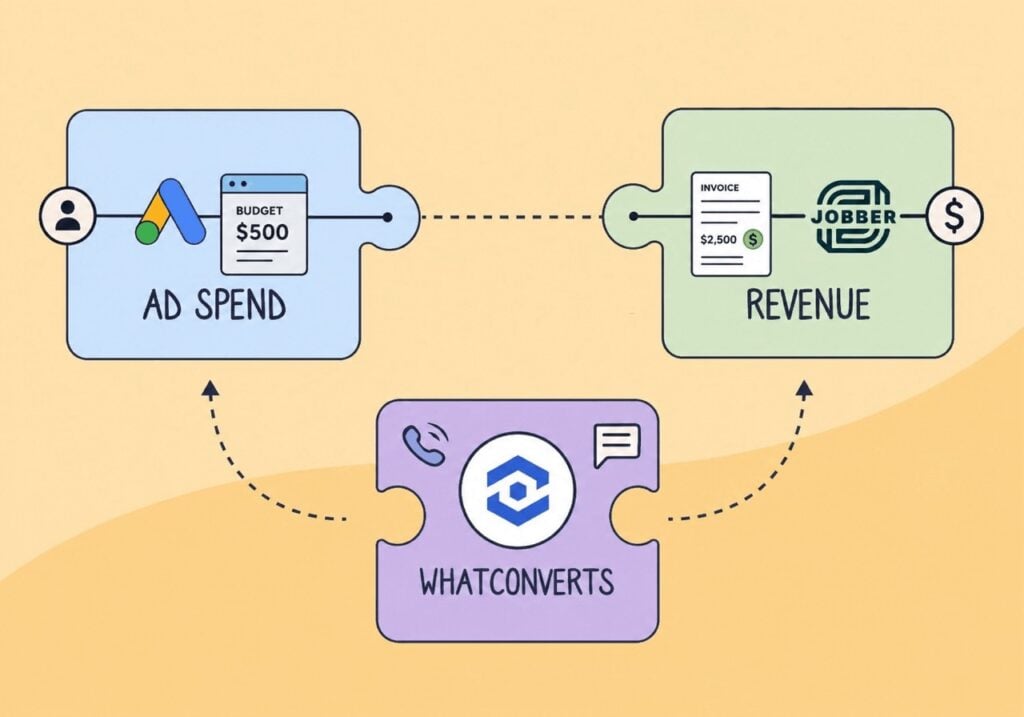
Building that number means connecting one lead across its whole path: the ad click, the tracked call or form, the quote, and the closed and paid job. Link those four points and “the revenue we created” becomes a figure you can put in a proposal. Closing that loop is the job WhatConverts built Revenue Engine to do. It’s in beta now.
| Ad click | → | Tracked call or form |
| ↓ | ||
| Closed, paid job | ← | Quote value |
| ↓ | ||
| The revenue figure you can price against | ||
Four tracked points on one lead produce the revenue figure.
Hand an agency that number and the value conversation turns into arithmetic. You show the client the revenue your campaigns produced and propose a share of it.
Every figure in that proposal comes out of the client’s own books, so they can check it without taking your word for anything.
Each closed job’s value, tied to the campaign that drove it.
There’s a way to pull each closed job’s dollar value back to the exact campaign and keyword that produced it. Here’s how it works.
Feature Highlight: CRM Lead Valuation
Turn the Number Into a Value-Based Price
Once you can see the revenue your marketing creates, value pricing becomes a short sequence of steps.
- Agree on the outcome. Name the result the client wants as a dollar figure rather than a task list. For example, a booked-revenue target that takes them from $1.2 million this year to $1.6 million next year, which is $400,000 of new revenue.
- Size the marketing. Work out the budget and campaigns it takes to drive that $400,000. You already estimate this for every media plan.
- Set your share. Price your fee as a percentage of the revenue you create, not a multiple of your hours. Haus Advisors puts core delivery around 10% to 20% of the value; Blair Enns argues for a percentage of the client’s expected return. Pick a share that’s fair both ways.
- Total it, then split it. Multiply your share by the year’s expected revenue, then divide it into a monthly retainer so cash flow, theirs and yours, stays steady.
- Set milestones you both track. Tie the retainer to monthly benchmarks against the attributable number: booked jobs, closed revenue, cost per booked job. Both sides watch the same scoreboard, so the fee doesn’t turn back into an argument each quarter.
Every step in that sequence runs on the attributable revenue figure from the previous section, which is why the number has to exist before the price can be set. Those five steps give you a proposal with a revenue figure at the top and your percentage at the bottom. You can build one this week for any client whose revenue you already track.
| The sequenceFrom a proven revenue figure to a value-based price |
| 1 Agree the outcomeName it as a dollar target. |
| 2 Size the marketingThe budget and campaigns it takes to drive that growth. |
| 3 Set your shareA percentage of the revenue you create, around 10–20%. |
| 4 Total it, then split itInto a steady monthly retainer, for both sides’ cash flow. |
| 5 Set milestones you both trackBooked jobs, closed revenue, cost per booked job. |
See that same math built into one monthly fee you can put on an invoice.
Read the Article – Introducing the Revenue Retainer: A New Way to Price Agency Work
The Top of the Market Already Prices on Outcomes
This isn’t a big-firm luxury, and the biggest firms are already there. McKinsey now ties about 25% of its global fees to outcomes rather than time, and its clients “arrive not with a defined scope but with a result they want.”
Across 500 large firms, only 15% to 20% price on value as their main approach, even though every dollar a company spends on improving its pricing is estimated to return $7 to $10.
McKinsey can charge this way because it can measure what it delivers. The gap between them and a four-person agency is tracking, not size.
You’re Not Missing a Mindset. You’re Missing a Number.
Come back to the question you started with. Not “am I leaving money on the table,” but “how much?” That’s a question you can now answer in dollars instead of a shrug.
Take your best-performing client, the one whose campaigns are printing booked jobs. Work out what you’re paid per dollar of revenue you create for them, then set that beside the same figure for your smallest account.
If the comparison stings, the thing standing in your way was never conviction. It’s the attributable, provable revenue figure your marketing created. Build that number, and value-based pricing stops being a mindset you nod along to and becomes a fee you can defend.
Ready to build that number from your own agency’s data instead of the roofing example? Revenue Engine is in beta now, and it is free while the beta runs.
Get a FREE presentation of WhatConverts
One of our marketing experts will give you a full presentation of how WhatConverts can help you grow your business.
Schedule a DemoGrow your business with WhatConverts