












































 Amanda Pell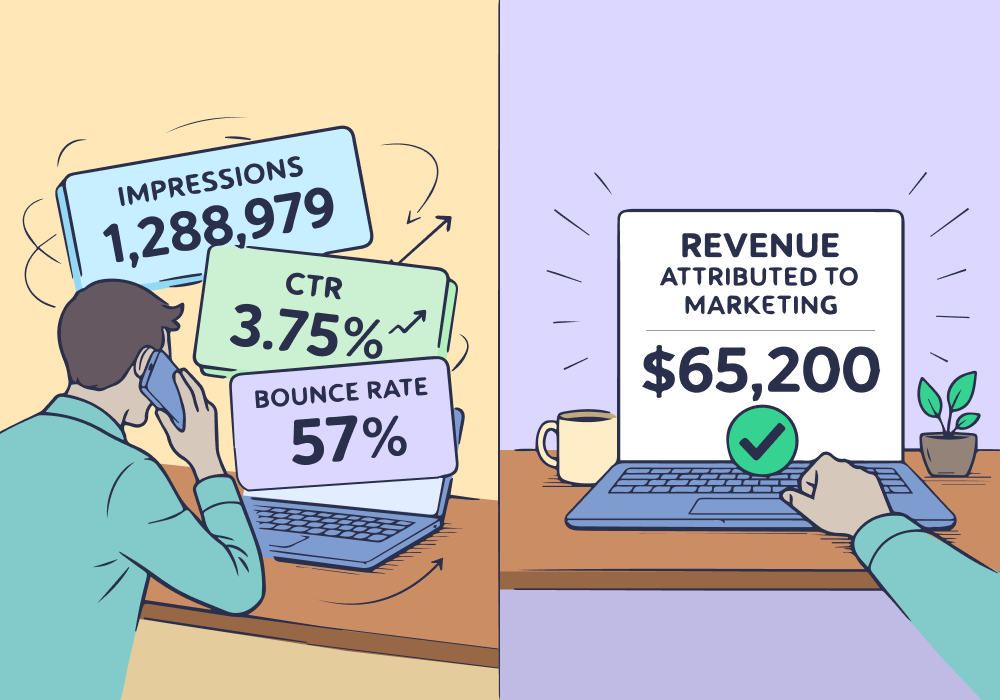
Most agency reports answer the wrong question. They show what happened: impressions, clicks, traffic, leads.
But clients aren’t paying for activity. They’re paying you to generate revenue.
Activity-based reporting creates a dangerous illusion that “busy” equals “valuable”. And until an agency can bridge the gap between what the dashboard shows and what the business actually earned, that illusion is a liability.
This article breaks down exactly why activity metrics undermine client confidence and what value-based reporting looks like in practice, so agencies can stop defending their work and start proving it.
Note: Not a WhatConverts user yet? Start your free 14-day trial today or book a demo with a product expert to see how we help prove and grow your ROI.
What Activity Reporting Actually Tells Clients
Traffic reports, CTR summaries, and impression charts answer one question: Did something happen?
That's not the question clients are paying to have answered.
When a client spends $15,000 on ads and services, they aren't asking "how many people saw the campaign?" They're asking: "Did this investment make us money?"
Activity metrics can't answer that. They're upstream from the outcome. A campaign can generate 5,000 clicks and zero qualified leads. A keyword can drive 300 impressions and one $40,000 job. The click counts don't tell you which is which.
And yet most agencies still lead with click counts.
The problem isn't the data; it's what the data stops short of. Activity metrics describe the top of the funnel and go silent exactly when the client needs them most.
Not all reporting tools are built the same—and the difference matters more than most agencies realize.
For a full breakdown of:
- How the top 9 agency reporting platforms compare
- What separates a data capturer from a data aggregator
- What to look for when choosing a reporting stack that actually proves client ROI
Check out the full guide:
9 Best Marketing Reporting Software for Agencies in 2026
Why the Gap Exists—and Why It Compounds
Most agencies report what their tools surface by default. Google Ads shows impressions and clicks. GA4 shows sessions and bounce rate. So that's what ends up in the client deck.
Nielsen's 2024 Annual Marketing Report found that 84% of marketers feel confident in their ROI measurement capabilities—yet only 38% actually evaluate holistic ROI across channels. Most agencies believe they're measuring what matters. They're actually measuring what's easy.
The result: clients receive a report that confirms activity and implies value without proving it.
Early in an engagement, that's fine. Clients extend goodwill. But over time, the gap between "we drove traffic" and "here's what your traffic was worth" becomes impossible to ignore.
Agencies that can't prove value don't lose clients all at once. They lose them one quiet renewal conversation at a time.
What Value-Based Reporting Actually Looks Like
To prove marketing value, you need to track what happens after the click.
To do that, you need to know:
- Which leads came from which campaign, keyword, or channel
- Whether those leads were qualified—or spam, wrong numbers, or tire-kickers
- What each lead was worth in revenue potential
- Which marketing sources consistently produce the leads that close
An activity report shows 4,300 clicks, 210 leads, and $71 CPL. It shows movement, but not impact.
A value-based report for the same period shows 210 total leads, 83 qualified leads, $268,000 in closed revenue, and 6.4x ROAS. With that information, this report changes the conversation.
Instead of explaining why cost per lead improved, now you’re showing exactly how much revenue the campaigns produced and which campaigns were responsible for it.
Once revenue is visible, optimization decisions get clearer, budget conversations get easier, and your role stops feeling optional.
The Manual Path (and Its Limits)
Agencies can build value-based reporting without new tools. It just requires stitching together data manually:
- Export leads from every source. Pull form submissions, call logs, and chat records, then map each one back to its campaign origin.
- Qualify each lead. Work with the client to flag which leads were actually worth pursuing—and which were junk.
- Assign revenue values. Attach estimated or actual deal values to qualified leads, then connect them back to the campaigns that generated them.
- Rebuild the report. Replace or supplement activity metrics with lead quality, cost per qualified lead, and revenue attribution.
This works, but it's time-intensive every single month. And if the client wants to drill into a specific campaign or keyword, the manual process starts over from scratch.
The Faster Path: Reporting Built Around Lead Value
The cleaner solution is a reporting stack that captures lead value automatically—so every report reflects business outcomes, not just activity.
That's what WhatConverts is built for. Every call, form, chat, and transaction gets tracked back to its exact marketing source. Leads are qualified and valued inside the platform. Reports show not just how many leads came in, but which campaigns drove the ones worth closing.
The result is reporting that answers the question clients actually care about: What did my marketing investment produce?
Not impressions, not sessions: revenue.

Proof: What Happens When Reporting Shifts
Constellation Marketing had five years of results with a law firm client—traffic up, leads up, business growing. Then the client hired a consulting group that questioned whether Constellation's marketing was actually responsible for any of it.
Activity metrics couldn't answer that. Revenue attribution could.
Using WhatConverts, Constellation proved 70% of the client's revenue (over $500,000) came directly from their campaigns. The result:
- 9x ROI
- 150% budget increase
- A thriving client relationship
"Churn is the biggest killer of growth," says founder Patrick Carver. "I think of WhatConverts like an insurance policy against client churn. It gives us the ability to prove our value."
Read More: 9X ROI Secures Client Retention for Law Firm Marketing Agency [Case Study]
From Reporting to Proof
Activity reporting isn't wrong; it's just incomplete. Clicks and impressions matter. But they can't stand alone as the evidence of marketing value.
The agencies that keep clients and grow retainers have figured out one thing their competitors haven't: reporting what happened is table stakes. Proving what it was worth is the differentiator.
With the right reporting tools, that proof becomes automatic:
- Capture every lead and tie it to its source
- Qualify leads and assign revenue value
- Report on lead quality and ROI—not just volume and traffic
- Show clients exactly what their investment returned
- Use that proof to defend budgets, expand scope, and retain accounts
The goal isn't a better-looking report. It's a report that makes the client's decision to stay—and spend more—obvious.
Ready to move from activity summaries to revenue proof?
Start your free 14-day trial of WhatConverts today or book a demo with a product expert to see how we help prove and grow your ROI.
Get a FREE presentation of WhatConverts
One of our marketing experts will give you a full presentation of how WhatConverts can help you grow your business.
Schedule a Demo
Grow your business with WhatConverts