


 Amanda Pell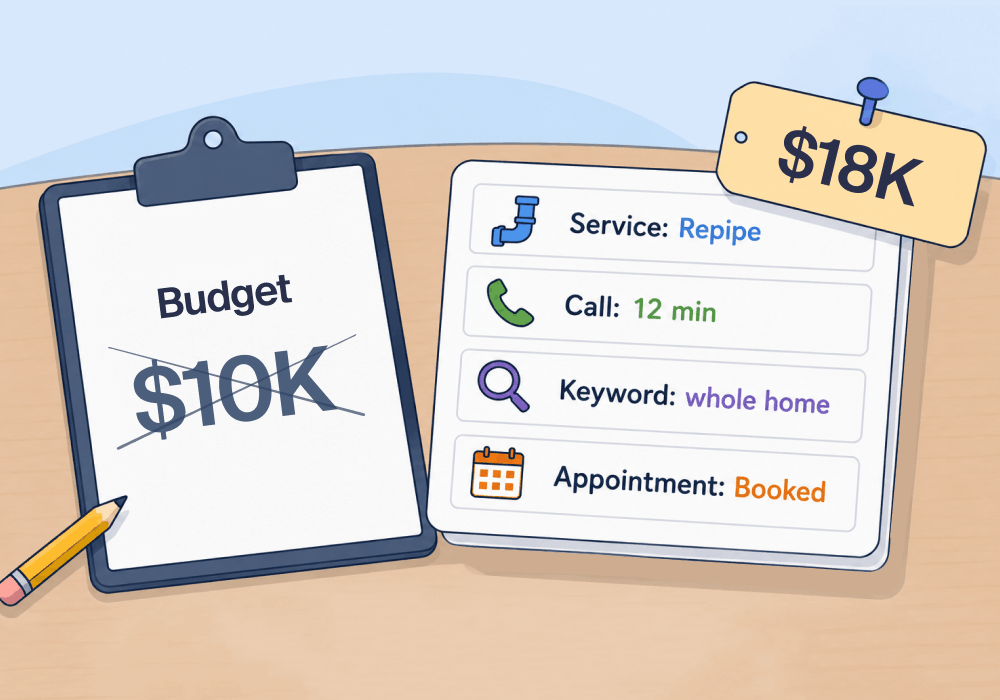
A budget field and a quote value field seem like they would hold the same number. They don’t.
The budget field captures what a prospect says they'll spend before they've talked to anyone. Half the time, that’s a guess. The other half, it's strategic: they lowballed to avoid upsells, inflated to seem serious, or skipped entirely with whatever the form requires as a placeholder.
Quote value is supposed to reflect what the lead is actually worth. When agencies copy a self-reported budget straight into that field, every downstream decision winds up being based on a number the prospect made up.
This article shows how to assign quote value based on what actually happens during the conversion, not what someone typed into a box.
Note: Not a WhatConverts user yet? Start your free 14-day trial of WhatConverts today or book a demo with a product expert to see how we help prove and grow your ROI.
The Self-Reported Budget Problem
Form fields don't measure intent. They measure how someone wants to be perceived.
A homeowner pricing a kitchen remodel types "$10,000" because that's what their neighbor said they spent. The actual job comes in at $42,000. Another prospect types "$100,000+" to look serious, then ghosts after the discovery call. A third leaves it blank, and the form defaults to "$0."
When that field becomes your quote value, it causes problems:
- Smart Bidding optimizes toward the wrong leads. Google sees a $0 conversion and stops chasing audiences that look like that prospect, even if they were a perfect fit.
- Pipeline forecasts get distorted. Sales projects $100K from a time-waster and $10k from a $40k job.
- Client reports lose credibility. When the numbers don't match what actually closes, the agency loses trust on the next renewal call.
The issue isn’t the self-reported budget field. The issue is that budget and quote value aren’t the same thing, and they’re being treated like they are.
What Quote Value Should Actually Reflect
Quote value should answer one question: based on what we know about this lead, how much is this opportunity worth to the business?
The signals that answer that question don't come from a self-reported budget. They come from the conversion itself:
- The service requested. A "drain cleaning" lead and a "repipe" lead carry very different revenue potential, regardless of what either prospect typed about budget.
- Call duration. A 12-minute call almost always indicates a real consultation. A 30-second call rarely does.
- Keywords spoken. "Whole home," "emergency," "commercial," "financing": each one shifts the expected job size.
- Appointment outcome. A booked estimate is worth more than a pricing inquiry that went nowhere.
These signals are observable, consistent, and harder to fake than a self-reported number.
How to Capture Real Quote Value Signals
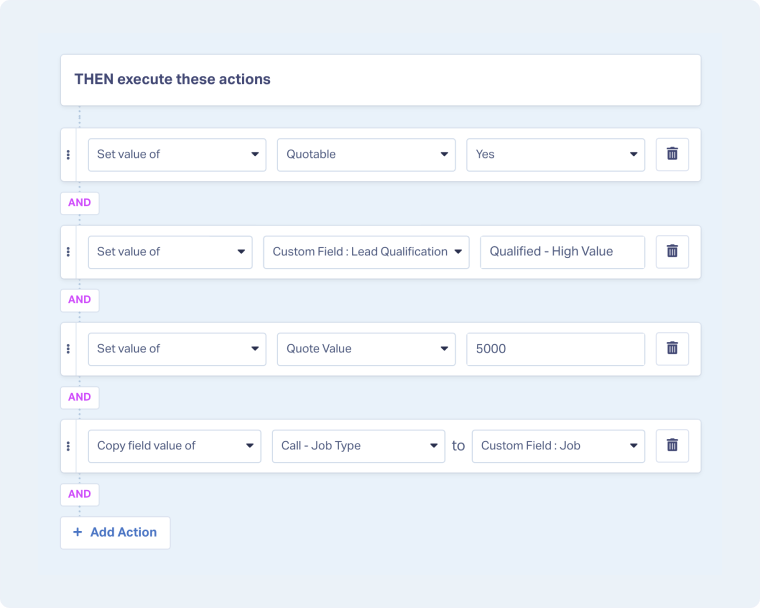
WhatConverts Lead Intelligence rules let you assign quote value based on what actually happened on the lead, not what someone claimed in advance.
Each rule is a stacked if/then statement. Combine signals to assign a quote value automatically:
| If the lead has these signals | Then assign quote value |
| Service = "Roof Replacement" + Call duration > 5 min + Keyword "estimate" detected | $18,000 |
| Service = "Repair" + Call duration > 3 min | $850 |
| Service = "Emergency" + Appointment booked = Yes | $2,400 |
| Service = "Quote request" + Call duration < 60 sec | $0 |
The rules run for every conversion. No copying budget fields, no manual review, no relying on what the prospect guessed.
A few examples of how stacked rules sharpen the value:
- Service type alone sorts repairs from replacements.
- Service type + call duration filters out hang-ups and misdials from real consultations.
- Service type + keyword detection distinguishes a $400 repair from a $15,000 system replacement on the same campaign.
- Service type + appointment outcome confirms the lead actually progressed before assigning full value.
Each layer makes the quote value harder to game and closer to what the lead is really worth.
Why This Matters Beyond Reporting
Accurate quote value isn't just cleaner data. It's the input every downstream system depends on.
Smart Bidding Optimizes on the Values You Send It
Feed Google a $0 conversion (because the prospect skipped the budget field) and the algorithm learns that audience isn't worth chasing. Feed it a $100,000 value from a tire-kicker and it doubles down on the wrong signal. Either way, the bidding strategy is optimizing toward fiction.
When the values reflect real conversation signals, Smart Bidding learns to chase the leads that drive revenue instead of the ones that fill out forms.
Learn how it works: Send Quote Value with Google Ad Conversions
Pipeline Forecasts Stop Overpromising
Sales leadership budgets headcount, capacity, and revenue targets against the pipeline numbers. When quote values come from self-reports, those forecasts swing wildly month to month. When they come from observed signals, they hold up.
Client Reports Match What Actually Closes
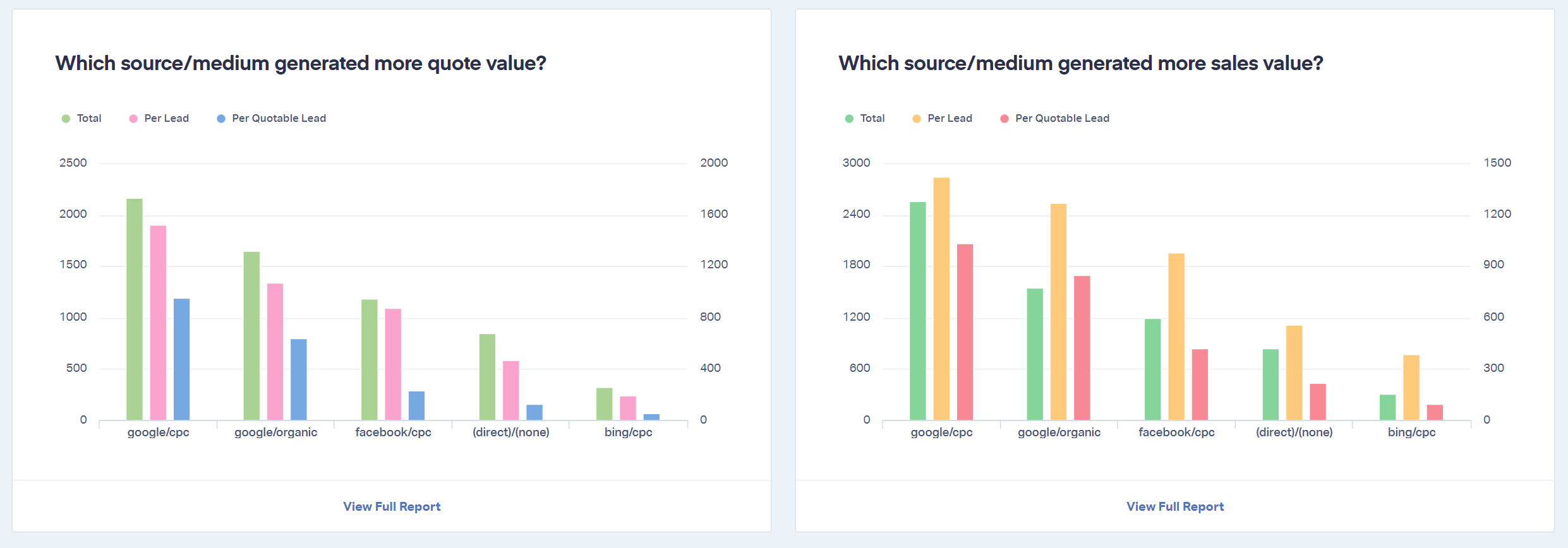
This is where most agencies lose trust. The dashboard shows $400k in pipeline value, the client's books show $180K in closed revenue, and now the agency is explaining the gap on a renewal call. Quote values built from real signals stay closer to closed revenue, which keeps the renewal conversation focused on growth instead of damage control.
The Whole Optimization Loop Tightens
Better quote values feed better bidding signals, which surface better leads, which generate better data on what high-value conversations actually look like. Each cycle sharpens the next. That's only possible when the input isn't a number a prospect made up on a Tuesday afternoon.
Build Quote Value That Reflects Real Worth
Quote value drives every optimization decision your campaigns make. Build it from real signals, not self-reports:
- Stop using the budget field as quote value. Treat it as one data point, not the answer.
- Identify the conversion signals that predict job size. Service requested, call duration, keywords spoken, appointment status.
- Build stacked Lead Intelligence rules that combine those signals into automatic quote value assignments.
- Sync the corrected values back to your ad platforms so Smart Bidding optimizes for revenue, not form fills.
- Audit the rules quarterly as service mix, pricing, and conversion patterns evolve.
Quote value should describe the lead, not the prospect's prediction of themselves.
Ready to build quote value logic that reflects what leads are actually worth?
Start your free 14-day trial of WhatConverts today or book a demo with a product expert to see how we help prove and grow your ROI.
Get a FREE presentation of WhatConverts
One of our marketing experts will give you a full presentation of how WhatConverts can help you grow your business.
Schedule a DemoGrow your business with WhatConverts