


 Alex Thompson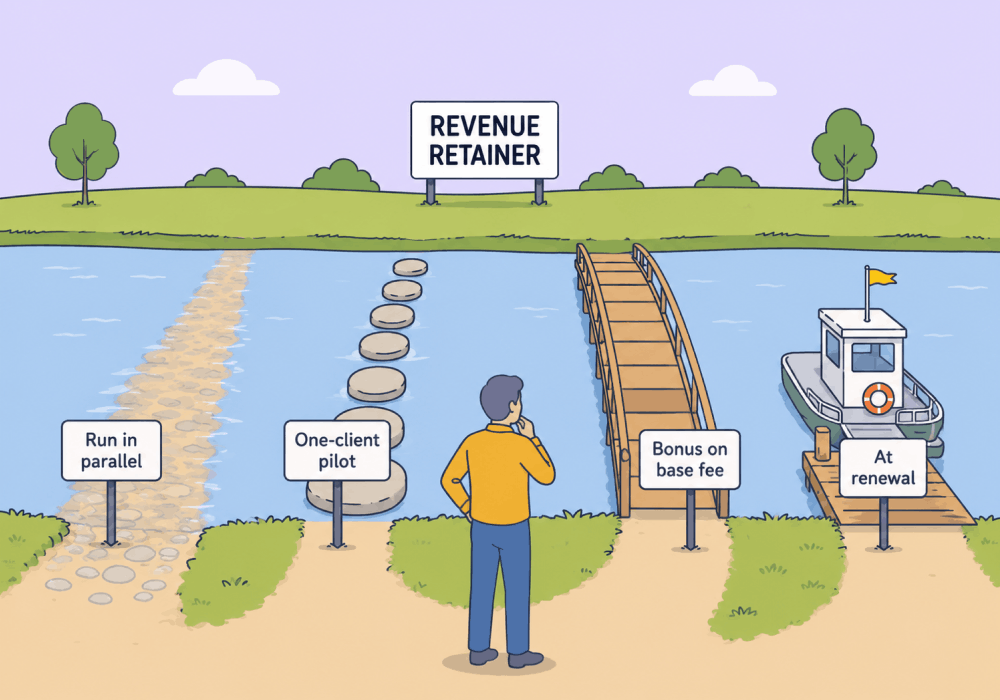
A revenue-based fee sets your monthly fee as an agreed share of the revenue your marketing drives for a client, instead of a rate for your hours or a cut of their ad budget. You don’t have to move any client onto it before you’re ready, and you certainly don’t have to move all of them at once. That second one is the move that really scares people.
Picture the account you’d never risk. Fifteen years with an HVAC company, a retainer that lands on time every month. Say you move that client first. Here’s the objection you’d hear from your own team, or from yourself: “I’m not blowing up a relationship that works to chase a fee model nobody’s seen.”
That’s a fair objection. You shouldn’t have to move that account first, or at all. Most pricing advice tells you to switch without showing how to get there gradually, and the all-or-nothing version really is risky. Law firms, hospitals, and Medicare all moved off a single default fee without doing it overnight, and their methods work on a marketing retainer.
This article covers four low-risk ways to start. Pick the one that fits your book and start this quarter without gambling a client relationship.
Well-Framed Fee Changes Rarely Cost You the Client
A fee change costs you far fewer clients than the fear suggests, because what drives clients away is rarely the number itself. The research is clear on why professional-services clients leave. Beaton Research tracks how clients feel across law, accounting, and consulting firms, and found that perceived price accounts for under 1% of what shapes a client’s view of a firm’s value. Two things sit well ahead of price: how easy the firm is to work with, and how much the client trusts it.
Founder George Beaton put it plainly:
“Price is not the biggest deciding factor for clients choosing a professional services firm.”
What actually drives client reactions is framing and notice. Agency consultant Karl Sakas documented three price increases he received as a buyer himself, and the outcomes differed by how each one was presented. He accepted paying 50% more on the spot, because it came with notice and a pre-pay choice. A 75% jump “on a month’s notice” felt “really abrupt,” and cost that vendor work. A third raise was pitched around the vendor’s own rising costs, and Sakas’s answer to that one was “your costs aren’t my problem.”
Fee changes framed well have already worked in other fields. In law, alternative fee arrangements are the norm now, and a 2021 survey put 84% of firms offering one alongside hourly billing.
So the risk isn’t the fee itself. It’s a 75% jump on a month’s notice, with every client hit at the same time.
What loses clients is the size of the jump and how little warning they get. Neither one is required to move to a revenue-based fee.
Four low-risk ways to start
Four low-risk on-ramps let you get there gradually: run the new number in parallel next to the current bill, add a performance bonus on top of the existing fee, pilot one well-tracked client, or switch at renewal. They aren’t ranked and they don’t run in sequence, so pick whichever fits your book.
See how open-book reporting keeps clients from leaving over unproven value, the same trust this fee change is asking them to extend.
1. Run the New Number in Parallel With the Current Bill
Start with the lowest-commitment move of the four. You show a client what they’d pay under the revenue-based model, right next to the invoice they get now. None of it is real money yet, and both sides watch the number prove out instead of taking it on trust.
The move has a formal name. Parallel running is a decades-old changeover technique in which you run the new system beside the old one, both producing output, until the new one proves itself. Then you cut over. It’s the safest way to switch, because you can fall back if the new number turns out wrong. A review typically lands three to six months in. The timeline below shows two tracks running together, then a single cut-over point.
Drug manufacturing uses it, where a mistake gets expensive fast. One biologics manufacturer ran its old and new systems in parallel to catch errors that would otherwise have surfaced late, after being burned once by a sequential rollout.
Parallel running isn’t free, though, and overselling it is a mistake. An ERP firm lists eight ways parallel running backfires. It eats time and doubles the tracking work, and running it too long tells the client you don’t trust your own number.
Note: Scope the comparison, don’t leave it open. One or two reporting cycles with a clear cut-over date proves the number. An indefinite shadow bill just doubles your work and reads as hesitation.
What this looks like on your own accounts
Parallel running works because the new number has to perform before anyone commits to it. On a client account, that means putting two prices side by side.
For an agency, the whole move is one step. Put the revenue-based fee for a given month beside the flat fee the client already pays, as shown below. Nothing on the contract changes. The client watches the revenue-based number track against the fee they pay now, for as many months as it takes to earn their confidence.
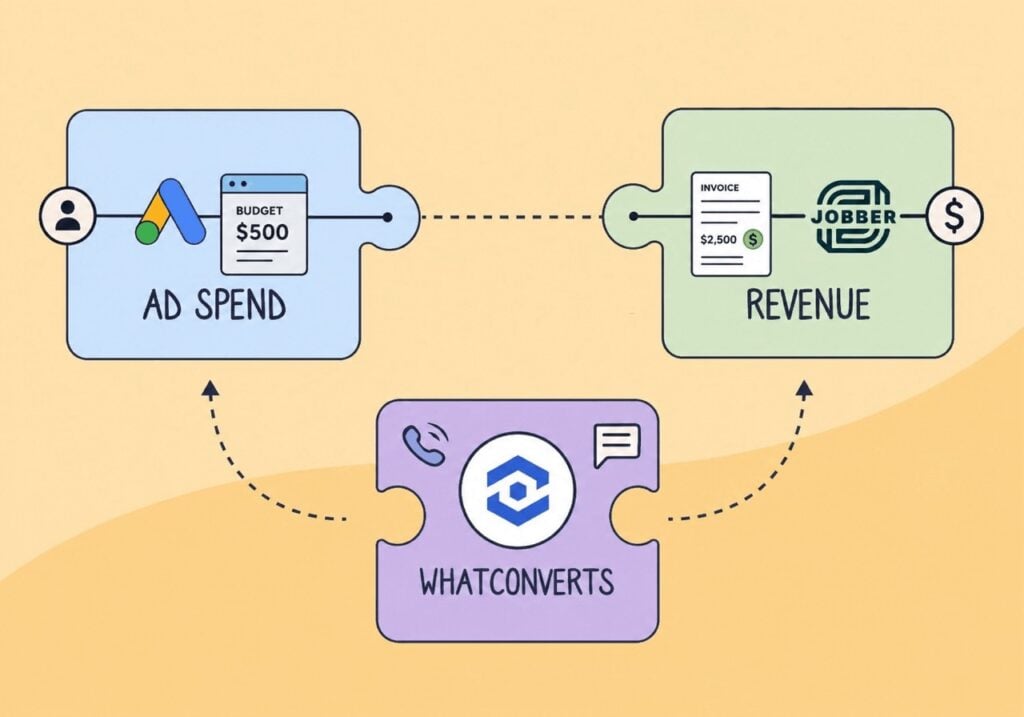
The move rests on one capability: being able to see the revenue each client’s campaigns produced. If you can attribute revenue to the campaigns behind it, you have a real number to run in parallel.
Nothing on the contract changes while you do this. If the number doesn’t hold up, you stop showing it, and the client never paid a cent differently.
The number you’d run beside their current fee.
See the fuller mechanics of tying marketing spend to the sales revenue it actually produced. The exact number every on-ramp but renewal timing runs on.
Related Reading: Revenue Attribution: How to Prove Your Marketing Pays for Itself
2. Add a Performance Bonus on Top of the Base Fee
The retainer doesn’t have to move at all for you to test revenue-based pay. Leave the base fee where it is and layer a bonus on top, tied to a result you can measure. The client keeps the floor they already trust, and the new part only pays out when a real outcome shows up.
If that sounds like a stretch for a services business, look at how many unrelated fields run it. In U.S. healthcare, Medicare’s Shared Savings Program paid $4.1 billion in performance bonuses on top of providers’ standard base rates in 2024. Of the 476 participating groups, 75% earned one by holding costs down while hitting quality benchmarks.
Hospital contracting does the same thing under a different name. Gainsharing pays physicians a share of the savings their work creates, on top of base pay, and the arrangement needed federal approval to set up safely. Law runs the pattern too, calling it a “success fee” or “hybrid arrangement”: a bonus on the base fee, used where pure contingency is too risky for either side.
Three unrelated fields arrived at the same structure independently. Keep the base fee, add a bonus tied to a measured result. The diagram below shows the shape all three landed on.
Why the base-plus-bonus shape de-risks the move
The client’s floor never moves, so the fee they already agreed to is never at risk. The new money appears only when both sides can see the result it’s tied to.
There’s one condition. A bonus is only fair if the outcome it rides on is clearly visible and traceable to your campaigns. Tie it to revenue you can attribute back to the leads you drove, and don’t tie it to a number the client has to take on faith.
What you’re adding is measurement work on your side, and a payout when the measurement comes back positive. The base fee they already agreed to is never at risk.
3. Convert One Well-Tracked, High-Trust Client First
Move one account first and leave the rest of the roster alone. That single client produces both the proof and the playbook for everyone after it.
A pilot has a specific job. The UK’s chartered project-management body defines it clearly: a pilot exists to prove it can work before you commit real time and money, and it hands you a short report and a route map. A pilot isn’t the full rollout shrunk down. You run it to answer one question, which is whether the model works on your book specifically.
Law applies that exact idea to fee changes. A legal-billing playbook tells firms to select two or three willing pilot clients who value predictability, track everything from profitability to satisfaction, then expand across the book only after the small group proves out.
Which client to pick
The instinct to test on your hardest account is backwards, so pick the one where the numbers are clean and the trust runs deep. Karl Sakas’s readiness checklist gets you there fast:
- Are you close to irreplaceable on this account?
- Is the relationship solid?
- Is there a pipeline of work behind it?
- Can you handle a three-to-six-month transition?
Say the answers point to that fifteen-year HVAC account from the top, the one whose calls and booked jobs you track cleanly. Make it your pilot. Its revenue is easy to see, so the revenue-based number comes out clean, and fifteen years of goodwill means a new idea won’t rattle the relationship. A pilot only works on an account whose leads and booked revenue trace back to the campaigns behind them.
The pilot’s job is to hand you two things: what you learned, and the repeatable steps for the rest of your book. Most of that comes out of the first month, so keep notes from day one.
Pick the account where you already trust the numbers. If the model fails there, it will fail on every other account too.
| 1 Prove it worksDoes the revenue-based number hold up on one account? |
| 2 Capture the proof and the clean numbersThe evidence and the repeatable steps for everyone after it. |
| 3 Roll out to the restExpand across the book only after the small version proves out. |
4. Introduce It at Renewal, Not Mid-Contract
Renewal is the one moment when changing terms is expected instead of alarming, so you introduce the revenue-based fee there and leave live contracts alone. Franchising makes the cleanest case for it, because a franchise renewal is not an extension of the old agreement. The franchisee signs the franchisor’s current form, which routinely carries a higher royalty and new or bigger fees, and the notice window runs six to twelve months before expiration. Nobody treats that as a betrayal, because everyone expects terms to change at renewal.
Keep the framing honest. A renewal is where you start the conversation, and it isn’t a way to force new terms through. The client can accept, negotiate, or walk, exactly as they could at any renewal.
For a book with agreements coming due in the next few quarters, this is the least disruptive of the four on-ramps. Nothing about a live contract changes, and you arrive at a renewal already on the calendar with the revenue-based number in hand.
This is also the only on-ramp that works without attribution in place, because you’re proposing terms rather than proving a number.
Match the On-Ramp to Your Book of Business
The four on-ramps aren’t ranked and they aren’t a set order. The right first move depends on how well your accounts are tracked, how much trust you’ve banked, and where your contracts sit in their cycle. Match your book to the on-ramp that fits it:
- Well-tracked accounts, but not ready to commit → run the number in parallel and let the comparison do the convincing.
- A base relationship you don’t want to disturb → add a bonus on top and leave the floor alone.
- One high-trust, cleanly tracked account → make it your pilot and let it write the playbook for the rest.
- Contracts coming due in the next few quarters → introduce it at that renewal and reopen nothing early.
They also stack. A pilot can grow into a bonus on the base fee, and a parallel run can tee up the switch you make at renewal, so starting with one doesn’t rule out the rest.
Three of the four depend on the same thing. Running the number in parallel, sizing a fair bonus, and picking a clean pilot all need revenue you can trace back to the campaigns that produced it, which is what lets you put the value behind your fee in front of the client. Renewal timing is the exception, and it works with or without attribution in place.
Start with the on-ramp your book already supports. You can add the others once the first one has produced a number you trust.
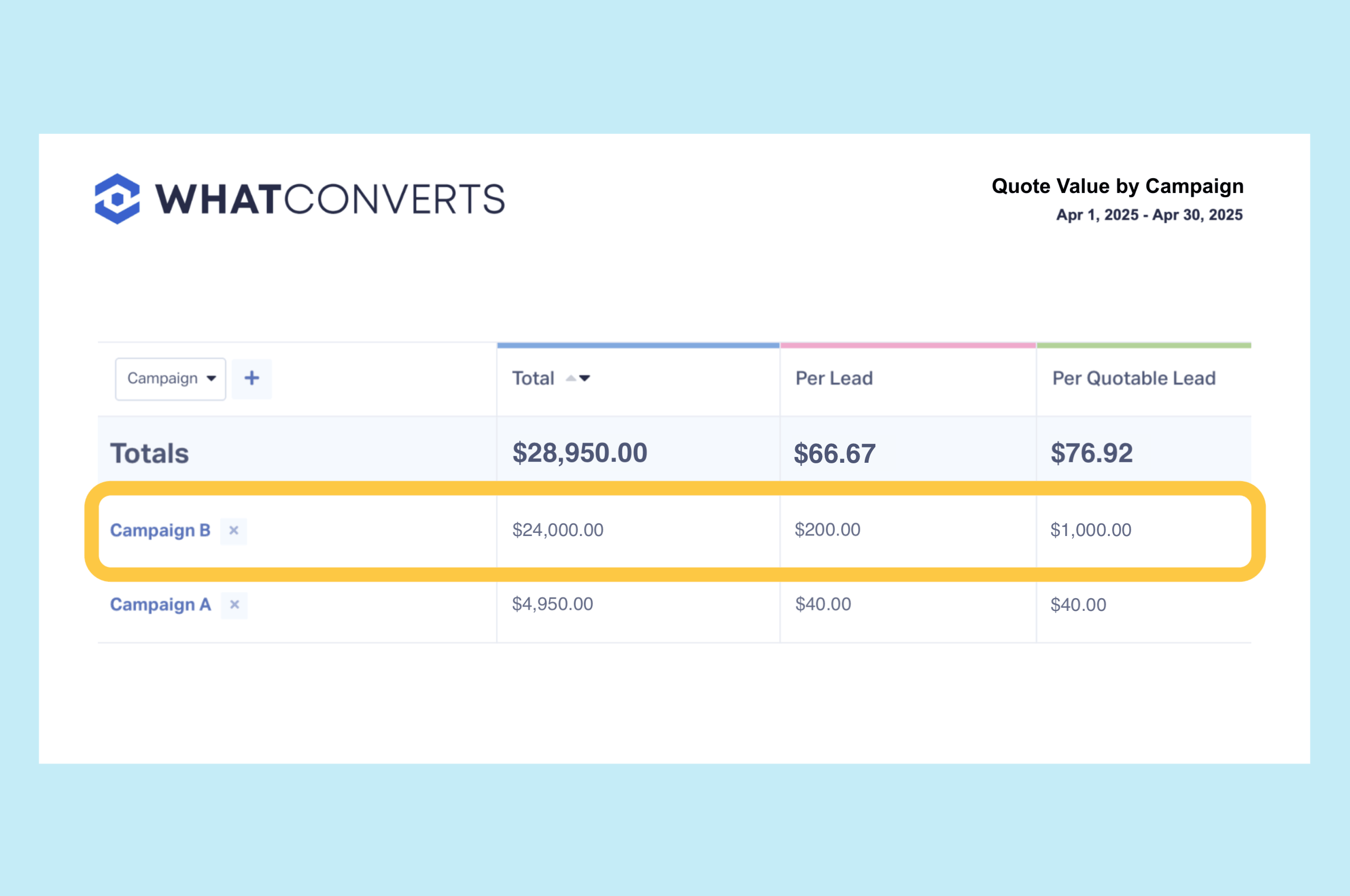
You can see exactly how much value each of your campaigns brought in using WhatConverts, giving you the data visibility you need to optimize for revenue, not lead count.
The shipped capability the first three on-ramps run on: seeing the revenue each client’s campaigns actually produced.
See how Call Tracking ties every call’s revenue back to the campaign that drove it, the number behind three of these four on-ramps.
Feature Highlight: Call Tracking
Pick the On-Ramp That Fits Your Book, and Start This Quarter
You came in with a fair worry. You’re not going to make every client rip up a working contract, and you don’t want to. Nothing here asks you to.
The all-or-nothing switch was always the risky version of this move. What’s left is four first steps, and each one already works in a field with more on the line than a marketing retainer: Medicare, law firms, franchising, and drug manufacturing.
Pick the one that fits where your book actually is. Run a number in parallel next month, or bring the revenue-based fee to the next renewal you already have booked. Either one starts the move without betting a relationship on it.
See the argument this series opens with, and why the tasks agencies bill for stopped being the product.
Ready to see the attributable revenue behind your own accounts, so you can pick an on-ramp and start this quarter?
Get a FREE presentation of WhatConverts
One of our marketing experts will give you a full presentation of how WhatConverts can help you grow your business.
Schedule a DemoGrow your business with WhatConverts