


 Alex Thompson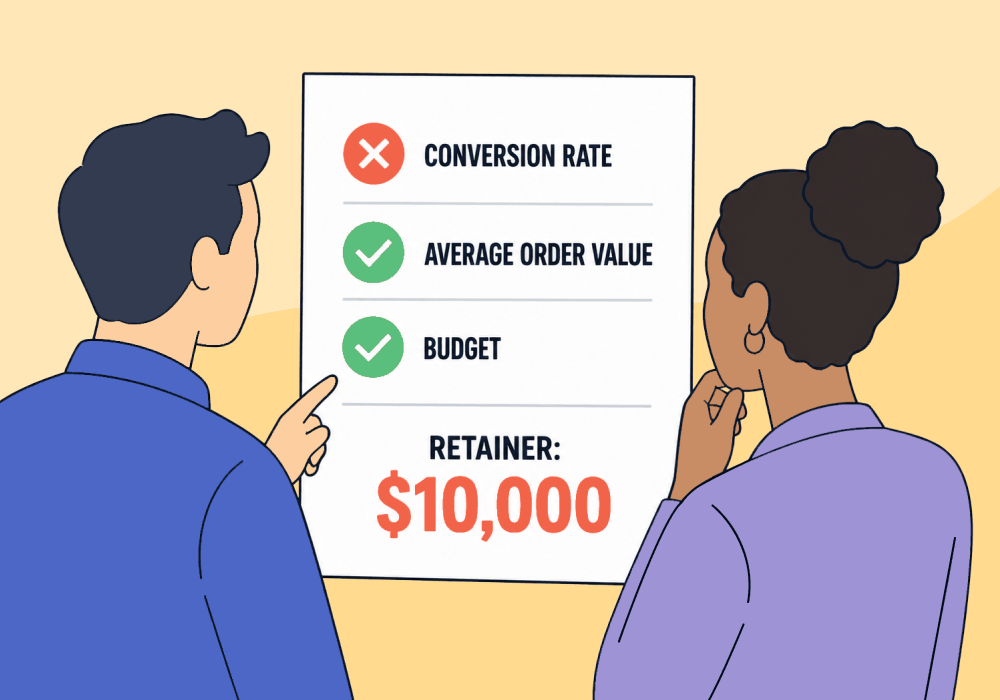
You name the rate, and your client’s expression changes. “How’d you land on that number?”
You’ve got an answer, but it’s based on your own judgment. You can hear how it sounds: you picked a number, and now you’re defending it. The pricing model doesn’t make the conversation any easier. With a revenue-share retainer, your fee is a percentage of the revenue your marketing generates, and most clients haven’t bought agency services that way before.
So how do you make the rate easier to trust? Don’t ask the client to accept your judgment alone. Use a process that produces the number from inputs they can check. A home appraisal works the same way: comparable sales produce an outside valuation, and that becomes the figure the deal runs on.
This article applies the appraisal model to your retainer. You’ll see how to present the rate, show the inputs behind it, and move the conversation from “Why should I trust you?” to “Do these numbers make sense?”
Clients Naturally Question a Rate That Benefits the Agency
The skepticism isn’t personal. When you name a retainer rate in a proposal meeting, you’re also the person who’ll profit from it. The client knows that. And you can’t solve the conflict just by explaining your expertise. Decades of persuasion research show that people find a source less persuasive when that source has a stake in the outcome.
Let’s say you quote a roofing client 10% of revenue. You used their close rate—the share of leads that become customers—and their average job value. Both came from the client’s records. But if you present only the final percentage, it can still look like your opinion from their side of the table.
The model can create a second concern: unpredictability. A fee based on revenue sounds as though it changes every month, even when the agreement fixes the rate for a full year. Switching back to billing for tasks instead of outcomes doesn’t solve the trust problem. It simply ties the fee to activity rather than a result the client values.
The missing piece is visibility. People trust a number more when they can see where it came from, even when the number itself hasn’t changed. If the client can’t see the process behind your rate, they can’t tell whether it’s fair.
That gives us the first takeaway: you don’t necessarily need a different rate. You need to show that shared facts and clear rules produced it. Once the client can trace the percentage back to inputs they recognize, the conversation is no longer based on your word alone.
Read the Article – Introducing the Revenue Retainer: A New Way to Price Agency Work
Home Appraisals Give Every Side One Shared Number
Real estate has a clear process for handling competing interests. The buyer wants a lower price, the seller wants a higher one, and the lender wants the loan to close. Because everyone has something at stake, the mortgage doesn’t rely on any one party’s opinion of the home’s value.
Instead, an independent appraiser produces the value. Federal rules bar the appraiser from having a financial interest in the transaction or being pressured to reach a preferred number. The profession’s ethics code also requires “impartiality, objectivity, and independence.”
| Buyer↓ wants it low | Seller↑ wants it high | Lender→ wants the loan to close |
| all three use the same figure | ||
| The appraised valueOne independent figure supported by comparable sales | ||
The appraiser uses comparable sales—recent transactions involving similar homes—to support the valuation. That figure then gives every party the same starting point. When it comes in below the agreed price, which happens in about 10% of cases, the process already defines the options:
- The buyer covers the gap out of pocket
- The seller drops the price to match
- Both sides split the difference
- The buyer walks away with their deposit (earnest money) intact
Certified general appraiser Mason Spurgeon explains why. When a Realtor or appraiser helps establish the price, the sale price and market value usually align. Low appraisals are more common when no outside professional helped set the price in the first place.
A Fair Process Makes a Difficult Number Easier to Accept
You may understand the math and still worry about the client’s reaction. Will they accept a number they didn’t choose—especially when the number affects what they’ll pay you?
Home-sale data suggests they can. As of December 2025, only about 19% of buyers waived their right to walk away after a low appraisal. In other words, roughly four in five kept that protection. Deals still closed, and appraisal issues accounted for only about 5% of sale delays.
Now look at the retainer from the client’s side. If a plumbing company owner hears “10% of revenue” from the agency that profits from it, they’ll probably push back. Show them how the 10% was calculated and let them check the inputs, and they may still wish it were lower. But they can see you didn’t invent it for the meeting.
A fair process won’t make every client love the rate. It does answer the more important question: Was this number chosen to benefit the agency, or did the client’s economics support it? That’s the question you need to resolve before you can discuss the agreement itself.
Other Industries Also Separate the Number from the Interested Parties
The appraisal model isn’t just a real-estate habit. Other industries also use standards, benchmarks, and independent processes when a number has to survive scrutiny.
Business valuation: build a number both sides can examine
A business valuation won’t produce one perfectly objective answer. Its value comes from using accepted methods and documented inputs. Practitioners say a valuation built to industry standards is “harder to refute or dismiss” than a number either party simply proposes.
Without a shared basis for value, buyers and sellers can stall. In Bain’s 2023 M&A analysis, more than two-thirds of buyers said the gap between their offer and the seller’s asking price hurt dealmaking that year. Global M&A fell to a decade-low $3.2 trillion.
Insurance: fair rates follow risk, not willingness to pay
Insurance regulators also focus on where a rate comes from. Two customers who present the same insurance risk should pay the same price. Charging them differently is what the National Association of Insurance Commissioners calls “unfairly discriminatory.”
That’s why regulators rejected “price optimization,” which partly based rates on what a customer would tolerate instead of what they were expected to cost the insurer. The principle is straightforward: a fair rate should trace to relevant risk data, not simply to whatever the seller can extract.
These examples don’t use identical pricing methods, but they do share a principle: a number is easier to defend when shared data and defined rules produce it. You can apply that principle to your retainer rate.
Give Your Retainer Rate Its Own Appraisal Process
You don’t need to become an appraiser. You need a repeatable process that plays the same role for your rate.
Here’s the mapping. The independent appraiser becomes a defined calculation that produces the recommendation instead of relying on your judgment alone. Comparable sales become three inputs: benchmark ranges for the client’s trade, the client’s actual close rate, and their average job value. Those inputs show the account’s revenue potential and let you tie the fee to the value you create. The appraised value becomes the recommended retainer percentage.
You can run the process manually:
- Find benchmark ranges for close rates and job values in the client’s trade.
- Calculate the client’s actual close rate.
- Calculate the client’s average job value.
- Use the same documented method to produce and present the recommended rate.
The result is a rate the client can inspect. They can compare their numbers with the benchmark, question an input, and see how a change would affect the recommendation.
A standard process makes the calculation faster and consistent across your client portfolio. The Forecast Tool reads those same inputs and produces a recommendation. Instead of bringing the client a percentage you chose, you’re bringing them a rate built from their data and an established method.
That changes the negotiation. The recommendation gives both sides a shared starting number, so the conversation can focus on the inputs instead of on whoever has more leverage.
Let’s say you serve an HVAC client that closes 35% of qualified leads at an average job value of $4,200. The process compares those numbers with benchmarks for the trade and produces a recommended rate. You walk into the meeting with the recommendation and its inputs on the table, much like a lender presents an appraisal and the comparable sales behind it.
Real Results: 2x Ad Budget, 2x Clients – ROI Reporting Fuels Growth
You Can Bring the Process Without Controlling the Result
There’s a fair objection here: your agency chose the process and brought the recommendation. Aren’t you still an interested party using a more sophisticated way to grade your own deal?
The distinction is between ordering the process and controlling its inputs. A lender orders an appraisal and acts on it but can’t dictate the value. The appraiser has to support the figure with real comparable sales.
Your rate is credible for a similar reason. The client’s records determine their close rate and average job value, while outside trade data provides the benchmark. The client can check all three inputs, just as a buyer can review the comparable sales behind an appraisal.
If the client asks, “How do I know this number isn’t just whatever benefits you?” walk through the inputs. Their close rate came from their lead and sales data. Their job value came from their invoices. The trade benchmark came from an outside source they can review. You brought the method, but you didn’t invent the underlying facts.
Make that distinction visible by giving the client all three inputs. When you attach a real dollar value to each lead and track which ones close, close rate and job value stop being estimates and become account records. The client can review the numbers behind the rate whenever they want. They don’t have to take your word for any of it.
Present a Rate the Client Can Check
The rate felt arbitrary in the meeting for a structural reason: you presented the final number without making the process visible. Because your agency profits from the rate, the client naturally discounts a figure that appears to come from your judgment alone.
The answer isn’t to pretend you have no role in the recommendation. It’s to separate your role from the inputs. Use outside benchmark data, the client’s close rate, and their average job value, then show how the method turns those inputs into a rate. The client can evaluate the evidence instead of deciding whether to trust your opinion.
Here’s how to do that in your next retainer proposal:
- Gather the inputs. Find benchmark ranges for the client’s trade, then calculate their actual close rate and average job value from account data.
- Use a consistent method. Apply those inputs manually or through the Forecast Tool. The same method should produce the recommendation every time the same inputs are used.
- Show your work. Present the inputs with the recommended rate. Let the client check the close rate, confirm the job value, and review the benchmark.
The next time a client asks, “How’d you land on that number?” you won’t have to defend a percentage you picked. You’ll point to the inputs, walk through the method, and show them a rate supported the same way an appraisal is supported: with shared evidence they can examine.
This article explains why a documented process makes a rate easier to trust. The companion article covers what the rate should be and how the same three inputs help produce it.
Read the Article – What Percentage Should You Charge? 5%, 10%, or 15% of Revenue
Get a FREE presentation of WhatConverts
One of our marketing experts will give you a full presentation of how WhatConverts can help you grow your business.
Schedule a DemoGrow your business with WhatConverts