


 Alex Thompson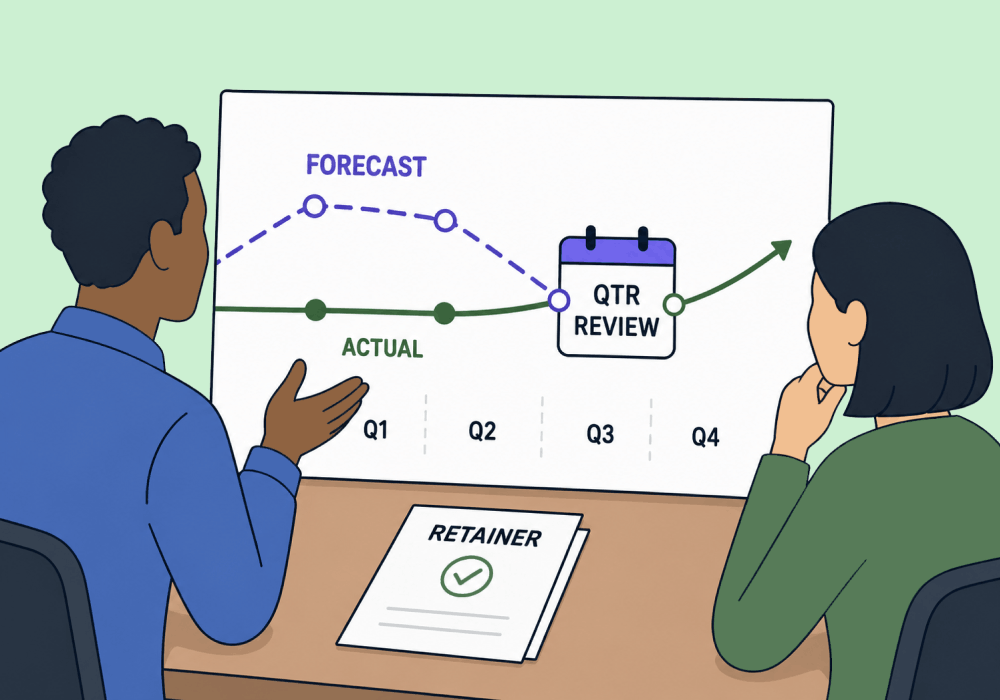
The quarter closed, and the client’s revenue came in below your forecast. Does that mean you owe them a refund?
Not automatically.
A Revenue Retainer sets your agency’s fee as a percentage of the revenue you forecast for the client. Under this model, both sides agree from the start that the forecast is an estimate, not a guarantee. If actual revenue is lower, the fee for the completed quarter stays in place. The shortfall is addressed in the quarterly review, where you identify the cause and update the plan for the next quarter.
This article explains why a forecast miss does not automatically change the fee, how the quarterly review creates accountability, and what to say to a skeptical client.
A Forecast Is an Estimate, Not a Promise
A forecast miss feels like a broken promise when no one has clearly defined what the forecast means. You gave the client a number, and the quarter came in below it. Without an agreed process for handling that difference, both sides may treat the forecast as a commitment you failed to meet.
Retainer critics raise the same concern from the client’s perspective. As one industry article puts it, the retainer model “pays for effort rather than outcomes, a fixed monthly fee for a bundle of activity, regardless of whether that activity moves the business.” When the invoice arrives whether or not the work produced results, “the incentives of agency and client drift apart.” Another article calls this “retainer drift,” the idea that agencies become less accountable once an engagement settles into a routine.
That criticism matters because clients still need accountability. The problem is not that the fee starts with a forecast. The problem is that most agency retainers provide no scheduled checkpoint for comparing the forecast with the result. Without one, a miss can go unexplained and the client has no clear way to evaluate it.
A Revenue Retainer builds that checkpoint into the agreement. You set the fee from an estimate, do the work, and compare the forecast with actual attributable revenue on a date both sides chose in advance. Because the review is scheduled from the start, a miss triggers a defined process rather than a surprise negotiation.
The key distinction is simple: the forecast sets the target and helps determine the fee, but it does not guarantee the result. A miss still requires an explanation and a response. It does not, by itself, mean the agency broke the agreement or must return part of the fee.
Accountability Does Not Require Performance Pay
If the completed quarter’s fee does not change with the result, what keeps the agency accountable? The answer is not necessarily performance pay. Other industries that price work from estimates use a defined review or remedy to address the difference between the estimate and the actual result.
Insurance offers the clearest example of the review process. An insurer prices a workers’ compensation policy using the employer’s estimated payroll. After the coverage period, it runs a “premium audit” to compare estimated and actual payroll. The audit resolves the variance through a credit or invoice without reopening the policy itself.
The variance can be significant. One group of employers sharing the same coverage saw its total payroll change by only 0.6% in a year, while individual members ranged from a 63% decrease to a 104% increase. The point is not that a Revenue Retainer should use the same financial remedy. It is that even a large variance can be handled through a process both sides accepted in advance.
Recruiting shows how the remedy can be separate from the fee. In a survey of agency recruiters, 95.9% said they guarantee every hire, usually for about 90 days. If a hire does not work out, the most common remedy, chosen by 61.4% of respondents, is a replacement search. The recruiter addresses the problem, but the original fee remains earned.
Legal and construction services use other methods. The details differ by industry, but the principle is consistent: define in advance when results will be reviewed and what happens when the estimate is wrong. The table below compares those approaches with a Revenue Retainer.
Pay-per-lead pricing ties every invoice directly to output, but it also makes the agency’s monthly revenue less predictable. A Revenue Retainer takes a different approach: keep the fee stable for the agreed period, then use the quarterly review to hold both sides accountable for the result. The fee is predictable, but performance is never ignored.
Read the Article – What Percentage Should You Charge? 5%, 10%, or 15% of Revenue
A Quarterly Review Explains the Miss and Resets the Plan
A Revenue Retainer review compares the forecast with actual attributable revenue, meaning the revenue credited to your marketing. If the numbers differ, the review should produce three clear answers: how large the gap was, what caused it, and what should change next quarter.
The review is not a retroactive repricing exercise. The fee for the completed quarter stays in place. You use the evidence to update the assumptions, strategy, and revenue target for the next quarter.
Why quarterly, specifically
A business-review framework explains the purpose of each review cycle. Weekly reviews use current data to “fix defects,” while monthly reviews help teams “understand trends.” Quarterly reviews use a fuller set of results to “reset bets and targets.” That makes the quarterly review the right place to revisit a revenue forecast.
One soft month may reflect timing, seasonality, or an isolated operational problem. A full quarter provides enough data to judge whether the miss is temporary or whether the forecast, marketing strategy, or client-side sales process needs to change.
What to bring to the review
Before you meet with the client, have these four things ready:
- The forecast revenue and actual attributable revenue for the quarter, shown side by side
- A clear explanation of why the gap occurred, including factors on the agency side, the client side, or both
- Supporting data, including close-rate changes, staffing gaps, and channel-level results
- A recommendation for what should change next quarter and what should stay the same
Suppose you manage PPC for an HVAC client. You forecast $180,000 in attributable revenue for Q2, but the actual result is $152,000. The review should turn that $28,000 gap into a specific decision:
- Measure the gap. The revenue your marketing drove was $152,000, compared with a $180,000 forecast.
- Trace the cause. The client’s close rate fell from 35% to 28% in June because the sales team was short one representative for three weeks. Lead volume stayed steady.
- Choose the right response. Because the ads continued to generate leads, replacing the campaign strategy would not solve the problem. The shortfall came from a temporary client-side staffing gap.
- Reset the plan. Keep the ad strategy, account for the restored sales capacity, and agree on a revised Q3 revenue target.
Turn a $28,000 shortfall into a clear next step
| 1 · Measured gap | $180,000 planned, $152,000 actual |
| 2 · What changed | Close rate fell from 35% to 28% in June |
| 3 · Root cause | A staffing gap at the client, not the ads |
| 4 · Decision | Keep the ad strategy and revise the Q3 target |
| What does not change | The fee for the completed quarter |
The review does not depend on a special tool. It depends on both sides using the same forecast, attributable-revenue data, and explanation of the variance. With those inputs, the conversation can move from “Who is responsible?” to “What should we do next?”
The agency should bring the miss to the client, not wait for the client to find it. That shows the review is a real accountability mechanism rather than a way to avoid discussing results.
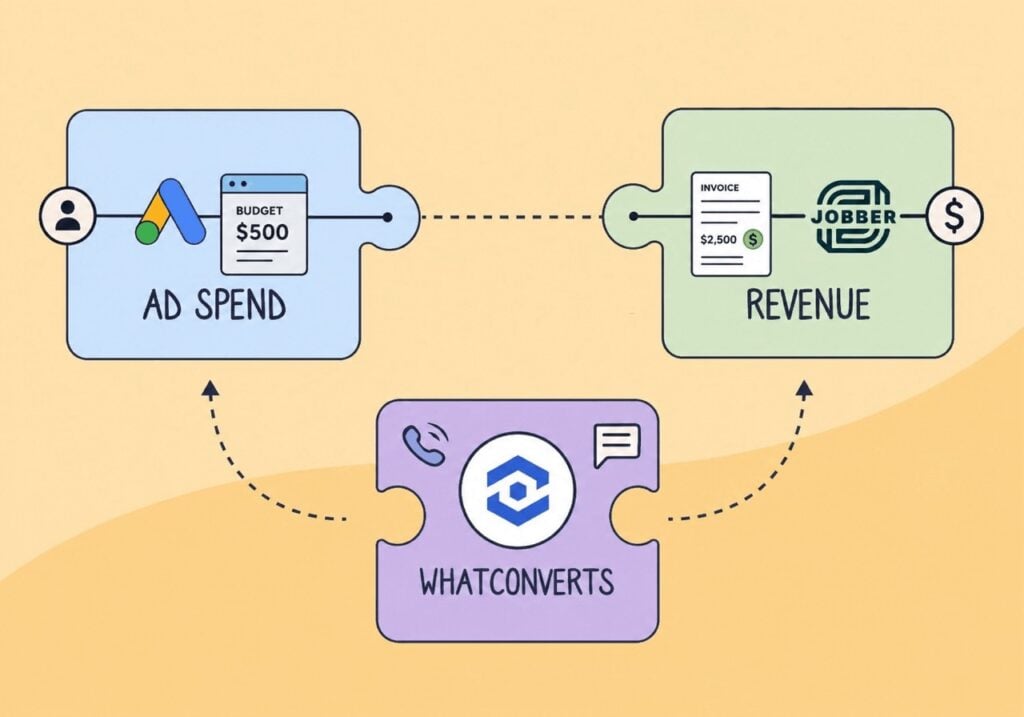
WhatConverts’ Forecast and Audit supports that process by showing the forecast and actual attributable revenue side by side. You can compare the plan with the result on one screen, establish a shared source of truth, and spend the review explaining the variance instead of debating the numbers. With that structure, the conversation feels less like a performance you have to defend and more like a planning discussion.
Real Results: 2x Ad Budget, 2x Clients – ROI Reporting Fuels Growth
Answer the Three Questions Clients Ask After a Miss
Clients usually want to know what the miss means for the fee, the agreement, and the future of the account. Answer each question directly.
“Do I have to refund the difference?”
No, not under the Revenue Retainer model described here. The fee pays for the strategy and execution designed to pursue the agreed forecast; it does not purchase a guaranteed revenue result. Because the contract defines the forecast as an estimate, a miss triggers the quarterly review, not an automatic refund. The completed period’s fee remains earned, just as a recruiter’s fee remains earned when a placement guarantee leads to a replacement search.
“Isn’t a quarterly review just renegotiation with a nicer name?”
No. A renegotiation reopens agreed terms, often after one side is surprised by a problem. A quarterly review follows terms both sides already accepted. It examines the result and updates the next quarter’s plan; it does not retroactively change the completed quarter’s fee.
“What if I miss every quarter?”
Then the problem is no longer normal forecast variance. Repeated misses suggest that the forecast assumptions, measurement, marketing strategy, client-side sales process, or some combination of them is wrong. Use actual results to rebuild the baseline and correct the underlying problem. Corporate finance teams treat a persistent variance the same way: as a signal to update their assumptions.
A one-time miss with a known cause, such as a roofing client’s seasonal slowdown from November through February, may require only a revised forecast. A pattern of misses requires a deeper correction. Quarterly reviews reveal the difference early, while there is still time to fix it before renewal.
Read the Article – How to Handle Seasonality Without Changing Your Price
Transparency Protects Trust After a Forecast Miss
A forecast miss does not have to damage the relationship. How the agency communicates the miss matters more than pretending the forecast was exact.
Hiding or minimizing the miss is more likely to damage trust than reporting it clearly. Research on consulting relationships identifies “integrity” as one of four pillars of client trust. In practice, that means giving “a transparent assessment of what went wrong and a clear plan to get things back on track.” In the same research, 87% of clients identified trust as the main factor when choosing a consulting provider.
Even when the miss reflects a service failure, research on how customers respond when a company corrects a mistake suggests that a strong recovery can preserve the relationship. The effect is modest, inconsistent, and strongest when the failure appears to be outside the provider’s control. The practical lesson is not that a miss improves trust. It is that a direct explanation and a credible response can protect the trust you already have.
The timing of that explanation matters. When a client discovers the shortfall without a process in place, the bad news comes without warning. When the review is scheduled as part of the original agreement, the same shortfall arrives within an expected process for evaluating results and deciding what happens next.
The review gives the agency a clear responsibility: bring the numbers, explain the cause, and recommend the next step. You are reviewing results both sides expected to discuss, so the client sees evidence and a plan rather than an excuse. This kind of open-book reporting can give a client confidence to renew after a soft quarter instead of looking for another agency.
What to Tell a Client When the Forecast Is Missed
The client needs a clear explanation of what the forecast meant, why the result differed, and what happens next.
When the quarter’s revenue comes in below the forecast, make these three points:
- The forecast was an estimate used to set the target and fee, not a guarantee of the final revenue result. The completed quarter’s fee stays in place.
- The miss is not being ignored. You are addressing it through the quarterly review included in the original agreement.
- The review will identify the cause, determine what should change, and set a more informed plan for the next quarter.
Earlier articles in this series explain what a Revenue Retainer is, how to introduce it during a client’s first 30 days, what percentage to charge, and how to keep the price stable through seasonal changes. The missing piece is what happens when the forecast is wrong. The answer is straightforward: keep the completed quarter’s fee in place, bring the variance to the scheduled review, and use actual results to improve the next quarter’s plan.
Get a FREE presentation of WhatConverts
One of our marketing experts will give you a full presentation of how WhatConverts can help you grow your business.
Schedule a DemoGrow your business with WhatConverts