








































Set Up ValueTrack and Auto-Tagging for Google Ads
ValueTrack templates and auto-tagging work together to capture detailed campaign attribution data from your Google Ads. Auto-tagging adds Google Click IDs (GCLIDs) to track leads back to specific campaigns, while ValueTrack templates pass additional parameters like campaign ID, keyword, and ad creative to WhatConverts for complete attribution.
Setting up both ensures WhatConverts captures comprehensive data for every lead generated from your Google Ads. Before you start, see What is the Google Ads Integration? and Connect WhatConverts to Google Ads for context.
Enable Auto-Tagging in Google Ads
Auto-tagging automatically adds Google Click IDs (GCLIDs) to your destination URLs when someone clicks your ads, enabling precise tracking back to specific campaigns, ad groups, and keywords.
To enable auto-tagging:
- Sign in to your Google Ads account.
- Click "Admin" in the left menu.
- Select "Account Settings".
- Click "Auto-Tagging".
- Check the box for "Tag the URL that people click through from my ad".
- Click "Save".
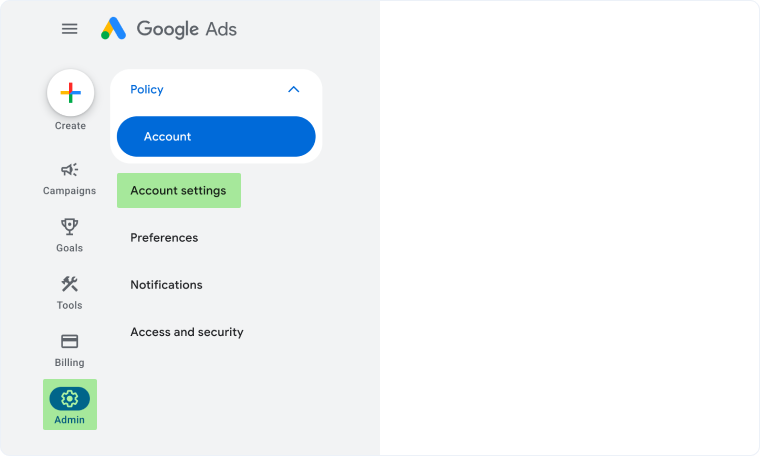

Auto-tagging is now enabled for your entire Google Ads account. All ad clicks will include GCLID parameters that WhatConverts uses to attribute leads to specific campaigns.
Add Account-Level Tracking Template
ValueTrack tracking templates add additional marketing data to your ad clicks using Google's built-in parameters. These templates capture campaign ID, keyword, and creative information that helps you analyze which ads drive the best leads.
To add a tracking template at the account level:
- Sign in to your Google Ads account.
- Click "Admin" in the left menu.
- Select "Account Settings".
- Click "Tracking".
- Under "Tracking template", add the following code inside the text box:
- {lpurl}?campaign={campaignid}&content={creative}&keyword={keyword}
- Click "Save".
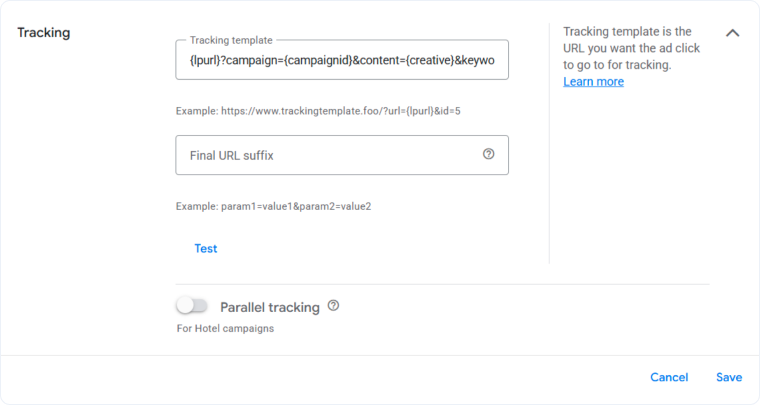
Your tracking template is now applied to all campaigns and ads within your account. WhatConverts will capture campaign ID, creative details, and keyword data for every lead.
Note: The {lpurl} parameter represents your landing page URL, and the additional parameters (campaign, content, keyword) pass attribution data to WhatConverts for detailed reporting.
Note: If you already have custom parameters in the "Tracking template" field, you can move those to the "Final URL suffix" field below to avoid conflicts.
Use ClickCease with UTM Tracking Template
When using ClickCease, follow the instructions above in Add the ValueTrack Tracking Template until Step 4. From here, add your ClickCease template into the Tracking template box and place the following template into the Final URL Suffix field:
campaign={campaignid}&content={creative}&keyword={keyword}
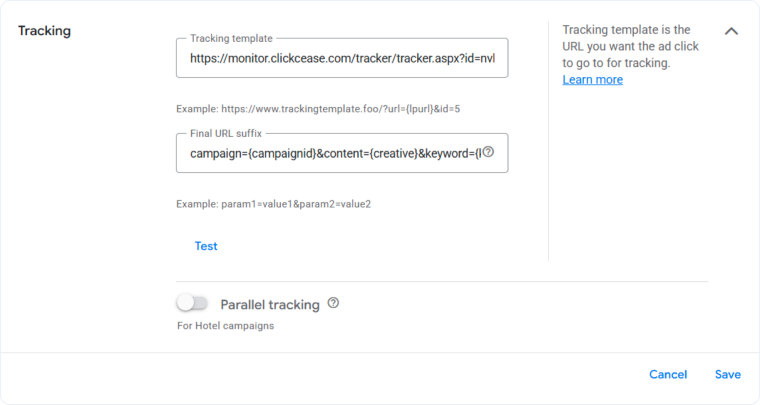
For more information, check Track Google Ads While Using ClickCease.
Understand the Tracking Template Hierarchy
Google Ads allows you to set tracking templates at three levels: account, campaign, and ad. More specific levels take precedence over broader levels.
Account Level:
- Applies the tracking template to all campaigns and ads within the account.
- Use this for consistent tracking across your entire account.
Campaign Level:
- Applies the tracking template to all ads under a specific campaign.
- Overrides the account-level template for that campaign only.
Ad Level:
- Applies the tracking template to individual ads.
- Overrides both account-level and campaign-level templates for that specific ad.
Tip: For most businesses, setting the tracking template at the account level is the simplest approach. Only use campaign or ad-level templates if you need different tracking parameters for specific campaigns.
Additional ValueTrack Parameters
The tracking template in this article uses the most common parameters, but Google Ads supports many additional ValueTrack parameters for more detailed tracking:
- {network}: Shows where the ad was clicked (Search, Display, YouTube, etc.)
- {device}: Shows the device type (mobile, tablet, desktop)
- {adposition}: Shows the ad's position on the page
- {placement}: Shows the website where a Display ad appeared
- {matchtype}: Shows the keyword match type (exact, phrase, broad)
To add more parameters, append them to your tracking template:
{lpurl}?campaign={campaignid}&content={creative}&keyword={keyword}&device={device}&network={network}
For a complete list of available parameters, see Google's documentation: About ValueTrack Parameters.
Related Topics
Get a FREE presentation of WhatConverts
One of our marketing experts will give you a full presentation of how WhatConverts can help you grow your business.
Schedule a Demo